Mumbai’s Toll Refund Miracle: Accountability in Action
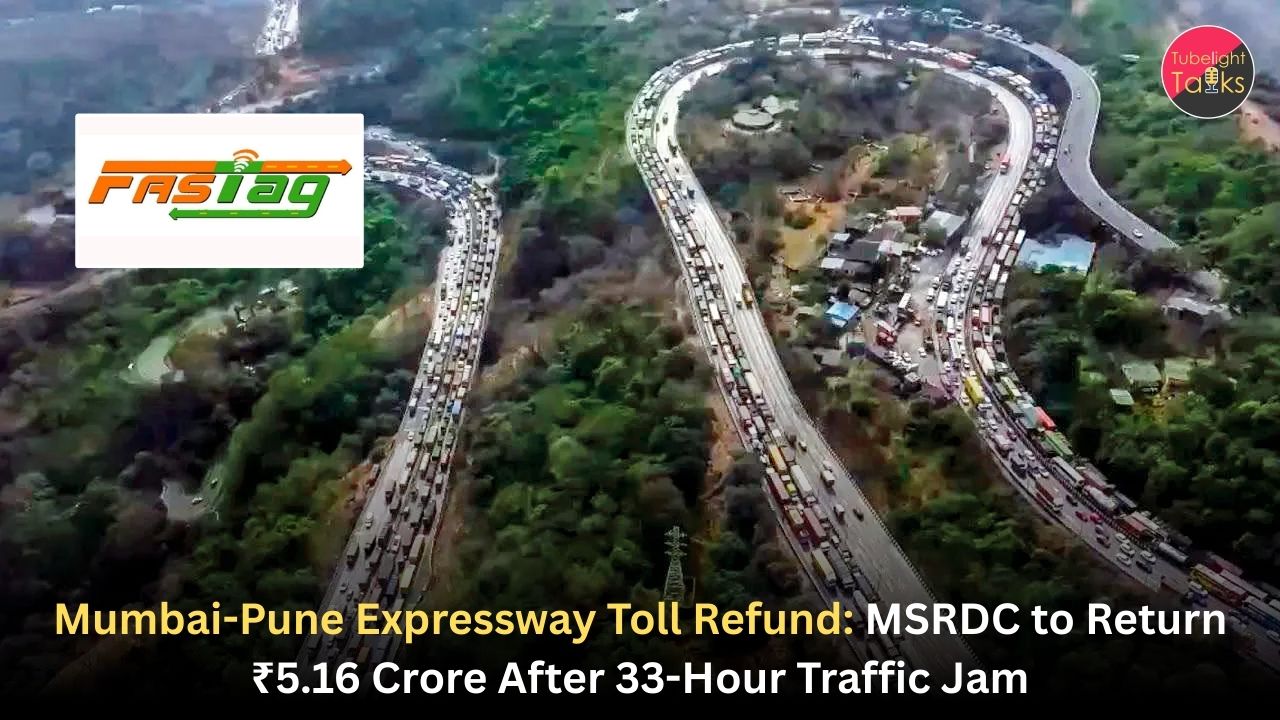
Mumbai-Pune Expressway Toll Refund: Traffic congestion is an unfortunate reality of urban life—but rarely does it result in direct compensation. That’s why Maharashtra’s recent decision is making headlines. Following a severe 33-hour traffic jam on the Mumbai-Pune Expressway caused by a gas tanker mishap, the Maharashtra State Road Development Corporation (MSRDC) has decided to refund ₹5.16 crore in toll fees to more than 100,000 affected motorists.
The move is being widely praised as a strong gesture of accountability and consumer respect. In a system often criticized for inefficiency, this decision sends a powerful message: governance can respond, acknowledge inconvenience, and act fairly.
What Happened on the Expressway?
The 33-hour gridlock
Earlier this month, a gas tanker accident on the Mumbai-Pune Expressway triggered a chain reaction of congestion. Road closures, emergency response measures, and diverted traffic led to an extraordinary 33-hour traffic jam.
Thousands of commuters—including families, truck drivers, and office-goers—were stranded for extended hours with limited mobility. For many, it meant missed appointments, financial losses, and physical exhaustion.
The financial implication
Motorists had paid toll charges expecting smooth and safe passage. Instead, they experienced one of the longest traffic disruptions in recent expressway history.
This gap between service expectation and reality likely influenced the authorities’ decision to initiate refunds.
The Refund Decision: Why It’s Significant
₹5.16 crore returned
The MSRDC announced it would refund ₹5.16 crore collected in tolls during the disruption period. Over one lakh motorists are expected to benefit.
In India, toll roads operate under a service-based model—users pay for maintenance, infrastructure quality, and time efficiency. When that expectation is severely compromised, refunding toll charges reflects recognition of service failure.
A rare administrative gesture
Public infrastructure systems are not always quick to admit lapses. This decision is being hailed as an example of proactive governance.
Rather than waiting for prolonged complaints or legal disputes, authorities chose to act decisively. The move strengthens public trust in administrative institutions.
Why This Story Is Trending Nationwide
A victory for consumer rights
Indian motorists have long expressed frustration over toll pricing and service standards. The refund sets a precedent—suggesting that accountability mechanisms are possible.
It reinforces the idea that public agencies can respond to citizen inconvenience without prolonged litigation or protest.
A social media moment
Stories of administrative accountability resonate strongly online. In a digital era where governance missteps are quickly criticized, positive corrective action spreads just as fast.
This decision has been widely shared as a reminder that systems can evolve.
Broader Implications for Public Infrastructure
Setting expectations
The refund could influence future standards of transparency in toll road management. Authorities may adopt stronger contingency planning and communication strategies to avoid similar disruptions.
Encouraging responsive governance
When citizens see tangible responses to inconvenience, civic engagement improves. Trust encourages cooperation, and cooperation improves public systems.
The Human Perspective
For stranded motorists, the refund is not just about money—it’s symbolic. It acknowledges that their time and inconvenience matter.
In large-scale infrastructure networks, human experience can sometimes be overlooked. This action brings empathy back into governance.
Lessons in Responsibility and Fairness
Accountability requires courage. Admitting a failure—especially in a public system—demands institutional maturity.
In spiritual teachings shared by Sant Rampal Ji Maharaj, honesty, fairness, and responsibility toward society are emphasized as moral duties. When institutions reflect these values through action, public trust deepens. Governance, like individual conduct, becomes stronger when it aligns with truth and accountability.
FAQs: Mumbai-Pune Expressway Toll Refund
1. Why were toll refunds announced?
Due to a 33-hour traffic jam caused by a gas tanker accident on the Mumbai-Pune Expressway.
2. How much is being refunded?
₹5.16 crore in total toll charges.
3. How many motorists are affected?
Over 100,000 motorists are expected to receive refunds.
4. Who announced the refund?
The Maharashtra State Road Development Corporation (MSRDC).
5. Why is this decision important?
It demonstrates government accountability and respect for consumer rights.
Related Stories




Discussion (0)