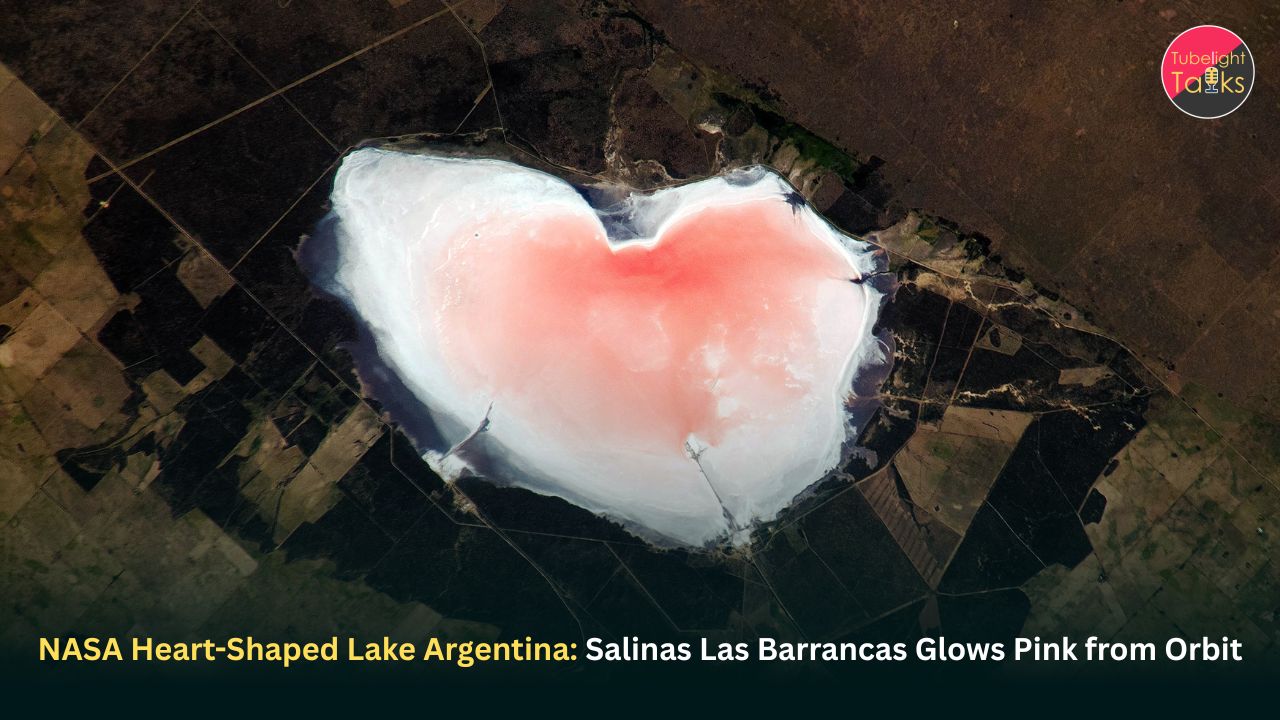
NASA Heart-Shaped Lake Argentina: A Pink Wonder Seen from Space
NASA’s Earth Observatory has drawn attention to the NASA heart-shaped lake Argentina phenomenon – Salinas Las Barrancas (also called Laguna de Salinas Chicas) – captured by an astronaut from the International Space Station on January 16, 2024 and shared widely since.
What people are calling “Love from Orbit” is, in reality, a harsh and disciplined natural system: a lakebed below sea level that fills when it rains and becomes a salt-mining landscape when it dries. The pink hue is not a miracle pigment surge – it’s a signal that life and chemistry are interacting in concentrated brine.
What NASA Actually Shared
An astronaut photograph, not a fantasy filter
NASA’s Earth Observatory describes the image as an astronaut photograph from the ISS taken with a Nikon camera, showing the lake’s candy-pink basin surrounded by agricultural fields.
Where it is
The lake sits on plains near the port city of Bahía Blanca in Argentina’s Buenos Aires province.
Why the Lake Turns Pink
Salt + sun create the perfect stress test for microbes
The lake repeatedly moves through a cycle: rain adds water; intense sunlight drives rapid evaporation; salinity rises; and salt-tolerant microorganisms can dominate.
LiveScience notes that pink tones in such salt lakes are often linked to microbial communities and algae (including Dunaliella salina) whose pigments become prominent as salinity conditions shift.
Important clarity: pink doesn’t automatically mean “healthy”
A pink colour can be natural in salt lakes – but colour alone doesn’t certify ecosystem health. Argentina has also seen other pink-water episodes where environmental groups feared industrial contamination (a separate issue from this heart-shaped salt lake).
The responsible takeaway is: this pink heart is consistent with a briny, microbe-driven system – but monitoring always matters.
Why It’s Heart-Shaped
The basin is the sculptor
Salinas Las Barrancas has a distinctive basin geometry. When water levels change – after rainfall or evaporation – the shoreline redraws quickly, making the heart outline appear sharper or softer depending on the season.
What the “Heart” Reveals About Earth
1) Climate signals you can see
This lake is a visible record of rainfall vs evaporation – a tug-of-war that many arid and semi-arid landscapes live with.
2) Industry and ecology sharing one space
NASA notes the site is mined for salt when dry, with large amounts harvested over decades – meaning the same landscape can be both economically active and ecologically distinctive.
3) A habitat that still supports life
Even in briny extremes, NASA highlights salt-tolerant plants and wildlife in the salt flats, including birds like the Chilean flamingo and the endangered yellow cardinal.
Also Read: Kashmir’s Dal Lake Sees Tourist Boom Despite Cold Wave: Winter Tourism Thrives in Sub-Zero Beauty
This Is Scientifically Positive
Wonder that leads to learning
This isn’t just “a pretty picture.” It’s a public science moment: a chance for students to understand how salinity, evaporation, microbial pigments, and remote sensing connect.
A reminder that Earth still has hidden chapters
Most people would never find this lake from the ground. Space-based observation doesn’t replace conservation – but it can trigger attention, curiosity, and better questions about how landscapes change over time.
Seeing the Earth as a Trust
When a lake turns pink and the world shares it as “beauty,” the deeper challenge is what we do next: treat nature as decoration – or as responsibility. In the teachings shared by Sant Rampal Ji Maharaj, the value of restraint, compassion, and responsible conduct is emphasized – so that human progress doesn’t become harm to the living world.
A salt lake like Salinas Las Barrancas quietly demonstrates that even harsh ecosystems support life when balance is respected. The real “love from orbit” is not the heart shape – it is the choice to protect what makes such wonders possible.
FAQs: NASA Heart-Shaped Lake Argentina
1. What is the heart-shaped pink lake called?
Salinas Las Barrancas (also called Laguna de Salinas Chicas) in Argentina.
2. Who captured the image NASA shared?
An astronaut aboard the International Space Station; NASA Earth Observatory describes it as an ISS astronaut photograph.
3. Why does the lake appear pink?
High salinity and seasonal water changes can favor salt-tolerant microbes and algae whose pigments tint the brine.
4. Is pink water always a sign of a healthy ecosystem?
Not always. Some pink-water events elsewhere have raised contamination concerns, so context and monitoring matter.
5. What else is notable about this lake?
It’s a salt-harvesting landscape that also supports salt-tolerant plants and wildlife such as Chilean flamingos and endangered yellow cardinals.
Related Stories










Discussion (0)