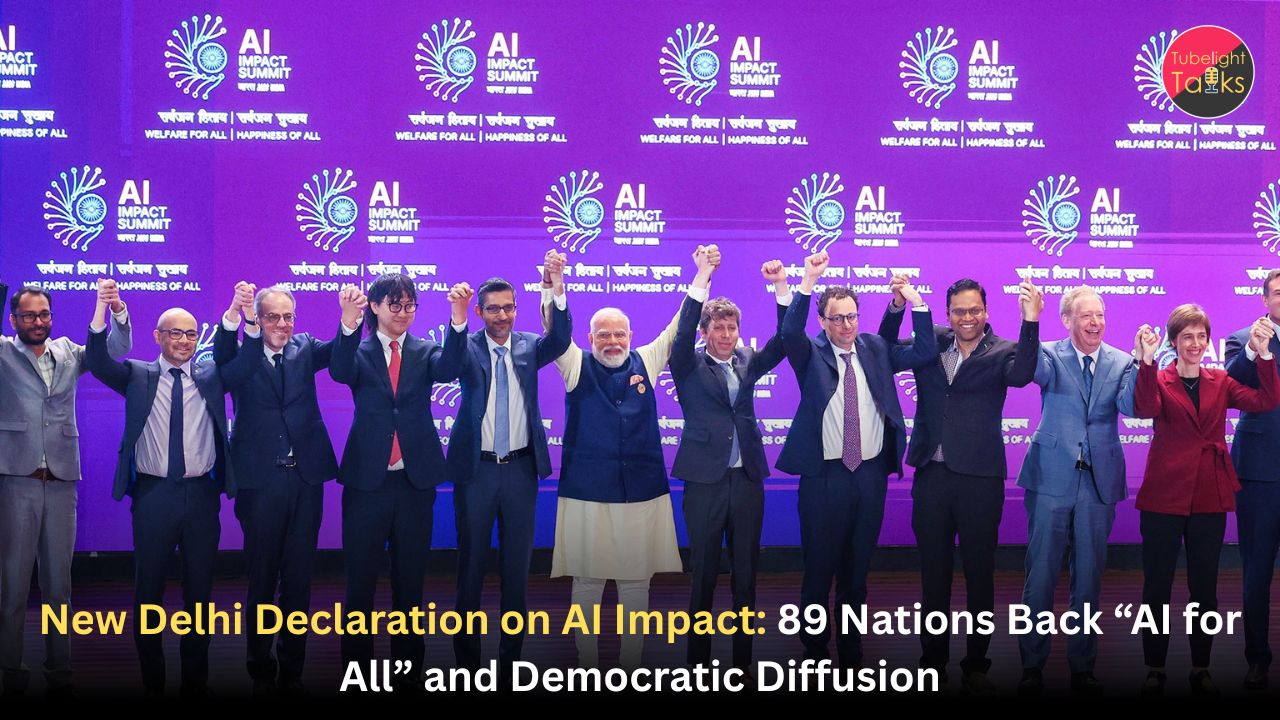
Global AI Unity: 89 Nations Endorse the New Delhi Declaration
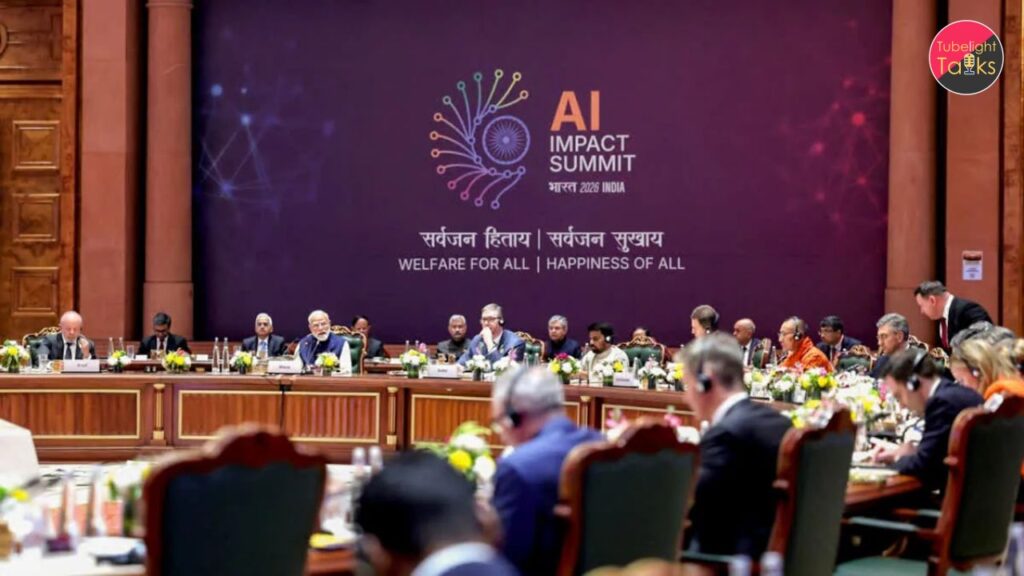
Global AI discussions usually split into camps—competition versus cooperation, innovation versus regulation, national security versus openness. That’s why the New Delhi Declaration on AI Impact is trending: it signals a broad effort to keep AI benefits from concentrating only in a handful of nations and tech giants. Adopted at the AI Impact Summit in New Delhi, the declaration was endorsed by 89 countries and international organisations and is framed around “welfare for all, happiness for all.” I
t is voluntary and non-binding, but it lays out seven pillars and multiple global platforms aimed at access, trust, skills, and efficient AI systems.
What the New Delhi Declaration Actually Is
A shared political signal—designed to be broad
The New Delhi Declaration is not a single “global AI law.” It is a voluntary, non-binding statement of direction—intentionally shaped so countries with very different systems can still sign on.
That design choice matters. If the document demanded a strict global regulator or one-size-fits-all rules, many countries would likely walk away. Instead, the declaration tries to create common ground: cooperate where possible, keep sovereignty intact, and focus on practical collaboration (shared tools, shared learning, shared capacity-building).
The guiding philosophy: “AI for all” with equity at the core
The declaration opens with a clear moral frame: AI’s promise is best realized only when its benefits are shared by humanity, guided by the principle of “Sarvajan Hitaya, Sarvajan Sukhaya” (welfare for all, happiness for all).
In a time when AI models and compute power are increasingly expensive—and increasingly concentrated—this emphasis on equitable sharing is the heart of why the declaration is being discussed far beyond policy circles.
Who Endorsed It—and Why the Number Varies in Headlines
The official count: 89 countries and international organisations
Official government communication states the declaration has been endorsed by 89 countries and international organisations.
Why you may see “88” in some reports
Some media coverage reports 88 signatories, sometimes listing the US and China among them. These variations often happen when outlets count only “countries” (excluding international organisations) or report numbers before final confirmations.
The key point is not the single digit—it’s the scale. Either way, the declaration reflects unusually wide participation for a global AI governance statement.
The Seven Pillars Explained in Simple Language
The declaration is structured around seven pillars (also called “Chakras”), presented as the foundation of global cooperation.
1) Democratizing AI Resources
This pillar is about access to the basics that make AI possible: robust digital infrastructure, affordable connectivity, and foundational AI resources (compute, data, tools). It explicitly links access to the ability of all countries to develop and deploy AI for their citizens, drawing on “Vasudhaiva Kutumbakam” (the world is one family).
Why it matters: If only a few nations can afford high-end compute and datasets, then “innovation” becomes a closed club. This pillar tries to keep the door open.
2) Economic Growth and Social Good
This pillar treats AI as a growth engine—but insists growth should translate into public value. It highlights the role of wide-scale adoption in economic and social development, including the value of open-source and accessible AI approaches where appropriate.
Why it matters: AI cannot be a “luxury tool” for rich economies only; it should help agriculture, education, health delivery, and governance services too.
3) Secure and Trusted AI
This pillar focuses on safety, robustness, and trust—recognising the need for security in AI systems, voluntary industry measures, technical solutions, and appropriate policy frameworks that protect public interest across the AI lifecycle.
Why it matters: Adoption collapses without trust. Citizens won’t accept AI in public services if it feels unsafe, biased, or unaccountable.
4) AI for Science
This pillar aims to remove structural barriers and increase availability of research infrastructure to accelerate scientific collaboration using AI. It supports an international network to connect institutions and pool capabilities.
Why it matters: AI can speed up discovery—from materials and clean energy to climate modelling—but many countries lack the infrastructure to participate.
5) Access for Social Empowerment
This pillar positions AI as a tool to uplift society by improving access to knowledge, services, and opportunities, and by enabling participation in social and economic activities. It supports a collaborative platform for sharing scalable practices.
Why it matters: If AI improves only productivity for corporations and not access for citizens, the tech backlash will grow.
6) Human Capital Development
This pillar pushes skilling, reskilling, AI literacy, training public officials, and upgrading vocational ecosystems—supported by guiding principles and a playbook for workforce development.
Why it matters: AI will reshape jobs; societies that treat workforce transition as an afterthought will see inequality spike.
7) Resilient, Efficient and Innovative AI Systems
This pillar focuses on energy-efficient AI and infrastructure resilience, acknowledging that AI’s growth increases pressure on power systems and resources.
Why it matters: The AI future cannot be “smart” if it’s also energy-wasteful and fragile.
The Declaration’s Most Practical Outcome: Seven Global Deliverables
A lot of global declarations fade because they remain abstract. The New Delhi Declaration stands out because it lists specific collaborative initiatives—tools and platforms that can be built and used.
1) Charter for the Democratic Diffusion of AI
A voluntary framework to promote affordable access to foundational resources, support locally relevant innovation, and strengthen resilient AI ecosystems while respecting national laws.
In everyday terms: Make sure AI doesn’t become a “compute monopoly.”
2) Global AI Impact Commons
A platform to encourage adoption, replication, and scaling of successful AI use cases across regions.
In everyday terms: If one country builds an AI solution that truly improves healthcare delivery or farm advisory, others should be able to adapt it quickly.
3) Trusted AI Commons
A repository of tools, benchmarks, and best practices to support secure, trustworthy AI systems—so countries don’t need to reinvent safety infrastructure from scratch.
4) International Network of AI for Science Institutions
A collaborative network to connect scientific communities and pool AI research capabilities.
5) AI for Social Empowerment Platform
A knowledge exchange mechanism aimed at equitable AI adoption, centred on learnings and scalable practices.
6) AI Workforce Development Playbook & Reskilling Principles
Guidance and principles for skilling/reskilling and improving AI literacy to prepare nations for an AI-driven economy.
7) Guiding Principles on Resilient & Efficient AI
A focus on energy-efficient AI systems supported by a playbook on AI infrastructure resilience.
Also Read: Delhi AI Summit 2026 Concludes With 88-Nation Global AI Agreement
The $250 Billion Question: What Was Actually Committed?
Official summit statement: infrastructure pledges crossed $250B
A separate official summit release states that infrastructure-related investment pledges crossed $250 billion, with around $20 billion in deep-tech venture commitments—presented as evidence of global confidence in India’s AI infrastructure ecosystem.
What “pledges” really mean in practice
A pledge is not the same as money already deployed. But it does matter because it signals intent to build the “hard layer” that AI needs: data centres, chips, energy systems, cooling, cloud capacity, and training infrastructure.
Reuters reporting around the summit described major corporate investment announcements aimed at AI and data infrastructure, with very large figures attached to long-term buildouts.
Why it matters for the declaration: A promise to democratize AI resources only becomes real if compute and infrastructure expand beyond a few regions and companies. Declarations need physical capacity behind them.
Why “Democratic Diffusion of AI” Is the Phrase Everyone’s Repeating
Because compute is becoming a geopolitical asset
Modern AI is powered by scarce resources: advanced chips, high-end data centres, stable electricity, and large datasets. When those inputs concentrate, influence concentrates too—who builds frontier models, who sets standards, who profits.
The declaration’s “democratic diffusion” push is essentially a call to stop AI from turning into the next global divide: those who can afford AI at scale, and those who cannot.
Because local problems need local models
Developing nations often need AI that works in local languages, local healthcare contexts, local crop cycles, and local governance systems. That is hard to achieve if every useful model is built elsewhere and sold as a “one-size-fits-all” product.
Democratic diffusion is also about enabling local ecosystems—startups, universities, and public institutions—to build solutions that fit their realities.
Why This Feels Like a Rare Moment of Global Cooperation
Even rivals showed up in the same sentence
Media coverage highlights that the declaration gathered broad backing, with reports noting that geopolitical competitors were among the signatories.
This doesn’t mean the world suddenly agrees on everything in AI. It means there is at least one area of overlap: AI is too powerful to be left to uncoordinated chaos, and too socially significant to be shaped only by a small set of actors.
“Voluntary and non-binding” can be a strength
Binding global rules are hard. Voluntary frameworks can still move the world if they create:
- a shared vocabulary (what “trusted AI” means),
- shared tools (benchmarks, best practices), and
- shared collaboration channels (commons, networks, playbooks).
The New Delhi Declaration explicitly positions its initiatives as voluntary and collaborative.
India’s “Show, Not Tell” Argument: Build at Scale, Share at Scale
A separate official PIB narrative from the summit paints India as a convening platform where global collaboration met large-scale public infrastructure thinking. It quotes the Prime Minister linking AI’s benchmark to “welfare for all,” and frames India’s pitch as: design and develop in India, deliver to the world, deliver to humanity.
It also highlights global leaders pointing to India’s digital public infrastructure as a proof point for building systems that are open, interoperable, and sovereign.
Whether one agrees fully or not, the strategic message is clear: India is positioning itself not merely as an AI consumer, but as a shaper of norms—especially around access, public value, and scalable governance.
The Real Test: What Happens After the Headlines Fade?
1) Do the “Commons” become real, usable platforms?
If the Trusted AI Commons becomes a living repository with benchmarks that governments and startups can actually use, the declaration gains teeth. If it stays a PDF concept, momentum will drain.
2) Does AI workforce reskilling move beyond slogans?
The workforce playbook is promising—but the world will judge by execution: new curricula, public training programs, tools for civil servants, and measurable literacy improvements.
3) Can AI become more energy-efficient while it grows faster?
The declaration puts energy efficiency at the centre, which is a very “real world” concern. AI will not be sustainable if it becomes a runaway demand engine for power and water.
4) Will access expand without weakening security?
Democratizing AI resources is a noble goal, but it must coexist with security concerns—cyber misuse, model abuse, and national security fears. The declaration tries to balance this by emphasising trust, security, and sovereignty.
The Human Question Behind the Policy Language
AI governance discussions can sound technical, but they touch everyday life:
- Will a farmer get better crop guidance in their language?
- Will a student access tutoring without paying premium fees?
- Will hospital triage become faster and fairer?
- Will government services become simpler, not more confusing?
- Will citizens have a way to challenge harmful automated decisions?
That’s why the declaration’s repeated focus on social empowerment, human capital, and trusted systems matters. It is trying to anchor AI’s future in lived outcomes, not only in model performance.
Keeping Power Humble in the Age of AI
Technology becomes dangerous when it grows faster than human responsibility. The New Delhi Declaration repeatedly brings the conversation back to shared welfare, trust, and human development—because AI’s biggest risk is not only technical failure, but moral drift.
In the spiritual teachings shared by Sant Rampal Ji Maharaj, a similar principle is emphasized: real progress is measured by truthfulness, compassion, self-control, and using knowledge for the upliftment of others—not for ego or exploitation.
Seen through that lens, “AI for all” becomes more than a policy slogan; it becomes a reminder that power—whether political, economic, or technological—must be guided by conscience and accountability, or it will eventually harm the very society it claims to serve.
FAQs: Global AI Unity
1. What is the New Delhi Declaration on AI Impact?
A voluntary, non-binding declaration adopted at the AI Impact Summit 2026 outlining shared priorities and collaborative initiatives for AI.
2. How many countries and organisations endorsed it?
Official communication states 89 countries and international organisations endorsed it.
3. What does “democratic diffusion of AI” mean here?
It refers to widening affordable access to foundational AI resources and enabling locally relevant innovation ecosystems.
4. What are the main outcomes besides the declaration text?
Initiatives like the Charter for Democratic Diffusion, Global AI Impact Commons, Trusted AI Commons, AI-for-Science network, and workforce reskilling playbook.
5. What’s the significance of the $250B figure mentioned with the summit?
An official summit release said infrastructure-related investment pledges crossed $250 billion (pledges, not guaranteed spending).
Related Stories










Discussion (0)