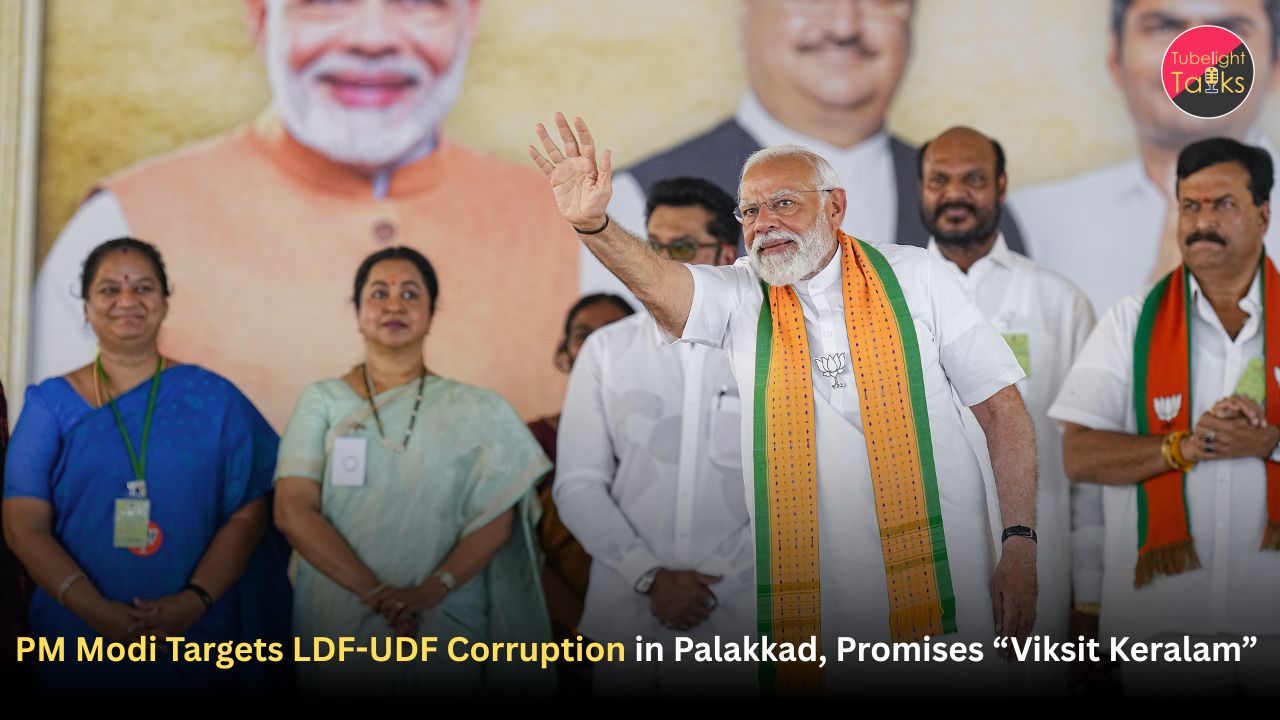
PM Modi Targets LDF-UDF “Corruption” and Promises “Viksit Keralam” at Palakkad Rally
Prime Minister Narendra Modi used his Palakkad rally to mount one of the sharpest attacks yet on Kerala’s two dominant political fronts, accusing the ruling LDF and the opposition UDF of trapping the state in a long cycle of corruption, nepotism and power-sharing politics.
Current reports said Modi argued that Kerala has suffered because the two fronts alternate in power while protecting the same political culture. He presented the BJP-led NDA as the only force capable of breaking that pattern and giving the state a new development path.
Modi’s main charge: Kerala has been trapped between two corrupt fronts
At the center of Modi’s speech was the claim that the LDF and UDF have not been true rivals in governance outcomes. Reports from Palakkad said he accused them of running Kerala through an “arrangement” in which one front governs for a few years, fills its pockets, and then the other takes over and continues the cycle. He described the state as being stuck between “two masks of selfish politics,” and current coverage quoted him as calling one front corrupt and the other highly or “mega” corrupt.
That attack matters because it goes beyond ordinary campaign criticism. Modi was not only attacking specific scandals. He was trying to delegitimize the entire LDF-UDF structure that has defined Kerala politics for decades. In political terms, that is the BJP’s central argument in Kerala: that change in the state cannot come from switching between the same two formations. This is an inference based on the reported speech framing.
“Viksit Keralam” was the positive side of the speech
Modi paired his corruption attack with a development pitch. Economic Times reported that he said “Keralam is sending a message of change,” while other reports said he linked that change to the idea of “Viksit Keralam.” That phrase is important because it turns the campaign from a negative anti-LDF/UDF argument into a positive NDA promise of growth, governance and transformation.
He also appears to have used the rally to argue that the NDA is no longer a marginal force in the state. Times of India reported that Modi called the BJP-led NDA the “real A-team” in Kerala, pushing back against long-running accusations by both the LDF and UDF that the other side functions as the BJP’s hidden “B-team.” That rhetorical move is politically significant because it seeks to place the NDA at the center of Kerala’s electoral story rather than on its edge.
Why Palakkad matters in this campaign
Palakkad is not just another campaign stop. It has long been seen as one of the more competitive zones for the BJP in Kerala, and that gives every major rally there extra weight. Current reports noted that Modi used the rally to energize NDA workers and reinforce the message that the state is ready for political change. In campaign strategy terms, Palakkad offers the NDA a place to show organizational seriousness, not just symbolic presence. This is an inference based on the emphasis given to the rally in current coverage.
The speech also came as Kerala’s election entered a more decisive phase, which made the tone sharper. Rather than sounding merely ceremonial, the Palakkad rally was framed as a serious electoral intervention meant to consolidate the NDA’s message: corruption versus change, rotation versus transformation, old fronts versus a new claim to power. That broader reading is supported by how the rally was covered across major outlets.
Also Read: PM Modi’s Thrissur Roadshow Boosts Kerala Campaign Visibility
The bigger political message
Modi’s Palakkad speech was designed to do three things at once. First, it attacked the moral credibility of the LDF and UDF. Second, it argued that Kerala’s political history has become a barrier to progress. Third, it tried to make the NDA look not just ambitious, but plausible.
That final point is the most important. In Kerala, the BJP has long struggled to convert attention into durable electoral scale, so every major Modi intervention is also an attempt to reshape what voters think is politically possible. This is an analytical conclusion based on the rally’s themes and the NDA’s positioning in current reports.
Clean Public Life
Teachings associated with Sant Rampal Ji Maharaj emphasize truth, honesty and responsibility in public conduct. In that spirit, political power has real value only when it is used for justice and public welfare, not for selfish gain. A campaign promise of development means little unless it is matched by integrity. This is a spiritual reflection, not a political endorsement.
Call to Action
This rally was not only about criticism. It was about persuading Kerala’s voters to believe that the state can move beyond its old political pattern. The real test now is whether that message of “Viksit Keralam” convinces enough people that change is both desirable and credible.
FAQs: PM Modi Targets LDF-UDF Corruption in Palakkad, Promises “Viksit Keralam”
1. What did PM Modi say in Palakkad?
He accused both the LDF and the UDF of corruption, selfish politics and effectively trapping Kerala in a rotating power arrangement.
2. What is “Viksit Keralam”?
It is the NDA’s development-focused pitch for Kerala, presented by Modi as a message of change and transformation for the state.
3. Did Modi directly target both fronts?
Yes. Current reports say he criticized both the ruling LDF and the opposition UDF rather than focusing on only one rival.
4. Why is Palakkad politically important?
Palakkad is viewed as one of the more significant battlegrounds for the NDA in Kerala, which makes a major Modi rally there strategically important. This is an inference based on campaign coverage.
5. What did Modi mean by the NDA being the “real A-team”?
He was arguing that the BJP-led NDA is now the genuine alternative in Kerala, not a secondary player in the contest.
6. Was the speech mainly negative or positive?
It was both: negative in its attack on LDF-UDF corruption, and positive in its promise of a developed Kerala under the NDA.
Related Stories








Discussion (0)