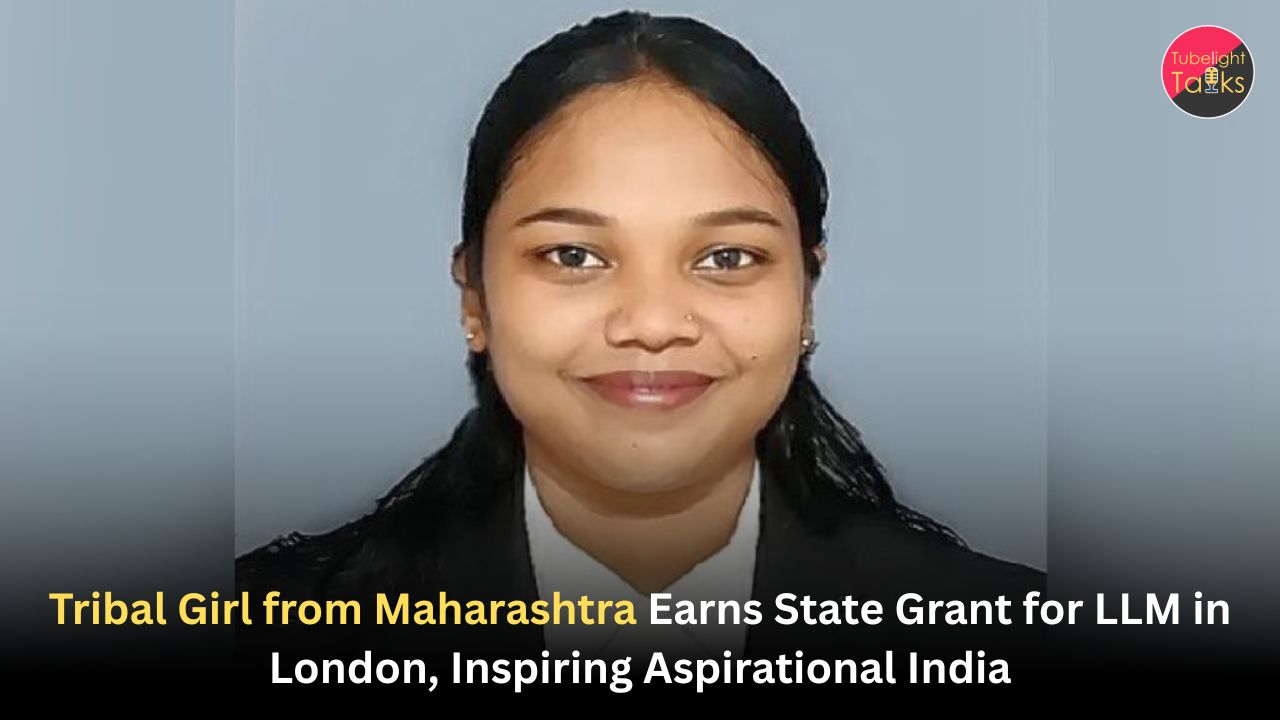
Priya Yashwant Tadam’s Journey from Tribal Maharashtra to London Law School with ₹37.61 Lakh Scholarship
Not every national milestone comes from a metro city or a famous surname. Sometimes it rises quietly from a village with no school, where children walk kilometres just to learn the alphabet. That is why the story of Priya Yashwant Tadam, a 24-year-old tribal woman from Bhanapur village in Chandrapur district, is going viral again as a symbol of aspirational India.
She secured a ₹37.61 lakh scholarship from the Maharashtra government to pursue an LLM in London at Queen Mary University of London – after years of study, internships, and a tense race against time as scholarship approvals were delayed.
A Village Start, a World-Class Destination
Bhanapur: where education begins with a long walk
Priya’s village is described as a small settlement of around 40 families surrounded by forests, with no school inside the village. As a child, she and her younger sister reportedly walked about two kilometres to attend a primary school in a nearby location.
This detail matters because it explains something India often forgets: for many students, “going to school” isn’t a routine – it’s a daily endurance test. When learning itself begins with distance, every academic milestone is already hard-earned.
From local schooling to law in Nagpur
According to reports, her family moved her to relatives’ places for schooling and later she pursued a BA-LLB degree at Dr Babasaheb Ambedkar College of Law in Nagpur. She also interned at the district court and high court, sharpening her practical understanding of law before aiming for an international specialization.
The Scholarship That Changed the Trajectory
What she received and why it matters
Priya received a ₹37.61 lakh scholarship from the Maharashtra government to pursue her LLM in London.
This isn’t just financial help – it’s access. For students from remote and low-income backgrounds, the biggest barrier to international education is not capability; it’s cost and timing. A grant like this can be the difference between “admission letter” and “actual enrollment.”
Also Read: Tribal Girl from Chandrapur Raises the Bar, Makes Maharashtra Proud
Admission to Queen Mary University of London
The same report notes she secured admission to Queen Mary University of London, a globally recognized institution, with help from acquaintances who guided her through the admission and documentation process.
The takeaway is practical: mentorship and navigation support are often as important as money. Forms, timelines, visas, and document verification can overwhelm first-generation students – especially when they’re doing it alone.
The Real Struggle People Don’t See: Delays, Deadlines, and Anxiety
When “merit” isn’t enough without administrative speed
A powerful part of Priya’s story is that even after she earned admission, her scholarship proposal reportedly faced delays due to scheduling issues and departmental processes, placing her enrollment at risk.
For students going abroad, deadlines are unforgiving:
- universities require deposits and enrollment confirmation,
- visa appointments run on limited slots,
- Housing and travel decisions need upfront money.
When approvals come late, students can lose seats – not because they lack merit, but because systems move slowly.
Intervention and an urgent clearance
The report describes how political leaders intervened, following which the Chief Minister issued directions to convene the required meeting, and the scholarship sanction letter was issued the same day.
This part went viral because it shows both sides of the reality:
- the vulnerability of students trapped in delays,
- and how swift decisions can immediately protect a young person’s future.
Why This Story Represents “Aspirational India”
Education as social mobility – not a slogan
In many tribal and remote communities, higher education does not just uplift one student – it reshapes an entire family’s future:
- more stable income potential,
- stronger confidence and social standing,
- role-model effect for younger children,
- long-term reduction in migration distress.
Priya’s journey illustrates the purest version of aspiration: study, struggle, persistence, and then a breakthrough opportunity.
The family’s sacrifices behind the headline
Reporting highlights how difficult it was for her family to arrange the deposit amount needed for enrollment, and how her sister reportedly resigned from her job to help manage documentation and preparations.
These details are the emotional core: success stories are rarely individual. They are often built on invisible family sacrifices.
The Bigger Picture: Maharashtra’s Overseas Support for Tribal Students
Why her story connects to ongoing policy conversations
Priya’s case is often cited as an example of why overseas education support matters – especially for students from Scheduled Tribe communities who have the talent but not the financial runway.
In February 2026, reporting also noted Maharashtra’s Tribal Development Department called on ST students admitted to reputed overseas universities to apply for an “Overseas Education Scholarship” for the 2026–27 academic year, outlining coverage that can include fees and allowances (including a UK contingency amount).
Even if different schemes apply in different cases, the direction is clear: states are increasingly treating global education as an empowerment tool – not a luxury.
Why awareness and guidance are as important as the scheme itself
Scholarships fail when students don’t know how to apply, don’t understand eligibility, or miss timelines. Priya’s journey shows what many rural students need:
- guidance on admissions and documentation,
- help with standardized tests and essays,
- clarity on scholarship steps and deadlines,
- local support desks that reduce confusion and delays.
If systems improve here, many more “Priya stories” can happen – without last-minute panic.
What India Can Learn From One Student’s Breakthrough
1) Build “pathways,” not one-time approvals
A scholarship is powerful, but a pathway is stronger:
- early career counselling,
- district-level facilitation centres,
- document and verification help,
- mentorship networks with alumni.
This reduces dependence on emergency interventions.
2) Reduce last-mile friction
For first-generation learners, friction kills opportunity:
- delayed mark sheets,
- slow verification,
- lack of travel and visa guidance,
- confusion over fees and deposits.
When the system becomes smoother, merit converts into outcomes.
3) Celebrate, but don’t romanticize struggle
It’s good that Priya’s story inspires. But the goal should be that future students don’t have to fight this hard just to access what they’ve earned. Inspiration should lead to reforms – so resilience becomes a choice, not a requirement.
When Knowledge Becomes a Form of Service
Education is not only about personal success; it becomes meaningful when it uplifts families and communities. In the spiritual teachings shared by Sant Rampal Ji Maharaj, emphasis is often placed on right conduct, humility, and using one’s capabilities for the welfare of others – so progress is measured not only by status, but by positive impact.
When a student from a remote background reaches global classrooms, the bigger opportunity is what comes next: returning knowledge to society, strengthening justice, and becoming a voice for those who are rarely heard. That is when achievement becomes service – and service becomes legacy.
FAQs: Tribal Woman to London LLM Story
1. Who is the tribal woman in the Maharashtra-to-London LLM story?
Priya Yashwant Tadam, a tribal woman from Bhanapur village in Chandrapur district.
2. How much scholarship did she receive?
She received a Maharashtra government scholarship reported as ₹37.61 lakh.
3. Which university did she get admission to for her LLM?
Queen Mary University of London.
4. Why is her story trending as a human-interest headline?
Because it highlights how education and targeted government support can break generational poverty and overcome systemic barriers.
5. Does Maharashtra have overseas scholarship support for tribal students more broadly?
Yes – recent reporting notes the Tribal Development Department invited eligible ST students admitted abroad to apply for an Overseas Education Scholarship for 2026–27.
Related Stories






Discussion (0)