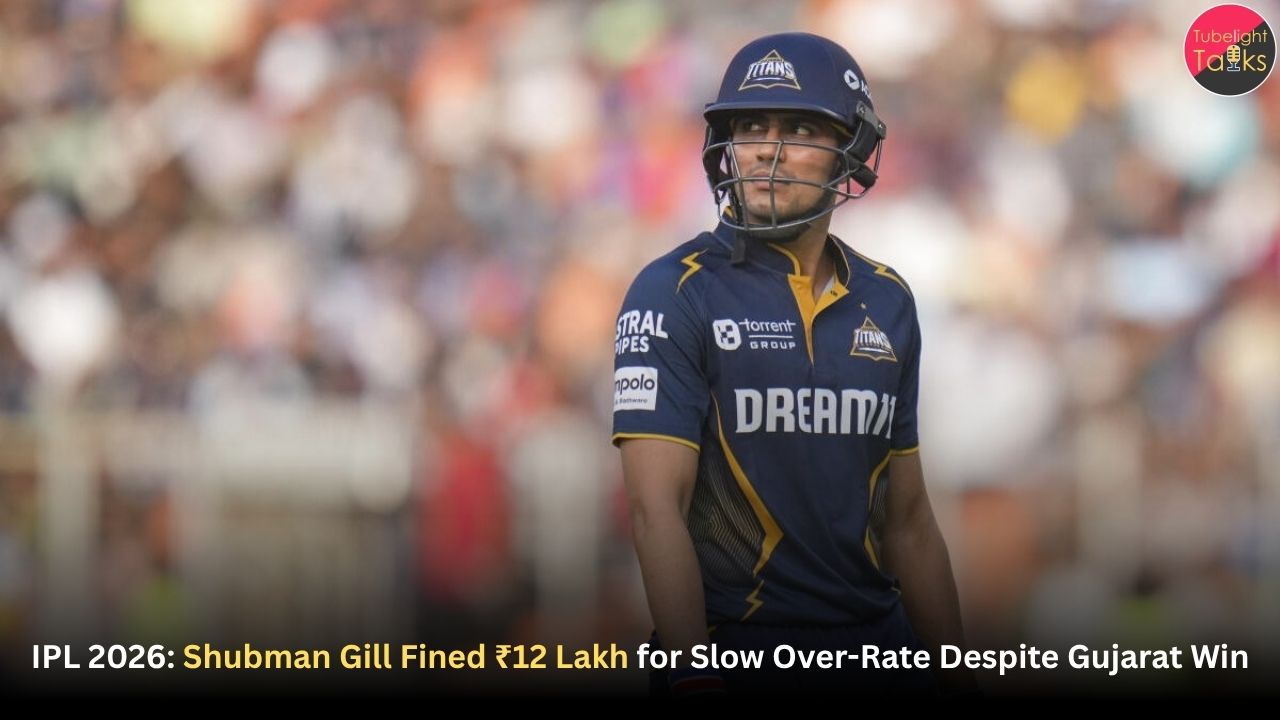
IPL 2026 Discipline: Shubman Gill Fined ₹12 Lakh After Gujarat Titans’ One-Run Escape
Gujarat Titans captain Shubman Gill has been fined ₹12 lakh for maintaining a slow over-rate during his side’s dramatic one-run victory over Delhi Capitals in IPL 2026. The penalty followed one of the most thrilling finishes of the season, with Gujarat surviving last-ball chaos to defend 210 at the Arun Jaitley Stadium.
Reuters reported that Gujarat’s win was sealed only after Jos Buttler’s direct-hit run-out dismissed Kuldeep Yadav on the final ball. Yet even amid that edge-of-the-seat finish, post-match discipline rules remained in force, and Gill was penalised under the league’s over-rate framework.
A thriller overshadowed slightly by a disciplinary note
The irony of the moment is obvious. Gujarat had just produced a nerve-filled, season-defining win, their first of the campaign according to Reuters, and much of the focus was on the tactical chaos of the final over. But the slow over-rate fine underlined an important truth about the IPL: the tournament is entertainment-rich, but its administrative structure is highly regulated. Captains are responsible not only for results but also for maintaining the pace of play within competition rules.
That means even an unforgettable victory does not erase procedural lapses. The ₹12 lakh fine is significant not because it will materially affect a top player financially, but because it signals accountability. In a competition as commercial and tightly scheduled as the IPL, over-rate enforcement is about fairness, broadcast discipline and time management as much as player punishment.
Why over-rate matters in T20 leagues
Slow over-rates have become a recurring issue in franchise cricket worldwide because T20 cricket operates under intense commercial and logistical pressure. Matches are expected to finish within a reasonable window for broadcasters, fans, venues and travel plans. When teams bowl overs too slowly, they not only disrupt flow but may also create tactical imbalance. That is why leagues treat over-rate infractions as more than technical breaches. They are seen as failures of game management.
For captains, the challenge is real. They must juggle field changes, bowler readiness, strategy adjustments, DRS decisions, injury interruptions and pressure moments, all while keeping the innings moving. In a high-scoring match like Gujarat vs Delhi, where nearly every over carried tactical consequence, it is unsurprising that timing slipped. The penalty does not necessarily imply negligence; it reflects a rule-based system that leaves little room for leniency.
Also Read: IPL 2026 Double Header Results: RR Edge GT in Thriller, DC Outclass MI in Dominant Win
Reconstructing the match that led to the fine
Reuters reported that Gujarat Titans made 210 for 4, driven by half-centuries from Shubman Gill, Jos Buttler and Washington Sundar. Delhi’s chase was powered by KL Rahul’s 92 and a late assault from David Miller, who nearly stole the game. In the last over, with Delhi needing two off the final two balls, Miller declined a single on the penultimate delivery in an attempt to finish with a boundary. He then missed the final ball, and Buttler’s direct hit caught Kuldeep short, giving Gujarat a one-run win.
This was the type of game where every second and every field adjustment mattered. Gujarat’s bowlers were under pressure, Delhi’s hitters were recalibrating with each ball, and the captain was managing the innings in real time. Matches that go down to the final ball often involve slower rhythms because captains use every legal pause to maximise planning. That does not excuse a slow over-rate, but it helps explain how such penalties arise in nail-biting finishes.
Gill’s role as captain continues to grow
For Shubman Gill, this episode is also part of a larger leadership journey. He is not just Gujarat’s premier batter; he is also learning the full burden of captaincy in a tournament that punishes both tactical hesitation and administrative lapses. Being fined for slow over-rate is not uncommon for IPL captains, but repeated penalties can affect image, planning and eventually match conditions if league rules escalate. The incident therefore becomes a leadership lesson as much as a disciplinary note.
Gill’s batting contribution in the match was substantial, and that matters too. Captains are judged first by results and performance, and on that front the evening was successful. Yet T20 captaincy is increasingly holistic. Teams expect leaders to score runs, set fields well, control tempo, manage personalities and remain compliant with league regulations. The modern franchise captain is part tactician, part timekeeper, part ambassador.
Also Read: IPL 2026: Sunrisers Hyderabad Beat KKR by 65 Runs at Eden Gardens
What the fine says about IPL discipline
The IPL’s appeal lies partly in its mix of spectacle and structure. Fans remember the sixes, run-outs and celebrations, but the league’s long-term credibility depends on consistency in enforcement. Penalising a captain after a huge win may feel harsh to some supporters, yet it also sends a useful message: high-profile players are not above procedural standards. That matters in a tournament where every team, venue and broadcaster works inside a precise system.
Discipline enforcement also protects competitive integrity. If captains were free to slow games significantly in pressure moments without consequence, innings tempo could become manipulable in ways that distort fairness. Over-rate rules exist partly to prevent that tactical exploitation. So while fines often look like side stories, they actually shape the playing environment in subtle but important ways.
The public takeaway is bigger than one fine
For casual fans, the incident is a reminder that cricket is governed at multiple levels. The scoreboard tells one story; the code of conduct tells another. A team can win gloriously and still fall short in compliance. That duality is part of professional sport. Great teams are not only talented; they are organised, disciplined and operationally sharp. Gujarat’s victory over Delhi may boost confidence, but the fine is a prompt to tighten match management going forward.
Pressure, timing and Sat Gyaan
In the light of Sat Gyaan, pressure reveals a person’s balance. When excitement rises, discipline is often the first thing to weaken. Sant Rampal Ji Maharaj teaches that steadiness and self-control protect one from avoidable errors. In cricket as in life, talent alone is not enough. Order, restraint and alertness complete success.
Call to Action
Celebrate great cricket, but also recognise the importance of rules that protect fairness and professionalism. The finest teams combine courage with control.
FAQs: IPL 2026: Shubman Gill Fined ₹12 Lakh for Slow Over-Rate Despite Gujarat Win
Q1. Why was Shubman Gill fined?
He was fined ₹12 lakh for maintaining a slow over-rate during Gujarat Titans’ match against Delhi Capitals.
Q2. How much was the fine?
₹12 lakh.
Q3. Did Gujarat still win the match?
Yes, Gujarat Titans beat Delhi Capitals by one run.
Q4. How did the match end?
It ended with Jos Buttler running out Kuldeep Yadav on the final ball.
Q5. Why are slow over-rates penalised?
Because leagues enforce time and match-management rules to protect fairness, scheduling and the pace of play.
Related Stories









Discussion (0)