
Gujarat Unveils ₹1,000 Crore Swadeshi Anusandhan Fund
On Sunday in Gandhinagar, Gujarat made a declaration that goes beyond conferences and speeches: the next phase of growth will be built on research sovereignty. During the inaugural session of the Gujarat SemiConnect Conference, Chief Minister Bhupendra Patel unveiled the Science, Technology and Innovation (STI) Policy 2026–2031.
At its center is the ₹1,000 crore Swadeshi Anusandhan Fund, designed to accelerate indigenous research and reduce import dependence in strategic, frontier sectors – especially semiconductors, AI and quantum technologies.
In a world where supply chains decide national power, this policy is being framed as Gujarat’s move from “manufacturing hub” to innovation engine.
Why This ₹1,000 Crore Fund Matters More Than the Number
It targets India’s most vulnerable dependency: critical tech imports
Semiconductors, advanced AI systems, quantum technologies, and defence-grade electronics sit at the heart of modern economies – and they also sit at the heart of strategic vulnerability. When chip supply tightens or technology access is restricted, entire industries slow down: automobiles, telecom, power systems, medical devices, even basic consumer electronics.
Gujarat’s fund is being positioned as a shield against that dependency, explicitly aimed at “indigenous research” and reducing import reliance in strategic sectors.
That’s why the announcement is resonating so strongly with researchers and startups: it’s not only “innovation funding,” it’s national capability funding, routed through the state.
It shifts the discussion from “startups” to “science outcomes”
Many policies celebrate innovation but struggle to fund the messy middle – where research becomes prototypes, prototypes become products, and products become supply chains. The Swadeshi Anusandhan Fund is designed to push that middle by supporting more than 100 high-impact research projects annually, according to officials.
That is a big structural change: it suggests Gujarat wants a pipeline of repeatable, measurable R&D outcomes, not one-off flagship labs.
Also Read: Global AI Unity: 89 Nations Endorse the New Delhi Declaration
What Gujarat Announced at SemiConnect: The STI Policy 2026–2031
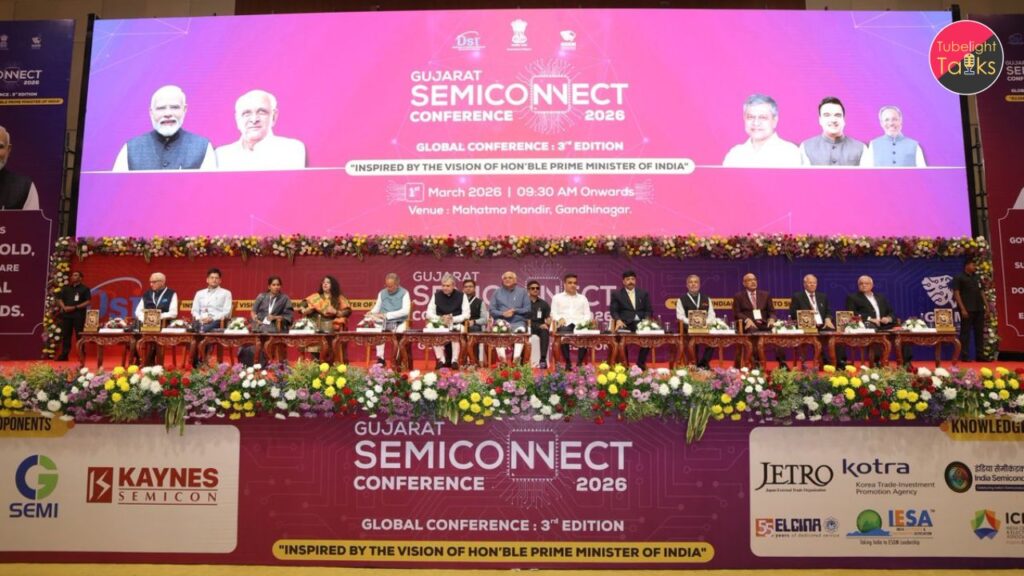
The focus sectors: where the fund will strike first
According to official briefings reported, the fund targets strategic and frontier sectors including:
- Semiconductors
- Artificial intelligence
- Quantum technologies
- Space technologies
- Biotechnology
- Green energy
- Defence technologies
- Immersive technologies
This breadth matters because it mirrors how modern technology works: chips power AI, AI optimizes energy and defence, quantum reshapes security, space reshapes communications, biotech reshapes health. Gujarat is essentially saying: we want the full stack.
The promise of scale: 100+ high-impact projects each year
The policy aims to support more than 100 high-impact projects annually, which is a strong signal that this is not a “pilot-policy” but a high-volume research push.
If executed cleanly, that scale could change the behavior of the ecosystem – because researchers and startups respond to predictable pipelines more than one-time grants.
The “R&D Capital” Strategy: Building Clusters, Not Isolated Labs
GRRIC: Gujarat Rajya Research & Innovation Clusters
One of the most important architecture pieces in the policy is the creation of Gujarat Rajya Research and Innovation Clusters (GRRIC) – a network that begins with the Gandhinagar–Ahmedabad region and expands to other corridors like Vadodara–Surat and Rajkot–Bhavnagar–Junagadh–Jamnagar.
The logic is brutally practical: you cannot build semiconductors or advanced AI with “solo institutions.” You need:
- shared labs and testing facilities,
- industry–academia platforms,
- easy movement of talent,
- fast commercialization pathways.
Clusters are how ecosystems beat fragmentation.
Why clusters change outcomes
A lab without industry becomes a paper factory. An industry without research becomes a fragile assembler. A cluster forces both into the same room.
That’s why the cluster approach is trending among deep-tech founders: it hints at a Gujarat where startups can access shared infrastructure without carrying impossible capex alone – especially important in semiconductors and hardware-heavy AI.
The Talent Pipeline: Gujarat Says “Build Researchers at Scale”
1 lakh skilled researchers by 2030
The state’s target is large and unambiguous: nurture 1 lakh skilled researchers by 2030, supported by fellowship pipelines and STEM engagement programs.
This is more than a number; it is a recognition that technology leadership is ultimately a talent war.
Fellowships and a dedicated women-focused track
Reported elements include 250 annual fellowships across JRF, SRF and post-doctoral categories, plus a dedicated Women in Innovation Fellowship.
This matters because deep-tech ecosystems often leak women at exactly the stage where research becomes career-defining. A named fellowship creates visibility, confidence, and a path.
STEM outreach and “scientific temper”
The policy also emphasizes expanding STEM learning centers, strengthening Science City and district science centers, deploying mobile science laboratories, and promoting experiential learning.
That’s the long-game: build the next generation before they reach university.
Patents, IP, and the Hard Reality of Global Competition
Gujarat’s stated target: 1,000 IP filings annually, including 500 patents
The policy includes a strong intellectual-property target: over 1,000 IP filings annually, including at least 500 patents, supported by more than 200 IP facilitation centers.
This is significant because in semiconductors, quantum and advanced materials, patents don’t just protect innovation – they determine who controls the market and who pays licensing fees forever.
Why this matters to “Make in India”
Manufacturing without IP becomes contract work. Manufacturing with IP becomes power. Gujarat is aiming for the second category: value creation that stays in India.
The Semiconductor Context: Why SemiConnect Was the Perfect Stage
A national push is underway, and Gujarat wants to lead it
At the SemiConnect Conference, Union minister Ashwini Vaishnaw emphasized that AI, semiconductors, and electronics manufacturing will drive India’s next phase of growth, and noted India’s momentum in semiconductor manufacturing projects.
Gujarat is aligning its STI policy to that larger national direction – but adding a key twist: state-backed R&D muscle, not only industrial parks and incentives.
From “chip plants” to “chip brains”
A fab without researchers becomes dependent on foreign design, foreign tools, and foreign upgrades. The STI policy is trying to build the “brains layer” so Gujarat doesn’t only host factories – it hosts invention.
What This Means for Startups and Young Researchers
For startups: less loneliness, more runway
Deep-tech startups fail for one major reason: they run out of time before the tech becomes real. Semiconductor tooling, hardware prototyping, advanced materials testing – these aren’t quick.
A 5-year policy with a defined fund and cluster infrastructure suggests:
- longer funding windows,
- clearer project pipelines,
- more shared facilities,
- better industry collaboration.
For researchers: a chance to stay, build, and scale
Many young Indian researchers leave because they don’t see stable funding, facilities, or industry pathways. If Gujarat’s fellowships and project volumes become real at scale, it can improve retention – and bring talent back.
The Real Test: Implementation, Governance, and Speed
Funding is powerful only when it moves quickly
The biggest danger to any R&D policy is slow disbursal and vague selection processes. The policy talks about scale; scale will demand:
- transparent calls for proposals,
- strong peer review,
- milestone-based funding,
- strong audit and outcome tracking.
Avoiding “paper innovation”
If success is measured only by MoUs and events, the ecosystem will drift into optics. Real success will look like:
- chips designed locally,
- patents that become products,
- startups graduating into manufacturing lines,
- research translating into exports.
Gujarat’s stated project count and IP targets make this measurable – so the state will be judged on delivery, not intention.
Research with Responsibility
A major R&D push is not only about money – it’s about intention. Knowledge can uplift society or inflate ego. In the teachings of Sant Rampal Ji Maharaj, social reform and responsible living are emphasized – removing harmful practices, supporting the vulnerable, and using knowledge to reduce suffering rather than increase exploitation.
Seen through that lens, a Swadeshi Anusandhan mission becomes truly meaningful when innovation translates into public welfare: affordable healthcare tools, safer infrastructure, cleaner energy, secure jobs, and dignity for ordinary families. The heaviest question is also the simplest: Will this research make life easier for the last person in the line? If yes, Gujarat’s R&D capital dream will become a moral achievement – not just an economic one.
FAQs: Gujarat unveils ₹1,000 crore Swadeshi Anusandhan Fund.
1. What did Gujarat launch at SemiConnect?
The STI Policy 2026–2031 with a ₹1,000 crore Swadeshi Anusandhan Fund.
2. What is the Swadeshi Anusandhan Fund for?
To accelerate indigenous research and reduce import dependence in strategic tech sectors like semiconductors, AI and quantum.
3. How many projects will be supported each year?
Officials said more than 100 high-impact projects annually.
4. What are GRRIC clusters?
A planned network of research and innovation clusters starting with Gandhinagar–Ahmedabad and expanding to other regional corridors.
5. What IP targets has Gujarat set?
Over 1,000 IP filings annually, including at least 500 patents.
Related Stories










Discussion (0)