Tamil Nadu’s Dark Sky Park Opens in Kolli Hills
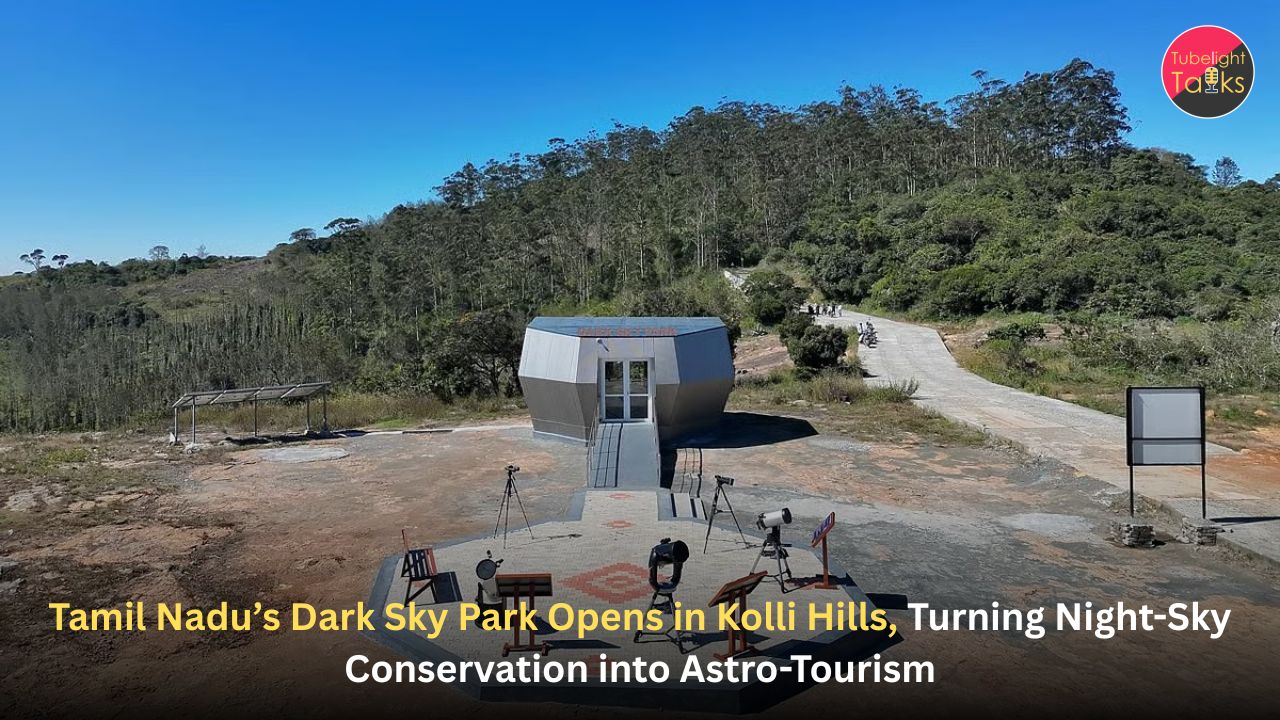
Tamil Nadu has formally stepped into astro-tourism by launching Tamil Nadu’s Dark Sky Park at the Ariyur Shola Reserve Forest in Kolli Hills, Namakkal. The government describes Tamil Nadu’s Dark Sky Park as a designated landscape protected from artificial light pollution – built to enable clear observation of the Moon, stars, planets and other astronomical phenomena.
Kolli Hills was chosen for the simplest scientific reason: elevated terrain, dense forest cover and minimal urban light disturbance create exceptional natural darkness. The park has been set up with three advanced telescopes and solar panels, and will host structured sessions and whole-night stargazing camps – making science, conservation and responsible tourism part of the same story.
Why This Dark Sky Park Matters More Than Weekend Tourism
Light pollution is not “urban glow” – it’s ecological damage
Artificial light at night doesn’t just block stargazing. It changes ecosystems: insects spiral around bulbs until exhaustion, nocturnal animals shift feeding patterns, and migratory birds can be disoriented by bright skylines. Dark Sky Parks exist because modern life has created a kind of invisible pollution – one that doesn’t smell, but still harms.
Tamil Nadu’s move is significant because it frames darkness as something worth conserving. When a government calls a site “protected from artificial light pollution,” it is acknowledging that the night sky is not merely “beautiful” – it is a natural resource.
Science access becomes real when the sky becomes the classroom
Many students learn astronomy only as diagrams and chapters. A dark sky park flips that. It makes learning physical: spotting Jupiter’s moons, identifying constellations, seeing star clusters with depth – not as pixels on a screen, but as light that has travelled for years.
The official plan explicitly states the center will function during daytime hours to promote scientific literacy and awareness in astronomy among students, researchers and the public.
What Exactly Is a Dark Sky Park?
A protected landscape where lighting is controlled, not uncontrolled
The Tamil Nadu government defines a Dark Sky Park as a “designated landscape protected from artificial light pollution,” allowing clear observation of celestial bodies.
That definition is important because it signals rules and design decisions:
- lighting is minimized, shielded, and directed downward
- bright, unnecessary lighting is restricted
- visitor movement is regulated so the sky remains observable
- conservation goals are built into tourism operations
In short: it isn’t “a viewpoint.” It is a managed conservation-education site.
Why Kolli Hills Was Chosen
Geography that naturally protects darkness
According to the state press release, Kolli Hills offers exceptional natural darkness due to:
- elevated terrain
- dense forest cover
- minimal urban light disturbance
This matters because true stargazing isn’t only about “being away from the city.” It’s about the entire landscape being dark enough that faint objects – like the Milky Way – are visible. Kolli Hills gives that baseline naturally.
Site selection was not random; it followed assessments
The government states Ariyur Shola Reserve Forest was selected after assessing ecological suitability and sky visibility conditions, and notes the project was announced in the Legislative Assembly on 25.06.2024.
That detail matters because it shows continuity: this is not a sudden “viral idea,” but a planned conservation-tourism model that moved from announcement to execution.
What Tamil Nadu Built at Ariyur Shola
Three advanced telescopes and solar-powered operations
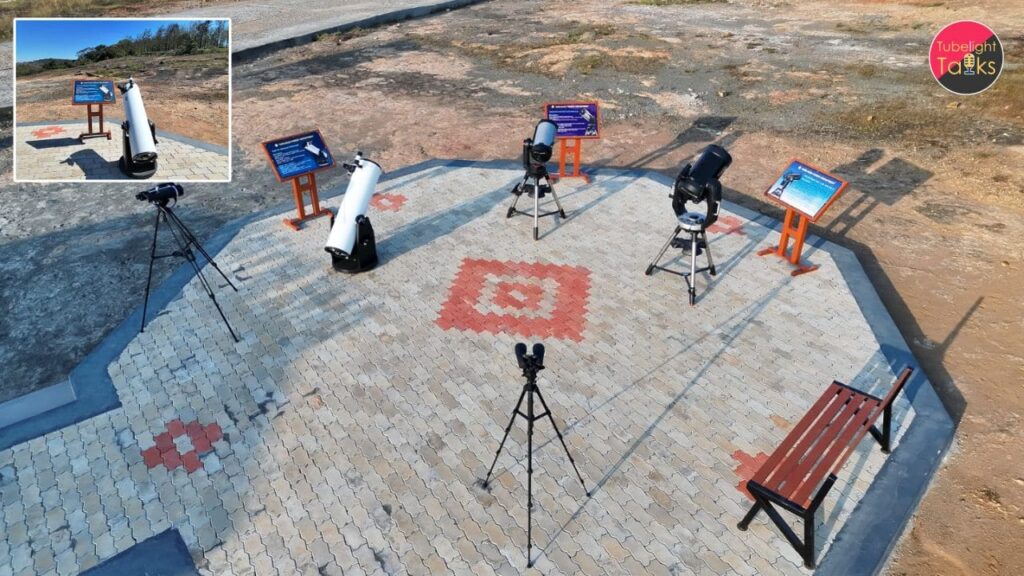
The official release states the Dark Sky Park was set up at a cost of Rs. 44 lakhs and includes:
- three advanced telescopes for structured sky observation sessions
- solar panels to sustainably harness power for onsite operations
This is the backbone of the project: science hardware plus sustainable infrastructure. It signals that the state wants astro-tourism without heavy environmental footprints – an important credibility marker in ecologically sensitive hill regions.
Daytime science education + nighttime stargazing camps
The park is designed to operate in two modes:
- Daytime: scientific literacy and public education in astronomy
- Nighttime: structured stargazing sessions and whole-night camps
The press release adds that whole-night stargazing camps will be organised two to three times a month, particularly around the new moon phase for optimal visibility.
That scheduling choice is not cosmetic – it’s scientific. Moonlight brightens the sky and washes out faint objects. Planning around new moons is how serious sky programs operate.
Also Read: Gujarat Unveils ₹1,000 Crore Swadeshi Anusandhan Fund
Why This Is Trending as an “Eco-Friendly Weekend Destination”
A tourism product built on restraint
Most tourism markets sell more noise, more lights, more “always on” energy. A dark sky park sells the opposite: silence, darkness, patience. That inversion is exactly why it’s trending among travelers and space enthusiasts – because it feels rare.
Media coverage notes that the Tamil Nadu Forest Department launched the facility to promote astronomy and eco-sensitive tourism by preserving natural night skies from light pollution, citing the location’s minimal urban lighting and elevated terrain.
A livelihood model that doesn’t require concrete-heavy development
The government explicitly states that by integrating conservation, education and regulated visitor access, the model strengthens environmental stewardship and local livelihood opportunities.
This is important because hill tourism often becomes extractive: more vehicles, more plastic waste, more illegal construction. A dark sky park can be a different model – earning through guided experiences, training local youth as astronomy interpreters and eco-guides, and creating a new kind of “pride economy” around conservation.
The Science Value: What Visitors Can Actually See
The Milky Way is not a metaphor here
In most cities, the Milky Way is something people see only in photos. In truly dark sites, it becomes visible as a pale river of light – because you are seeing the plane of our galaxy. That experience changes people. It’s not just “beautiful”; it’s perspective.
The official communication emphasizes that the park will allow clear observation of celestial bodies including stars, planets, and other astronomical phenomena, enabled by minimal light disturbance.
A gateway for citizen science
With structured sessions and repeated camps, a park like this can enable citizen science activities:
- meteor shower watches with time-stamped counts
- lunar observation logs
- basic astrophotography workshops (without flashing lights)
- night-sky mapping sessions for students
Even when outcomes are not “research papers,” they build scientific temper – exactly what the state says it aims to promote.
Conservation Benefits: What Darkness Protects Beyond Stars
Protecting nocturnal life
Ariyur Shola Reserve Forest is not just a scenic site – it is a living system. Reducing light intrusion helps preserve natural rhythms: insects, bats, and nocturnal mammals rely on darkness for navigation and behavior. When tourist lighting spreads uncontrolled, ecosystems become stressed.
The state’s framing – tourism aligned with ecological safeguards and regulated visitor access – signals that conservation is not a footnote, but a condition.
Reducing “tourism waste” through controlled access
The press release explicitly mentions regulated visitor access.
That is crucial because fragile hill ecosystems cannot absorb unlimited crowds. A controlled model can reduce:
- litter accumulation
- noise stress on wildlife
- vehicle congestion and unsafe driving
- unplanned lighting and local disturbance
Dark sky protection fails quickly if tourism becomes uncontrolled. So regulation is not “restriction” – it is what makes the park’s purpose possible.
How a Visitor Experience Could Work
Timing built around the sky, not convenience
The whole-night camps are planned around new moon phases and significant astronomical events.
This is the correct way to run astro-tourism: people must learn that nature has schedules. When a destination teaches visitors to respect cosmic timing, it quietly teaches a larger lesson – patience and alignment with the natural world.
Basic behavioral rules that protect the sky
A functioning dark sky experience typically requires simple discipline:
- no bright flashlights; use red-light options
- phones dimmed, no flash photography
- vehicle headlights controlled within the zone
- quiet movement and guided pathways
- no litter, no loud music
The state’s emphasis on regulated access suggests such discipline will be part of the visitor model.
Why This Step Matters for Tamil Nadu’s Tourism Identity
It adds a “science tourism” lane
Tamil Nadu is known for temples, beaches, hill stations, and heritage. Astro-tourism adds a new lane: science-first travel rooted in conservation.
The Forest Department’s framing, and the tourism-style information now appearing on state-linked platforms, positions the Kolli Hills park as a destination blending astronomy, nature conservation and environmental education.
It spreads tourism pressure away from over-saturated hubs
Hill tourism often concentrates in a few places, leading to crowding, strain on water resources, and waste issues. A new destination category – especially one requiring regulated access – can distribute tourism more responsibly.
The Real Challenges Ahead
1) Maintaining darkness as popularity grows
The biggest enemy of a dark sky park is its own success. As visitor numbers rise, so do:
- vehicle movement
- demand for lighting, stalls, and amenities
- informal vendors and unregulated activity
The only way to protect the mission is strict control over lighting and access – exactly what the state mentions in its approach.
2) Protecting the forest from “event tourism”
If the park becomes only an “event space,” the forest becomes collateral. The correct approach is education-led, guide-led, and low-impact – so the forest remains a sanctuary, not a stage.
3) Training local guides and ensuring safety
Night tourism needs trained personnel: basic first aid, visitor management, wildlife safety protocols, and knowledge-driven guiding. Done well, it creates dignified jobs. Done poorly, it creates risk.
The press release explicitly connects the model to local livelihood opportunities – meaning capacity-building will be essential.
The Sky That Teaches Humility
Standing under a truly dark sky does something that books cannot. It shrinks ego. It reminds people that life is brief, and nature is vast – yet also precise, disciplined, and balanced. In the teachings shared by Sant Rampal Ji Maharaj, there is strong emphasis on living with restraint, avoiding waste, and recognizing that real progress is not only outward comfort but inward clarity and compassion.
A Dark Sky Park fits that flow naturally: it protects nature from unnecessary excess, encourages learning instead of distraction, and invites people to look up with humility. When society chooses conservation over noise, it quietly chooses wisdom – because what we protect reveals what we value.
FAQs: Tamil Nadu’s Dark Sky Park
1. Where is Tamil Nadu’s first Dark Sky Park located?
At Ariyur Shola Reserve Forest in Kolli Hills, Namakkal district.
2. Who launched the Dark Sky Park?
Tamil Nadu’s Forest Minister R. S. Rajakannappan launched the initiative.
3. What facilities does the park include?
Three advanced telescopes and solar panels for sustainable onsite operations.
4. How often will whole-night stargazing camps be held?
Two to three times a month, especially around new moon phases for optimal visibility.
5. What is the main purpose of the park?
To protect the night sky from artificial light pollution while promoting astronomy education and responsible astro-tourism.
Related Stories










Discussion (0)