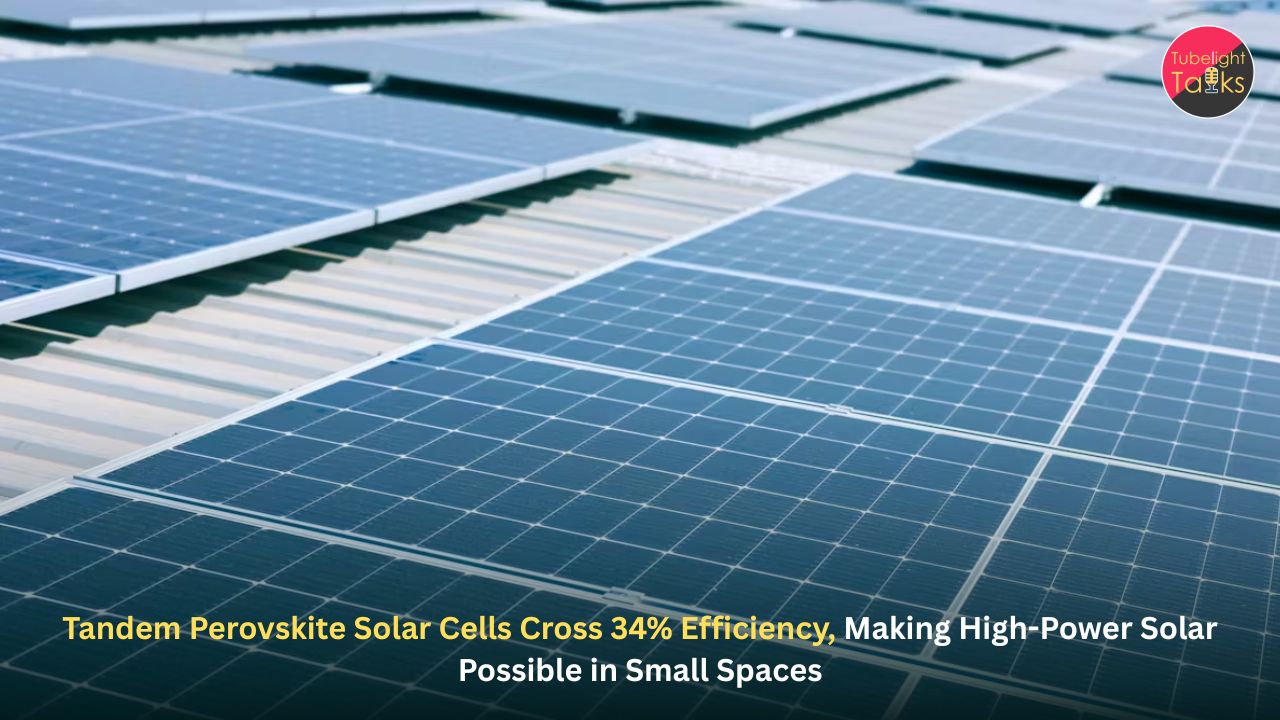
Tandem Perovskite Solar Cells Break Efficiency Records for Rooftop Power
The biggest barrier to rooftop solar in cities isn’t interest – it’s space. Most urban homes and small businesses don’t have endless roof area, so conventional panels often can’t cover enough of the electricity bill to feel “worth it.” That’s why tandem perovskite solar cells are trending: certified lab results have now surpassed 34% efficiency, meaning significantly more power can be produced from the same surface area.
One widely reported benchmark is LONGi’s 34.85% two-terminal silicon-perovskite tandem cell, certified by the U.S. National Renewable Energy Laboratory (NREL). This is not a minor upgrade – it’s the kind of jump that can reshape rooftop economics for millions.
What Are Tandem Perovskite Solar Cells?
Two solar “engines” stacked to capture more sunlight
Traditional silicon panels are approaching their physical ceiling. Fraunhofer ISE notes that conventional silicon solar cells can’t exceed a fundamental limit (they cite 29.4%), and that commercially available PV modules are already around 24% efficient.
Tandem perovskite-silicon cells break that ceiling by stacking two materials that absorb different parts of the solar spectrum:
- Perovskite (strong at capturing higher-energy light)
- Silicon (excellent at lower-energy light)
Instead of wasting the “extra” energy as heat, tandems convert more of it into electricity – raising total conversion efficiency.
Why 34% is a line in the sand
In practical terms, efficiency is “power per square meter.” If a standard commercial silicon panel is around ~21% efficient (as Reuters has reported, citing NREL), then moving to 34%+ is a dramatic leap in energy density.
That matters because rooftop solar is often area-constrained: the roof is the roof – no expansion is possible.
Also Read: India’s Renewable Energy Mission 2030: Complete Guide to New Solar & Wind Targets
The Record: What “Officially Reached 34%” Means
Certified results have crossed the 34% threshold
Recent years have seen multiple certified milestones over 34% in tandem perovskite-silicon research cells. Examples widely cited in industry reporting include:
- LONGi: 34.85% (NREL-certified) for a two-terminal silicon-perovskite tandem cell.
- JinkoSolar: 34.76% (confirmed by China’s NPVM testing center) for a perovskite-silicon tandem cell.
So when headlines say “34% efficiency reached,” the accurate story is: the 34% barrier has been crossed and independently verified in multiple high-profile demonstrations.
Why certification matters more than hype
Solar labs can claim many things. What changes industry confidence is third-party confirmation – because it signals repeatability and measurement discipline. That’s why the LONGi result being certified by NREL carries extra weight.
Why This Breakthrough Is a Big Deal for Urban India
More power from small rooftops
Higher efficiency means:
- fewer panels for the same output, or
- more output from the same roof
Reuters has described how tandem advances can reduce the space needed for solar installations – because higher efficiency produces more energy per area.
For dense Indian cities where rooftops are shared, shaded, or partially usable, that difference can decide whether solar is a “nice idea” or a real monthly benefit.
A new door for space-constrained surfaces
Once power density rises, solar becomes viable on places that were previously marginal:
- apartment rooftops with limited install area
- small commercial rooftops (bakeries, clinics, workshops)
- EV rooftops and mobile systems (where surface area is fixed)
This doesn’t mean every car roof becomes a powerhouse tomorrow. But it does mean the math is moving in favor of “small-surface solar,” which is exactly where adoption needs help.
The Heavy Reality Check: What Must Be Solved Next
Durability is the battlefield now
Perovskites have long been criticized for stability under heat, moisture, UV exposure, and real-world operating stress. Reuters, reporting on perovskite-silicon tandem development, notes that even when tandems are more efficient, they still must prove they can produce power reliably for years through field testing.
In plain terms: efficiency wins headlines – durability wins markets.
Scaling from tiny cells to real modules
Record efficiencies are often achieved on small research cells. Turning that into large-area commercial modules requires:
- uniform coating and defect control
- stable encapsulation
- manufacturing yields that don’t collapse cost advantages
That’s why this breakthrough is best seen as a powerful signal that the direction is right – while the industry still has to earn “bankable reliability.”
Why People Like This as “Positive”
It makes renewable energy feel more reachable
People support clean energy, but many feel locked out by practical limits: “I don’t have roof space,” “My building is shared,” “My shop roof is tiny.” This is exactly the pain point tandem efficiency attacks.
It accelerates the transition without demanding lifestyle changes
Unlike many climate solutions that require behavioral sacrifice, solar efficiency improvements deliver impact quietly – more electricity, same sunlight, same roof.
Progress That Must Uplift the Smallest Household
A technology is truly “good news” only when it becomes accessible – not just impressive. In the teachings shared by Sant Rampal Ji Maharaj, there is emphasis on responsibility, compassion, and using knowledge to reduce suffering rather than increase inequality.
In that spirit, the real victory of ultra-efficient solar will be measured by whether it helps the ordinary household: lower bills, cleaner air, and energy security without exploitation. When scientific progress is guided toward public welfare – especially for the weakest and most space-constrained – then innovation becomes service, not just spectacle.
FAQs: Solar for the Small – Tandem Perovskite Cells reach 34% efficiency.
1. What does “34% efficiency” mean in solar?
It means about 34% of the sunlight hitting the cell is converted into usable electricity – very high compared to mainstream panels.
2. Have tandem perovskite cells actually crossed 34% in certified tests?
Yes – industry reports cite certified results above 34%, including 34.85% (NREL-certified) and 34.76% (NPVM confirmed).
3. Why does higher efficiency matter for apartment rooftops?
Because it increases power output per square meter, helping buildings with limited roof area generate meaningful electricity.
4. Will these tandems replace silicon panels immediately?
Not immediately. High efficiency must be matched with long-term durability and scalable manufacturing before mass adoption.
5. What’s the biggest challenge left?
Proving long-term reliability in real-world conditions and scaling the technology from lab-scale cells to commercial modules.
Related Stories










Discussion (0)