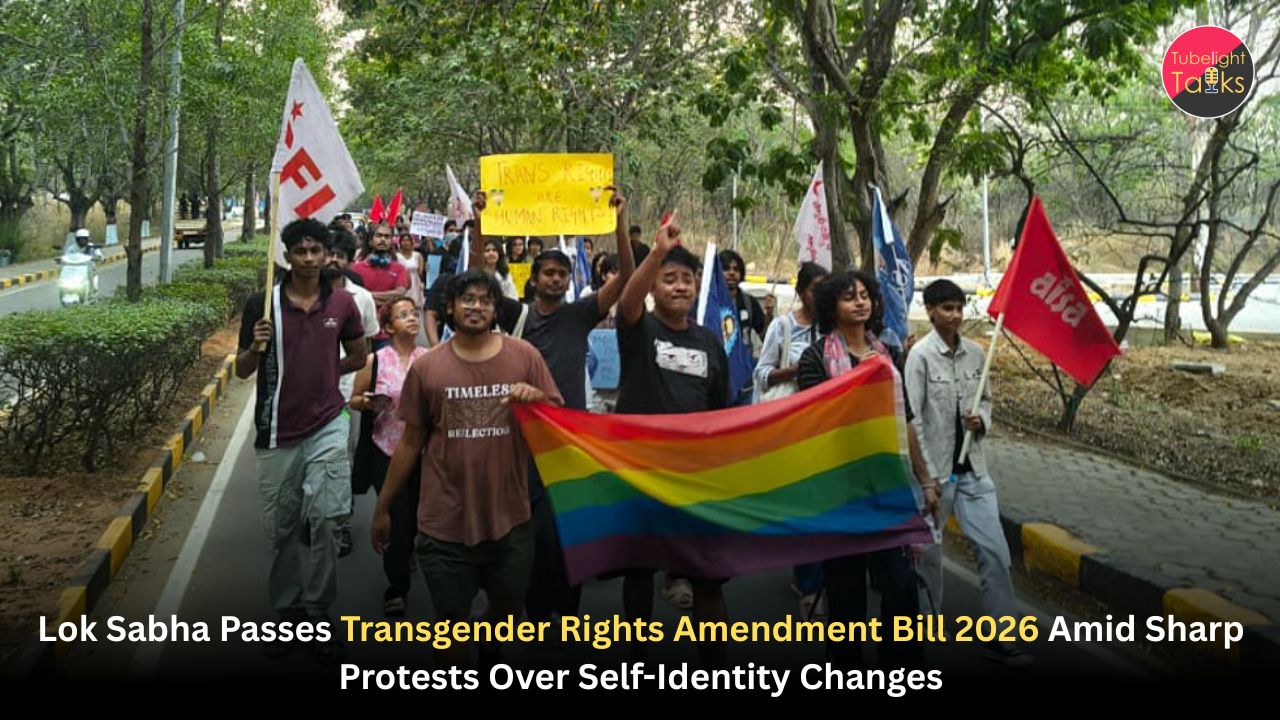
Lok Sabha Passes Transgender Rights Amendment Bill, Triggering a New National Battle Over Identity and State Power
The Lok Sabha has passed the Transgender Rights Amendment Bill 2026, pushing one of the most controversial social-legislation changes of the current session into its next phase. The Bill was passed on Tuesday by voice vote after Opposition criticism and demands for wider consultation, and it now stands as a major turning point in India’s transgender-rights debate.
At the center of the controversy is a sharp legal shift: the amendment narrows the statutory definition of “transgender person,” removes the 2019 Act’s explicit recognition of self-perceived gender identity, and inserts a medical-board-linked certification structure into the recognition process.
The government says the Bill is meant to create a more precise framework so that legal protections and welfare reach those it believes are the intended beneficiaries of the law. Critics, however, argue that the Bill reverses the rights-based direction associated with self-identification and replaces it with a narrower, more bureaucratic, and more intrusive model.
That is why this is not just another amendment story. It is now a constitutional, social, and moral debate about who gets to define identity: the person, or the state.
What exactly the Lok Sabha has passed
The Bill was cleared by voice vote despite strong objections
According to Indian Express’ live Parliament coverage, the Bill was passed in the Lok Sabha on March 24 by voice vote after Opposition MPs objected to its exclusions and sought committee scrutiny. The same report said amendments proposed by Opposition members were rejected before passage. Indian Express separately reported criticism from MPs across parties, including objections that the Bill was rushed and that the transgender community had not been adequately consulted.
That procedural context matters because the politics of passage often shape the politics of legitimacy. A Bill dealing with identity, dignity, and recognition is always likely to face intense scrutiny, but that scrutiny grows further when affected communities and Opposition MPs say there was not enough consultation. That does not invalidate the law by itself, but it helps explain why resistance has been so immediate and emotionally charged. This is an inference from the reported debate and objections in Parliament.
The amendment changes the core definition of “transgender person”
The most important change is in the definition clause. The Bill text, as introduced in the Lok Sabha, replaces the 2019 Act’s broader definition with a narrower one focused on specified socio-cultural identities, intersex-related biological variations, and persons or children allegedly forced into outwardly assuming a transgender identity through coercive means.
It also adds a proviso stating that “persons with different sexual orientations and self-perceived sexual identities” are not, and shall never have been, included within this definition.
That is a major departure from the 2019 framework reproduced in the Bill’s annexure. The current law’s annexed text shows that the 2019 Act defined “transgender person” more broadly and explicitly included trans-man, trans-woman, person with intersex variations, genderqueer, and persons with socio-cultural identities such as kinner, hijra, aravani and jogta. The annexure also reproduces Section 4(2) of the 2019 Act, which says a person recognized as transgender has a right to self-perceived gender identity.
Why “self-perceived identity” is the central flashpoint
The Bill removes an express right that the 2019 law spelled out
The Bill does something critics consider foundationally regressive: it omits Section 4(2) of the 2019 Act, the provision that expressly said a person recognized as transgender has a right to self-perceived gender identity. That omission is not a side edit. It removes one of the clearest rights-based statements in the existing law.
The controversy becomes sharper when this change is read alongside Supreme Court jurisprudence. In a 2025 judgment, the Supreme Court explicitly said that in NALSA, the Court recognized the right of transgender persons to decide their self-identified gender, and quoted NALSA’s view that each person’s self-defined sexual orientation and gender identity is integral to dignity, freedom, and self-determination.
A 2024 Supreme Court judgment also described self-determination, including the right to determine one’s gender, as part of personal autonomy and liberty under Article 21.
That is why critics keep invoking NALSA. Their argument is not simply emotional or symbolic. It is rooted in the claim that the amendment moves away from a constitutional understanding of identity tied to autonomy and dignity and toward a state-screened model tied to classification and eligibility. Whether courts will ultimately agree is a future question, but the legal basis of the criticism is real. This is an inference from the Bill’s text and the Supreme Court passages cited above.
Also Read: Census 2027: After 16 Years of Darkness, India Finally Counts Every Soul – Digitally
The certification process is being reshaped around a medical authority
A medical board now enters the recognition framework
The Bill inserts a new definition of “authority” as a medical board headed by a Chief Medical Officer or Deputy Chief Medical Officer. It also changes Section 6 so that the District Magistrate issues the certificate after examining the recommendation of this authority and, if considered necessary or desirable, after taking assistance from other medical experts.
NDTV’s report on the Lok Sabha passage summarized the same shift in practical terms: identity certification would be issued by the District Magistrate after examination by a designated medical board, and the Bill links recognition more closely to a formalized official-medical process. Critics say this converts recognition into scrutiny. Supporters say it creates clarity and administrative consistency.
This issue goes to the heart of the current dispute. A self-identification model begins with the person. A medical-board-linked model begins with institutional verification. That difference is not merely procedural. It changes the lived experience of recognition, the balance of power between citizen and state, and the degree of privacy a person can expect in asserting identity. That is an analytical conclusion drawn from the amendment text.
The Bill also changes the process for post-surgery gender change recognition
The amendment changes Section 7 as well. It makes certain follow-up steps mandatory rather than optional and requires the medical institution where surgery took place to furnish details to the District Magistrate and the authority. It also revises the process for issuing a certificate indicating change in gender and removes the existing sub-section (3) and proviso.
The government can present these changes as administrative standardization. But critics are reading them as part of a broader medicalization of recognition. That reading is understandable because the Bill’s overall architecture does not merely tighten procedure; it narrows definition, removes explicit self-perceived identity language, and adds medical-board involvement across recognition steps. This is an inference grounded in the structure of the Bill as a whole.
Why the government says the Bill is needed
The official justification is precision and targeted protection
The Bill’s Statement of Objects and Reasons lays out the government’s rationale in unusually direct terms. It says the law is intended to protect a specific class of transgender persons facing severe social exclusion for biological reasons, not “each and every” class of persons with various gender identities or self-perceived identities. It argues that the existing definition is too vague for proper implementation and says identification should not be extended on the basis of personal choice or claimed self-perceived identity.
In Parliament and in media reporting, the government’s public line has tracked that logic. NDTV reported that Social Justice Minister Virendra Kumar said the Bill aims to protect those who face severe social exclusion because of biological condition, while Indian Express’ Parliament live coverage said the government defended the law as a way to create a clearer legal framework and ensure continued legal recognition.
That framing matters because it shows the government is not presenting the Bill as a rollback. It is presenting it as targeted welfare legislation with definitional precision. The conflict, therefore, is not over whether protection is needed; it is over who qualifies for protection and who gets to decide that.
Why opponents call it exclusionary and regressive
Opposition MPs say the Bill narrows identity and weakens dignity
Indian Express reported that Opposition MPs argued the Bill’s definition excludes trans-men, trans-masculine persons, trans-women, gender-queer and non-binary identities. MPs quoted in the report described the move as a regression and warned that removing self-identification takes rights away rather than expands them. Indian Express’ live coverage also noted that some Opposition members wanted the Bill referred to a parliamentary committee for wider consultation.
Economic Times reported similar criticism from activists, including objections that the Bill narrowly recognizes only selected traditional or socio-cultural identities while excluding other contemporary gender-diverse identities. Activists quoted there also criticized the use of terminology such as “eunuch” and argued that the Bill would deepen stigma rather than reduce it.
The criticism is broader than identity labels alone. It also concerns autonomy, privacy, and bureaucratic power. If legal recognition is narrowed and medicalized at the same time, opponents say the state is not just defining eligibility; it is redefining personhood in a way that makes some people visible and others legally disposable. That is an inference drawn from the reported objections and the text of the amendment.
The Bill also contains a tougher penal framework
Supporters will point to stronger punishments for grave offences
The government is not wrong to say the Bill contains provisions it can market as stronger protection. The amendment substitutes Section 18 of the 2019 Act and adds graded punishments for a range of offences.
The text includes harsher penalties for kidnapping or abducting adults or children and inflicting grievous or permanent bodily harm to compel adoption of a transgender identity, as well as for forcing persons or children into outward presentation as transgender for begging, servitude, or bonded labor. Some of these proposed punishments run from five years up to life imprisonment, and Indian Express’ Parliament live coverage noted punishments of up to 14 years in jail for certain offences.
This is one reason the legislation is politically complex. It is not a simple one-direction Bill. It narrows recognition while also hardening penal provisions for specific forms of abuse and exploitation. So the debate is not “rights” versus “no rights.” It is about whether stronger punishment for certain crimes can justify, or outweigh, a narrower rights framework around identity and recognition. That is the core legislative trade-off now being contested.
What happens next
The Bill has passed the Lok Sabha, but the constitutional debate is only beginning
Passage in the Lok Sabha is a major milestone, but it is not the end of the story. The next institutional stages will matter, and even beyond Parliament, legal scrutiny is likely. Because the Bill directly touches autonomy, identity, privacy, and the scope of statutory recognition, it is difficult to imagine that it will escape constitutional challenge if enacted. That is an inference based on the issues raised by MPs, activists, and the contrast with existing Supreme Court jurisprudence on self-determination and gender identity.
Politically, the law may also become a larger test of how India handles rights claims by marginalized communities in an era of increasingly precise administrative classification. The government is arguing for narrower legal certainty. Opponents are arguing for dignity-centered inclusion. The future of this Bill will turn on which of those constitutional visions proves more persuasive in the legislative and judicial arenas ahead. This is an analytical conclusion based on the current record.
Human Dignity, and the Need for Compassionate Justice
Teachings associated with Sant Rampal Ji Maharaj place repeated emphasis on equality, compassion, and the idea that every human being deserves dignity rather than humiliation. Read in that spirit, any law dealing with vulnerable communities should be judged not only by administrative neatness but by whether it protects human respect, reduces suffering, and avoids unnecessary cruelty.
A society guided by Sat Gyaan does not measure people merely through labels or rigid categories; it tries to see the human being first. In that sense, the transgender-rights debate is also a moral test of whether law is moving closer to compassion or farther from it. This is an interpretive spiritual reflection rather than a legal claim.
Call to Action
Read the Bill itself before accepting slogans from either side
This amendment is too important to understand only through outrage posts or partisan talking points. Its actual text changes the definition of “transgender person,” removes the existing law’s explicit right to self-perceived gender identity, introduces medical-board-linked certification, and adds stronger graded punishments for certain offences.
Citizens, lawyers, students, and policymakers should read those clauses closely and compare them with the 2019 law and the constitutional language around dignity and self-determination.
A serious democracy should protect both vulnerable people and their autonomy
The strongest legal systems do not force a choice between welfare and dignity. They try to protect both. As this Bill moves forward, that should remain the standard: whether the law genuinely protects vulnerable people without shrinking their autonomy, privacy, and personhood in the process.
FAQs: Lok Sabha Passes Transgender Rights Amendment Bill 2026
1. Has the Lok Sabha passed the Transgender Persons (Protection of Rights) Amendment Bill, 2026?
Yes. Indian Express’ Parliament live coverage reported that the Lok Sabha passed the Bill on March 24, 2026 by voice vote after rejecting Opposition amendments.
2. What is the biggest legal change in the Bill?
The biggest change is that it narrows the definition of “transgender person,” excludes persons with different sexual orientations and self-perceived sexual identities, and removes the 2019 Act’s explicit right to self-perceived gender identity.
3. Does the Bill introduce a medical board?
Yes. It defines an “authority” as a medical board headed by a Chief Medical Officer or Deputy Chief Medical Officer, and links certification to the District Magistrate examining that authority’s recommendation.
4. Why are activists and Opposition MPs protesting?
They argue the Bill is exclusionary, narrows recognition, undermines self-identification, and imposes medicalized bureaucratic barriers. Reports also say they objected to the lack of broad consultation.
5. What does the government say the Bill is trying to do?
The government says it wants a more precise definition so protections reach those facing severe social exclusion, and it says the Bill also strengthens punishments for grave offences.
6. How does this connect to earlier Supreme Court principles?
Recent Supreme Court judgments citing NALSA have said transgender persons have a right to self-identified gender and that self-determination is part of dignity, autonomy, and Article 21 liberty. That is why critics say the Bill departs from the earlier rights-based approach. b cfdf
Related Stories










Discussion (0)