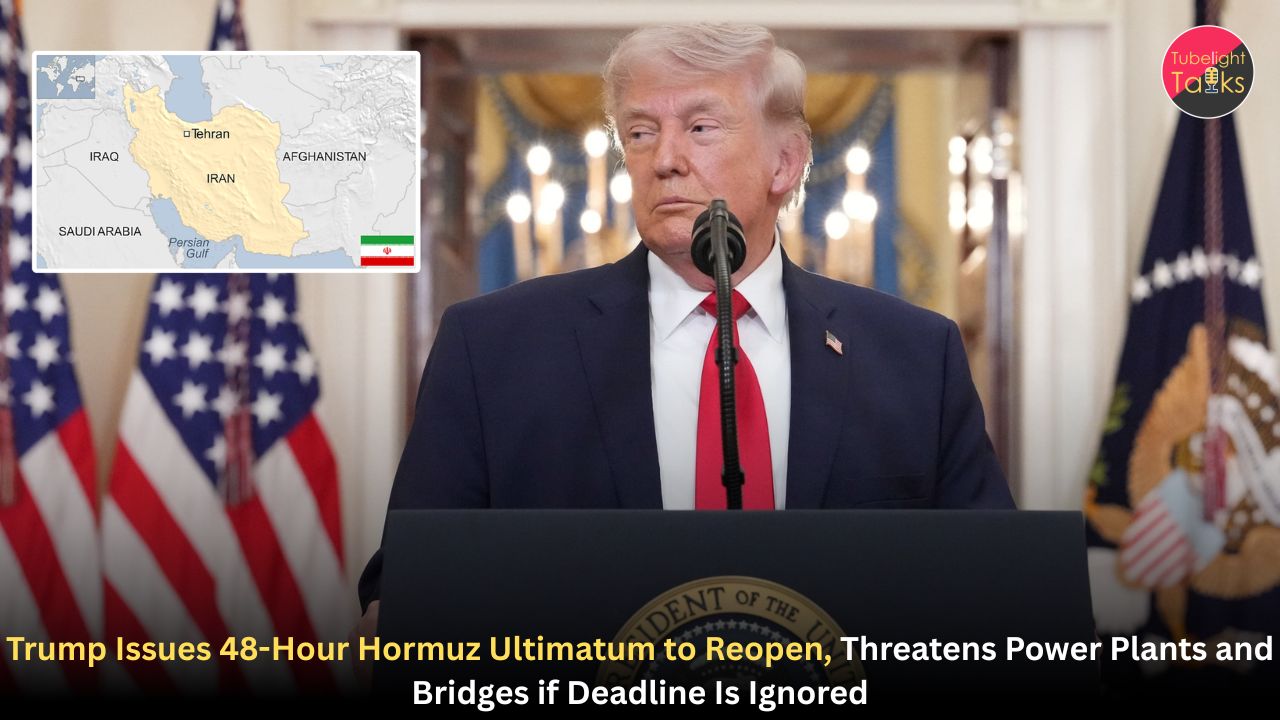
Trump Issues 48-Hour Hormuz Ultimatum to Iran as Threats Against Power Plants and Bridges Intensify
Trump Issues 48-Hour Hormuz Ultimatum: U.S. President Donald Trump has issued one of his clearest and most dangerous warnings yet in the Iran war, telling Tehran it must reopen the Strait of Hormuz by Tuesday evening or face attacks on critical infrastructure. Reuters reported that Trump told The Wall Street Journal that if Iran does not act by then, “they won’t have any power plants and they won’t have any bridges standing.”
The ultimatum sharpens an already volatile crisis in which Hormuz, a route for roughly one-fifth of global oil and LNG flows, has become the center of both military pressure and global economic anxiety.
Trump has moved from broad threats to a precise deadline
Tuesday evening is now the declared red line
The most important development is that Trump has attached a specific deadline to his demand. Reuters reported on April 5 that Trump said Iran must open the Strait of Hormuz by Tuesday evening or face infrastructure strikes, and that he later posted, “Tuesday, 8:00 P.M. Eastern Time!” on social media. Earlier Reuters reporting from April 2 had already shown Trump threatening that “Bridges next, then Electric Power Plants,” but the latest statement is more specific because it ties those threats to a fixed deadline.
That matters because deadlines change the nature of a crisis. A vague threat can be absorbed, delayed or spun diplomatically. A timed ultimatum narrows room for maneuver and increases the chance that rhetoric becomes action. In this case, the red line is not over some abstract negotiation point. It is over the reopening of one of the world’s most important maritime chokepoints for energy trade. This is an inference, but it follows directly from Reuters’ reporting on the deadline and the role of Hormuz.
The threatened targets are civilian-linked infrastructure
Reuters’ April 2 report said Trump explicitly threatened to strike and destroy bridges and electric power plants in Iran. Reuters’ April 5 report then clarified the ultimatum, quoting Trump as saying Iran would lose its power plants and bridges if it failed to comply. That means the focus is no longer only on military sites or strategic ambiguity. The threatened targets are now plainly infrastructure tied to ordinary economic and civilian life.
This is one reason legal and humanitarian concerns have become sharper. Reuters had already reported that international law experts warned earlier U.S. strikes on Iranian infrastructure could amount to war crimes. When leaders publicly name bridges and power plants as targets, they move the debate from military escalation into the realm of civilian protection and the laws of war.
Iran has rejected the pressure and answered with threats of retaliation
Tehran’s response has been defiant
The strongest verified reporting does not show Iran accepting Trump’s ultimatum. AP reported that Tehran called Trump’s threat “unbalanced and foolish.” AP also reported that Gen. Ali Abdollahi Aliabadi, speaking through Iranian state-linked reporting, warned that “the doors of hell will be opened to you” if Iran’s infrastructure is attacked. That is not the language of concession. It is the language of deterrence and escalation.
There is one nuance worth keeping clear. I could verify “unbalanced and foolish” from AP, but I could not verify the exact phrase “desperate and foolish” from the strongest sources I checked. The broad meaning still holds: Iran has not accepted Trump’s terms and is publicly rejecting the ultimatum.
Also Read: Iran Pushes Back Against Trump’s 48-Hour Ultimatum as Retaliation Threats Rise
Iran is threatening U.S. and regional infrastructure in return
AP reported that the same Iranian military warning threatened all infrastructure used by the U.S. military in the region. That widens the danger well beyond a U.S.-Iran exchange at sea. If Tehran acts on that threat, bases, logistics facilities and associated regional infrastructure in Gulf states could become more direct targets.
This makes the crisis broader than a shipping dispute. It becomes a confrontation over whether one side can coerce Hormuz open through threat of air power while the other side tries to raise the price by endangering U.S.-linked infrastructure across the region. That is an inference, but it is strongly supported by the deadline, the named targets, and Iran’s stated response.
The Strait of Hormuz is why the whole world is watching
Hormuz is not just symbolic. It is economically critical
Reuters reported that the Strait of Hormuz normally carries about one-fifth of the world’s oil and liquefied natural gas. That fact explains why every threat around Hormuz has immediate global consequences. When Trump issues a 48-hour ultimatum over reopening the waterway, he is not only addressing Iran. He is also speaking to oil markets, shipping firms, allied governments and domestic consumers worried about fuel prices.
Because the strait is so central to energy flows, even a limited disruption changes global expectations. Prices, freight routes, insurance costs and political calculations all shift. That is why this deadline matters even before any new strike happens. In crises like this, markets react not just to bombs, but to credible timelines for more bombs. This is an inference supported by the centrality of Hormuz in Reuters’ reporting.
The ultimatum comes after weeks of shifting signals
Reuters’ April 2 report noted that Trump had offered shifting goals and timelines in the war before this latest escalation. That history matters because it explains why the current deadline is being taken seriously but also scrutinized. Markets and governments have already seen Trump threaten Iran’s infrastructure before. The difference now is that the threat is tied to a specific evening and a specific waterway objective.
That combination creates a dangerous compression of time. The more specific the deadline becomes, the less space there is for ambiguous diplomacy or face-saving gestures. If neither side backs down, the result may be that Tuesday evening becomes not a negotiating marker but an operational trigger. This is an inference, but it is a reasonable one based on the wording of the ultimatum and the lack of Iranian acceptance.
Diplomacy still exists, but it looks weak against the current momentum
There are still reported channels for talks
AP reported that Pakistan’s foreign ministry said efforts to broker a ceasefire were “right on track” and that Iran’s foreign minister Abbas Araghchi said Iranian officials “have never refused to go to Islamabad.” That means the diplomatic door is not fully shut. There are still mediators trying to get Washington and Tehran to the table.
But the larger picture remains grim. A public ultimatum about bombing power plants and bridges is not the language of a stabilizing negotiation. It is coercive brinkmanship. Even if talks remain technically possible, the public atmosphere is moving in the opposite direction. This is an inference, but it follows directly from the coexistence of mediation reports and explicit infrastructure threats.
The risk is that diplomacy becomes a footnote to escalation
If diplomacy cannot produce a visible shift before the deadline, it may become irrelevant to immediate events. A crisis like this can move faster than mediators can shape it, especially when one side has chosen a public countdown. That is why the next two days matter far beyond Washington and Tehran. They may determine whether the region gets a tense pause or a new round of infrastructure war.
Why this ultimatum is especially dangerous
It links military action to civilian hardship directly
Threatening bridges and power plants is not just a show of force. It is a threat to mobility, electricity, economic continuity and civilian life. Even if the objective is coercion, the effect would likely be felt most by ordinary people. Reuters’ reporting makes clear that the named targets are not hidden or speculative. They are explicitly part of Trump’s current threat.
That raises the stakes in two directions at once. First, it increases the humanitarian cost if action follows. Second, it increases the political difficulty of backing down, because both sides have now used absolute language in public. Once leaders talk this way, even small tactical moves can be interpreted as weakness or provocation. This is an inference, but it is strongly grounded in the reported rhetoric on both sides.
When ultimatums replace wisdom
A crisis governed by threats, deadlines and destruction quickly pushes ordinary families to the edge. The real victims of power struggles are often the people who control nothing: workers, children, travelers and households already living under fear. According to Spiritual Sant Rampal Ji Maharaj true strength is shown not by how close leaders can drag the region to disaster, but by how firmly they can step back from it.
Call to Action
The most important thing now is not more rhetoric. It is whether facts on the ground begin to change before Tuesday evening. Readers should watch three developments closely: any verified reopening or easing of Hormuz traffic, any signs of U.S.-Israeli preparations to hit power or transport infrastructure, and any Iranian moves against U.S. or allied assets in the region. Those three signals will reveal whether this ultimatum remains political pressure or turns into a new military phase.
FAQs: Trump Issues 48-Hour Hormuz Ultimatum
1. Did Trump really give Iran 48 hours to reopen the Strait of Hormuz?
Yes. Reuters reported that Trump said Iran had until Tuesday evening to open the Strait of Hormuz or face attacks on critical infrastructure.
2. What exactly did Trump threaten?
Reuters quoted Trump as saying that if Iran did not act by Tuesday evening, it would not have any power plants or bridges standing.
3. Did Trump also threaten bridges and electric power plants earlier?
Yes. Reuters reported on April 2 that Trump wrote that bridges and then electric power plants would be next targets in Iran.
4. How did Iran respond?
AP reported that Tehran called Trump’s threat “unbalanced and foolish” and warned that attacks on Iranian infrastructure would bring retaliation against U.S. military-linked infrastructure in the region.
5. Why is Hormuz so important?
Reuters reported that the Strait of Hormuz normally carries about one-fifth of the world’s oil and LNG flows, making it one of the most critical energy chokepoints in the world.
6. Is diplomacy still possible?
Yes, at least in principle. AP reported that Pakistan said ceasefire efforts were progressing and that Iran’s foreign minister said Iranian officials had not refused to go to Islamabad.
Related Stories





Discussion (0)