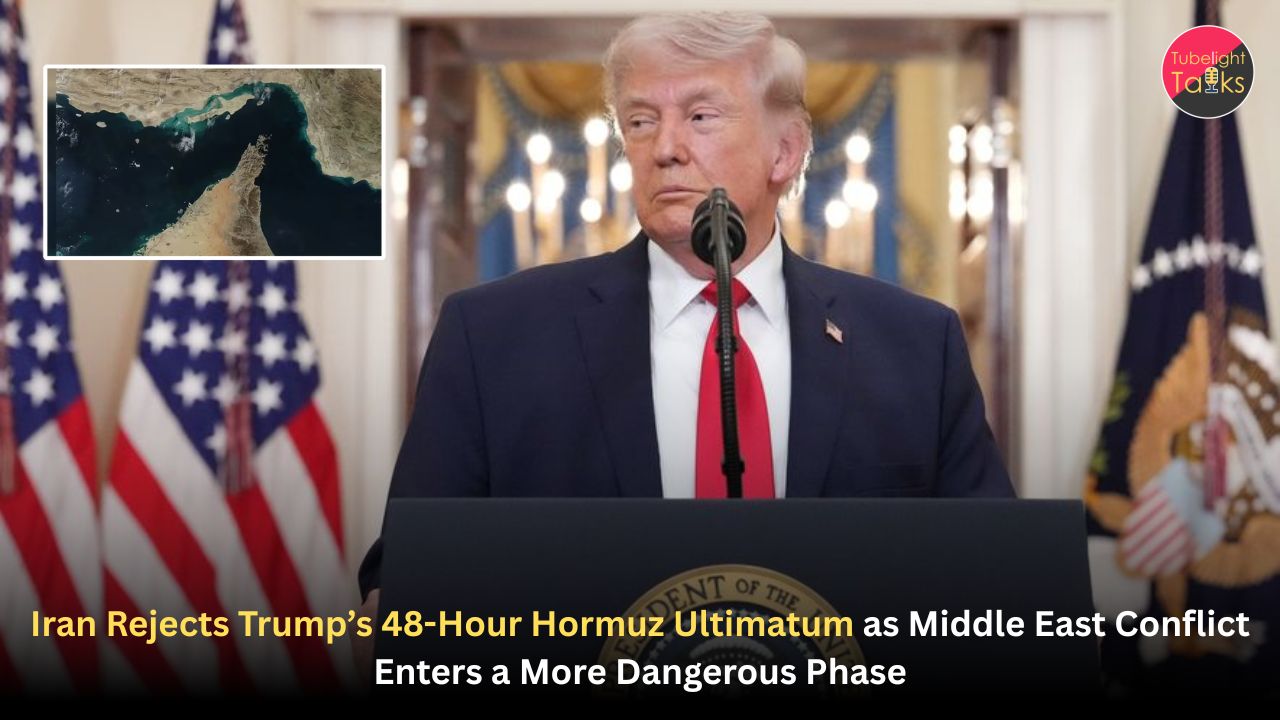
Iran Pushes Back Against Trump’s 48-Hour Ultimatum as Retaliation Threats Rise
Iran has effectively rejected the U.S. President Donald Trump’s 48-hour ultimatum to reopen the Strait of Hormuz, signaling that it will not comply under threat of force. Reuters reported that Trump warned Tehran it had 48 hours to make a deal or reopen the strait or face severe attacks, while Iranian media and military messaging answered with threats that the “entire region will become a hell” for the U.S. and Israel if the war escalates further.
At the same time, Iran’s foreign minister indicated openness in principle to mediated talks through Pakistan, but gave no sign that Tehran would yield to Washington’s demands.
Trump’s 48-hour ultimatum has sharply raised the stakes
Reuters reported that Trump posted that Iran had “48 hours before all Hell will reign down on them” unless it made a deal or opened the Strait of Hormuz. The same Reuters report said Israel was simultaneously preparing possible attacks on Iranian energy facilities and awaiting U.S. approval, showing that the ultimatum is backed not only by rhetoric but by an active escalation framework.
That matters because the Strait of Hormuz is not a symbolic bargaining chip. Reuters said Iran has virtually shut the waterway, which normally carries about a fifth of the world’s oil and liquefied natural gas. A 48-hour deadline tied to such a chokepoint is therefore not just a diplomatic demand. It is a threat aimed at the heart of global energy movement.
Iran’s response has been defiant, not conciliatory
The strongest verified reporting does not show Iran accepting the ultimatum or moving to reopen Hormuz under pressure. Reuters said Iran warned the U.S. and Israel that the “entire region will become a hell for you” if attacks escalated. It also reported that Iranian leadership remained defiant and that Foreign Minister Abbas Araqchi, while not ruling out talks in principle, showed no willingness to bow to Trump’s demands.
That means the broad substance of the headline is correct: Iran is resisting the ultimatum. One caution is that I could not verify from the strongest sources the exact phrase “desperate and foolish.” What I could verify is Tehran’s defiant posture, its refusal to yield publicly, and its warning of harsher retaliation against the U.S. and Israel if the pressure campaign intensifies.
The retaliation threat is aimed at both U.S. and Israeli interests
Reuters reported that Iran has continued launching drones and missiles at Israel and has also aimed at Gulf countries allied to the U.S. Iranian state TV, as cited by Reuters, said Iranian forces launched drones at U.S. radar installations, a U.S.-linked aluminium plant in the UAE, and U.S. military headquarters in Kuwait in retaliation for attacks on Iranian industrial centers.
This shows that Tehran’s warning is not abstract. Its message is that if Washington and Israel broaden the war, Iran will respond not only inside Israel but across the regional network of U.S.-linked military and economic assets. That expands the crisis from a bilateral confrontation into a wider regional danger zone involving Gulf infrastructure and allied territories. This is an inference, but it is directly supported by the range of targets Reuters says Iran has already threatened or struck.
Hormuz remains the center of the crisis
The Strait of Hormuz remains the most consequential pressure point in this war. Reuters reported on March 31 that Trump had already urged countries to go to the strait and “just TAKE it,” underscoring how central the chokepoint has become to his messaging. The same Reuters coverage said the war has roiled global markets and driven up energy prices because Iran has effectively closed oil tanker traffic there.
The reason this matters so much is simple. A war over Hormuz is not only about Iranian sovereignty or U.S. military dominance. It is about whether global energy trade can function at all without a wider confrontation. That is why every statement from Trump and every warning from Tehran now carries immediate consequences for oil, gas, inflation and shipping beyond the Middle East itself.
The conflict still looks closer to escalation than settlement
Although Reuters reported that Iran’s foreign minister left the door open in principle for talks through Pakistan, the same report makes clear there is no sign Tehran is prepared to accept Trump’s terms. Meanwhile, Trump’s own language remains coercive and threatening, and Reuters said Israel is preparing for possible strikes on Iranian energy facilities. That combination leaves little evidence of an imminent diplomatic breakthrough.
This is why the next 48 hours matter so much. If Iran does not move on Hormuz and the U.S. or Israel act on the threat to escalate, the conflict could shift from a punishing air war into a direct campaign against core energy infrastructure. That would likely deepen both the humanitarian crisis and the global economic shock already building around the war. This is an inference supported by Reuters’ reporting on the ultimatum, the energy-target threat and the existing closure-related disruption.
When force replaces wisdom
A conflict built on ultimatums, vengeance and destruction can quickly trap entire populations in fear. This is a reminder that true strength does not come from pushing others to the brink, but from restraint, truth and just action. When nations abandon wisdom, ordinary people pay the highest price first.
Call to Action
The key thing to watch now is not only the rhetoric, but whether any side changes facts on the ground in Hormuz or against energy infrastructure within Trump’s deadline window. Readers should follow three developments closely: any actual movement on Strait traffic, any U.S.-Israeli strikes on Iranian energy targets, and any confirmed Iranian retaliation against U.S. or Israeli assets in the region. Those will define whether this crisis moves toward negotiation or into a far more destructive phase.
FAQs: Trump’s 48-Hour Hormuz Ultimatum
1. Did Trump really give Iran 48 hours to reopen the Strait of Hormuz?
Yes. Reuters reported that Trump said Iran had 48 hours to make a deal or open the Strait of Hormuz or face severe attacks.
2. Has Iran accepted that ultimatum?
No verified reporting from the strongest sources shows Iran accepting it. Reuters instead described Iran as defiant and unwilling to bow to Trump’s demands.
3. What did Iran say in response?
Reuters reported that Iran warned the U.S. and Israel that the “entire region will become a hell” if attacks escalate.
4. Is Iran still open to talks?
Reuters said Foreign Minister Abbas Araqchi left the door open in principle for talks via Pakistani mediation, but without accepting Trump’s conditions.
5. Why is the Strait of Hormuz so important?
Reuters reported that Hormuz normally carries about one-fifth of the world’s oil and LNG flows, making it one of the world’s most critical energy chokepoints.
6. Why are global markets so sensitive to this standoff?
Because Reuters says Iran has effectively shut tanker traffic through Hormuz, and the conflict has already driven up energy prices and shaken global markets.
Related Stories






Discussion (0)