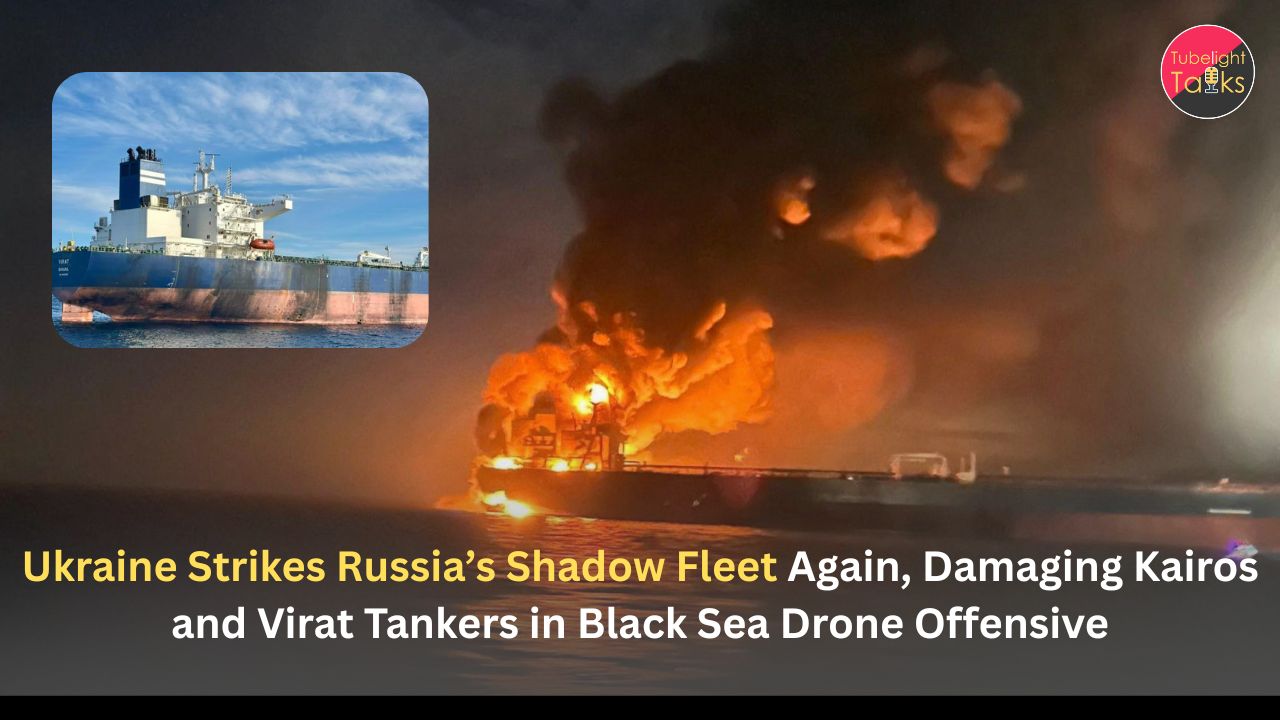
Ukraine Strikes Russia’s Shadow Fleet Again, Damaging Kairos and Virat Tankers in Black Sea Drone Offensive
Ukraine Strikes Russia’s Shadow Fleet: Ukraine has intensified its maritime campaign in the Black Sea after deploying domestically produced Sea Baby naval drones to strike two sanctioned Russian-linked oil tankers — Kairos and Virat. The dramatic twin attacks, captured in explosive footage, set off fires, triggered rescue operations by Turkey, disrupted one of the world’s key oil corridors, and marked a deeper escalation in Kyiv’s effort to cripple Russia’s wartime revenue.
The strikes coincided with Ukraine’s peace delegation travelling to the United States, creating a rare moment where diplomatic efforts and frontline escalations unfolded in parallel across two continents.
Key Takeaways on Ukraine’s Black Sea Drone Offensive and the Damage to Russia’s Shadow Fleet
- Ukraine struck two sanctioned tankers — Kairos and Virat — using Sea Baby naval drones, inflicting critical damage and rendering both vessels inoperable.
- Dramatic footage showed explosive impacts as drones raced toward the hulking tankers, igniting fires and structural destruction.
- Kairos caught fire after a massive blast, while Virat was hit twice, suffering starboard-side damage but remaining stable.
- The strikes occurred inside Turkey’s Exclusive Economic Zone, prompting navigational warnings and emergency response operations.
- The attack forced the Caspian Pipeline Consortium (CPC) to halt loading after one of its Novorossiysk mooring points was significantly damaged.
- Both tankers are part of Russia’s “shadow fleet,” used to quietly transport oil and bypass Western sanctions.
- Amid the strikes, a Ukrainian delegation led by Rustem Umerov travelled to the U.S. for crucial peace negotiations.
- Russia has not issued any public comment on the tanker attacks.
Ukraine Targets Russia’s Sanction-Evading Shadow Fleet
Ukraine confirmed that the operation was carried out jointly by the Security Service of Ukraine (SBU) and the navy using Sea Baby naval drones, explosive-packed unmanned vessels engineered to deliver pinpoint strikes. These drones have become central to Kyiv’s evolving maritime strategy, enabling high-impact attacks deep inside the Black Sea.
The targeted tankers, Kairos and Virat, are part of Russia’s “shadow fleet” — a network of aging, often uninsured vessels operating under obscure ownership and foreign flags to evade Western sanctions imposed after the 2022 invasion. According to Ukrainian officials, disabling these vessels deals a direct blow to Moscow’s wartime oil revenue.
The SBU stated the tankers were capable of transporting up to $70 million worth of oil, underscoring the economic significance of the operation.
How the Strikes Unfolded: Explosions, Fires and Turkish Rescue Efforts
The Attack on Kairos
The 274-meter Kairos, which was travelling empty from Egypt toward Russia’s Novorossiysk port, suffered a violent explosion late Friday. The blast triggered a major fire that continued to burn within the ship’s enclosed compartments.
Turkey’s Transport Ministry confirmed that all 25 crew members were safely evacuated by rescue boats as firefighting operations continued.
The Attack on Virat
The Virat, also Gambia-flagged and tied to Russia’s shadow fleet, was first hit 35 nautical miles off the Turkish coast. Hours later, unmanned vessels struck the tanker again, causing minor starboard-side damage above the waterline.
Early reports suggested a fire in the engine room, but Turkish authorities clarified that the vessel was not ablaze and remained structurally stable. All crew members were reported safe and in good health.
Footage released by Ukrainian officials showed Sea Baby drones hurtling across the Black Sea before detonating into fireballs — a visual testament to Kyiv’s expanding drone capabilities.
Turkey Warns of Navigational Risks in Its Exclusive Economic Zone
The strikes took place within Turkey’s Exclusive Economic Zone (EEZ), prompting swift action from Ankara. Turkish authorities warned of serious navigational hazards and said investigators were assessing signs of external impact, including the possibility of mines, missiles, drones, or underwater explosive devices.
Turkey emphasized that it was communicating with multiple international parties to prevent further escalation and safeguard the region’s economic and maritime interests. These incidents also underline the Black Sea’s increasing volatility, now shaped by both military operations and energy-transport vulnerabilities.
Caspian Pipeline Consortium Halts Loading After Drone Damage
In a separate yet connected event, the Caspian Pipeline Consortium (CPC) — responsible for transporting more than 1% of the world’s oil supply — halted loading operations after a Ukrainian naval drone severely damaged a mooring point at Russia’s Novorossiysk terminal.
The CPC primarily carries Kazakh crude to global markets via Russia. Kazakhstan condemned the attack as unacceptable, expressing concern over the impact on regional energy stability.
The damage adds immediate logistical pressure to global oil flows and further intensifies the conflict’s economic consequences.
Russia’s Shadow Fleet: A High-Risk Network Under Growing Pressure
OpenSanctions data lists both Kairos and Virat as sanctioned vessels operating under the shadow fleet’s umbrella. These tankers frequently:
- Switch flags to evade scrutiny
- Sail without proper insurance
- Use complex ownership structures to conceal Russian ties
- Employ irregular or risky maritime routes
Virat, built in 2018, previously sailed under the flags of Barbados, Comoros, Liberia and Panama. Kairos, built in 2002, has formerly been flagged under Panama, Greece and Liberia.
Also Read: Oil Prices Slide on Oversupply Concerns and Trade Tensions
Ukraine argues that targeting these vessels is essential to undermining Russia’s wartime economy.
Diplomatic Tensions Rise as Ukraine Sends Delegation to the U.S.
As the Black Sea attacks unfolded, Ukraine announced that a delegation led by National Security Chief Rustem Umerov was travelling to the United States for renewed peace talks.
They are expected to meet:
- U.S. Secretary of State Marco Rubio
- Special Envoy Steve Witkoff
- Jared Kushner, senior White House figure
These talks follow former Chief of Staff Andrii Yermak’s resignation after a corruption investigation, leaving the Ukrainian negotiation team reshuffled at a critical diplomatic moment.
Also Read: Russia Prepares for Nuclear Test With Draft Proposal Ready, Says Lavrov
President Zelenskyy said the American side was adopting a “constructive approach”, adding that steps to reach a “dignified end” to the war could emerge in the coming days.
Meanwhile, Russia Launches Another Wave of Attacks on Ukraine
Parallel to maritime tensions, Russia fired 36 cruise and ballistic missiles and launched nearly 600 drones overnight.
Ukrainian officials reported:
- Three deaths in and around Kyiv
- Two deaths in Dnipropetrovsk
- One death in Kherson
- 29 injured in Kyiv, many due to falling debris
Energy infrastructure was damaged, temporarily cutting power to hundreds of thousands in the capital before restoration teams stabilised supply. Kyiv described the assaults as part of Moscow’s ongoing strategy to “weaponise the cold” during winter months.
Spiritual Insight: How Saint Rampal Ji Maharaj’s Knowledge Guides Humanity Amid Global Conflicts
In a world shaken by wars, geopolitical tensions, and the struggle for dominance, the spiritual teachings of Saint Rampal Ji Maharaj offer a transformative path rooted in peace, truth, and universal welfare. His divine knowledge explains that lasting harmony cannot be achieved through weapons or negotiations alone but through understanding the Supreme God, adopting devotion based on true scriptures, and living a morally disciplined life.
Saint Rampal Ji Maharaj emphasizes that when humans detach from hatred, greed and violence, the world naturally moves toward stability. His spiritual guidance inspires individuals to rise above conflict, recognise the futility of destruction, and embrace a way of life that promotes global unity, compassion, and meaningful coexistence — values urgently needed during such turbulent international crises.
A Defining Shift in Maritime Warfare and Geopolitical Pressure
Ukraine’s high-precision strikes on the Kairos and Virat tankers signal a pivotal evolution in the conflict — one where economic warfare, drone innovation and diplomatic manoeuvring intersect simultaneously.
By targeting the vessels that support Russia’s shadow fleet, Kyiv is striking at the financial infrastructure that fuels Moscow’s war effort. With peace talks opening in the U.S. and global energy routes rattled, the Black Sea has rapidly emerged as one of the most consequential battlegrounds of the war.
FAQs on Ukraine Strikes Russia’s Shadow Fleet
1. Why did Ukraine strike the Kairos and Virat tankers?
Ukraine targeted the sanctioned tankers to disrupt Russia’s shadow fleet and weaken Moscow’s wartime oil revenue using Sea Baby naval drones.
2. What damage did the drone strikes cause to Kairos and Virat?
Kairos caught fire after a major explosion; Virat was hit twice, sustaining minor starboard-side damage but remaining stable with all crew safe.
3. Where did the Black Sea tanker attacks occur?
Both strikes happened inside Turkey’s Exclusive Economic Zone, prompting Turkish rescue operations and warnings over navigational safety.
4. What impact did the attacks have on global oil movement?
The Caspian Pipeline Consortium halted loading at Novorossiysk after a drone damaged a key mooring point, affecting over 1% of global oil flow.
5. Were there any diplomatic developments linked to the strikes?
Yes. A Ukrainian delegation led by Rustem Umerov travelled to the U.S. for renewed peace talks as Russia launched fresh missile and drone attacks on Ukraine.
Related Stories









Discussion (0)