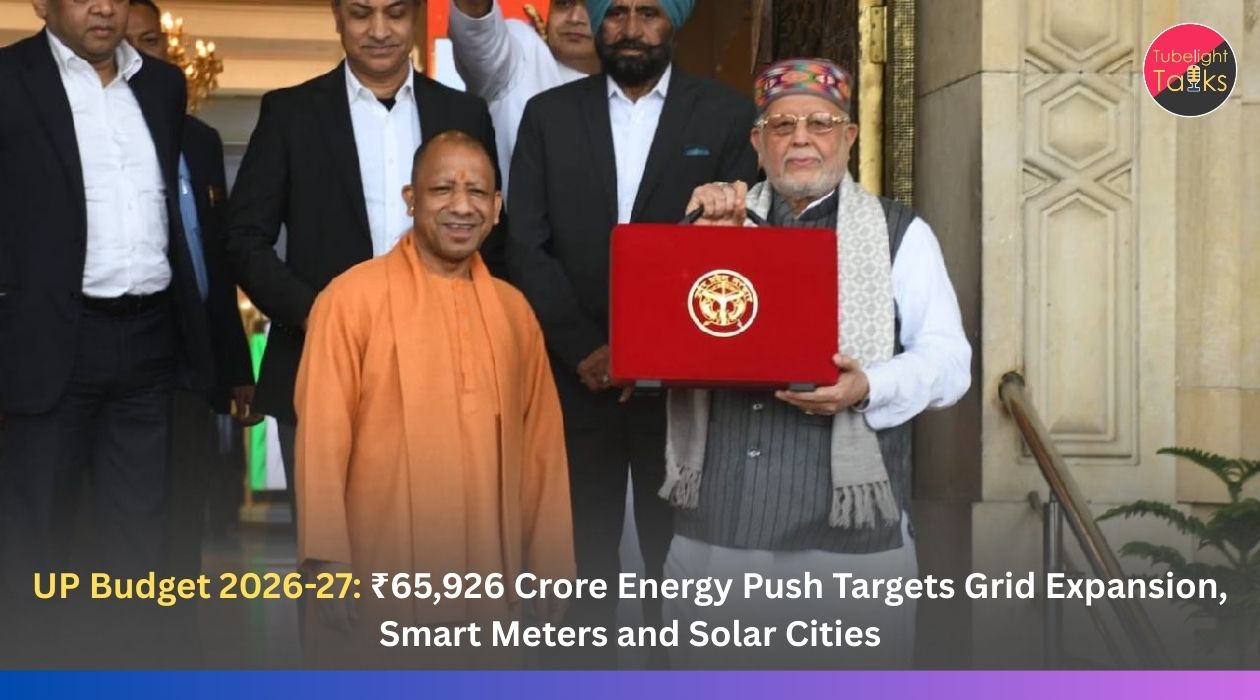
UP Budget 2026-27: ₹65,926 Crore Energy Push Targets Grid Expansion, Smart Meters and Solar Cities
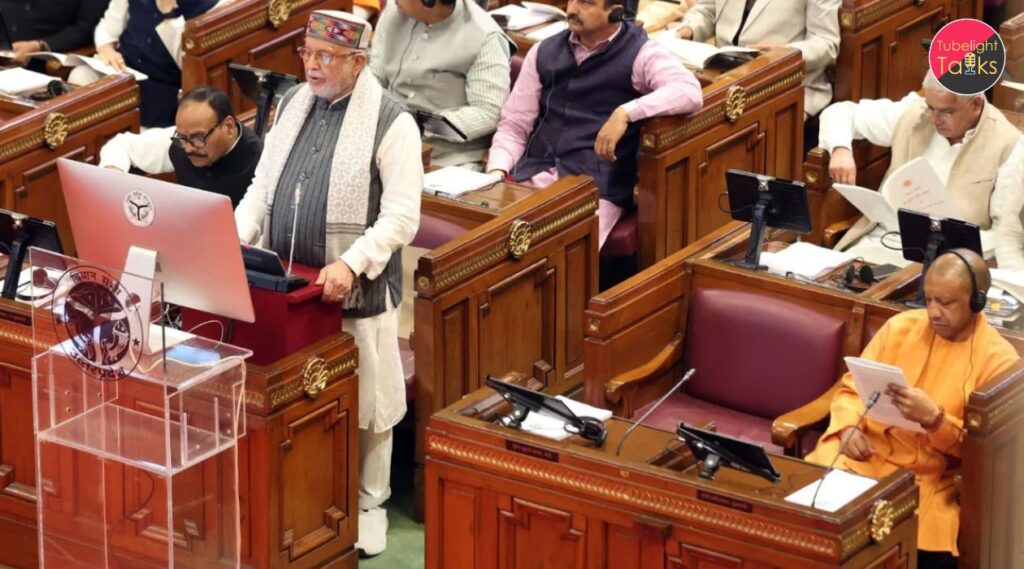
UP Budget 2026-27, presented in the state Assembly with a record outlay of about ₹9.12 lakh crore, puts the energy sector in sharp focus with a ₹65,926 crore allocation. The headline isn’t just “more money”; it’s where the money is pointing—grid reinforcement, distribution reforms through smart meters, and a visibly urban-facing renewable push through solar cities.
With demand rising from agriculture, industry and fast-growing digital infrastructure, the state is trying to ensure that reliability improves while clean energy scales up in parallel.
The headline numbers: energy spend rises, renewables get a sharper lane
In Budget 2026-27, Uttar Pradesh has earmarked ₹65,926 crore for the energy sector and ₹2,104 crore for renewable/additional energy sources—figures that multiple reports and the budget highlights have placed at the centre of the fiscal plan.
The political messaging around this allocation is notable: the state is framing energy not as a “supporting service” but as a growth engine. Capital expenditure has also been emphasised at 19.5% of total outlay—an infrastructure-heavy approach that aligns with the “assets on the ground” theme repeatedly referenced by the finance minister in interviews.
Grid reinforcement: substations, transformers, and the “backbone” logic
The most concrete part of the plan is physical network strengthening. According to reporting on the budget’s grid track record between April 2022 and December 2025, the state constructed/augmented 2,410 new 33/11 kV substations, installed over 20,900 distribution transformers, and enhanced capacity of more than 85,000 transformers.
This matters because grid expansion is not glamorous, but it is the difference between “announcing renewable targets” and actually absorbing renewable power without frequent trips, voltage swings, and feeder-level failures. In the same interview coverage, the finance minister underlined the rationale in plain words: “We are reinforcing the system in advance.”
Also Read: Budget 2026: Relief or Gimmick Ahead of Elections?
Supply hours: reliability is being used as the proof-point
UP’s energy story in recent years has often been judged by a basic question people ask at home: “Bijli kitni aa rahi hai?” Budget-linked reporting says that by December 2025, average availability was around 19 hours in rural areas, nearly 22 hours at tehsil headquarters, and 24 hours at district headquarters.
The state is also highlighting feeder-level improvements for agriculture: budget speech details mention 4,048 agriculture feeders where electricity availability is stated as 10 hours per day, along with 7,117 new or strengthened “power sub-stations” built/augmented between 2017-18 and Dec 2025.
Transmission capacity: scaling the “highway” for rising demand
A modern economy does not only need local distribution; it needs transmission headroom. Budget speech data highlights that UP’s transmission capacity rose from 17,890 MW (2016-17) to 32,500 MW, described as an 82% increase.
That expansion becomes especially important when you look at the new demand sources being discussed—industrial corridors, logistics, and data centres. Reports explicitly connect the strengthened grid with the ability to handle higher loads and renewable integration at the same time.
Smart meters + RDSS: distribution reforms move into the billing layer
Grid strength is half the story; billing and loss reduction is the other half. Budget-linked coverage points to a major allocation for smart metering and RDSS-linked distribution works. One report lists ₹4,155.17 crore for installing smart meters, along with allocations for RDSS loss reduction (₹2,920.99 crore) and a summer-focused reliability/tariff support provision.
Why does this matter? Because smart metering is not just about “digital convenience”—it is tied to collection efficiency, theft control, and ultimately the financial health of DISCOMs. A Ministry of Power PIB release explains RDSS was launched in July 2021 to improve operational efficiency and financial sustainability of distribution utilities, and it explicitly identifies smart metering (consumer meters, distribution transformer meters, feeder meters) as a key initiative.
The same PIB note provides a national context that explains why states are leaning into this: as of 31 Dec 2025, it reports 3.90 crore smart meters installed under RDSS and 5.28 crore overall under various schemes; it also states AT&C losses improved from 21.91% (FY2021) to 15.04% (FY2025), connecting reforms (including smart metering) to measurable outcomes.
Solar cities: the urban renewable story gets a named identity
Perhaps the most publicly visible part of the energy push is the “solar cities” framing. Budget reporting states Ayodhya, Mathura and 17 municipal corporations are being developed as solar cities, with rooftop solar, rural solar street lighting and distributed renewable systems being scaled up.
This is not coming out of nowhere. UP’s Solar Energy Policy 2022 explicitly mentions that “Solar city will be developed in the state,” with emphasis on rooftop solar and related off-grid solar systems—meaning the budget push aligns with an existing policy intent.
Bundelkhand signal: solar + storage and evacuation planning
Beyond rooftops, reporting also indicates utility-scale solar parks paired with battery energy storage are being planned in Bundelkhand—an important signal because storage is what turns “clean energy” into “dispatchable clean energy.”
The policy ecosystem again supports this direction: UP’s Solar Energy Policy 2022 includes promotion of solar projects with storage systems and strengthening transmission for evacuation (including a green energy corridor concept for Bundelkhand).
Agriculture focus: PM-KUSUM funding and pump/feeder solarisation
The budget positions agriculture as a central pillar of the clean energy strategy, including ₹1,500 crore for PM-KUSUM and work around pump solarisation and feeder-level solarisation (reported as around 1,700 MW).
On the scheme side, MNRE describes PM-KUSUM’s objective as adding 34,800 MW solar capacity by March 2026, with components covering decentralised plants, standalone solar pumps, and solarisation of grid-connected pumps (including feeder-level solarisation).
A practical on-ground indicator cited in budget reporting is also worth noting: since April 2022, over 2.41 lakh private tubewell connections were issued—showing that irrigation demand and electrification momentum are real and need stable supply planning.
Green hydrogen: Centres of Excellence and an innovation narrative
UP is also trying to enter the “next decade” energy conversation. Reports say two Centres of Excellence for green hydrogen are being established—one at HBTI Kanpur with IIT Kanpur and another at MMTU Gorakhpur with IIT BHU.
This sits neatly alongside UP’s Green Hydrogen Policy 2024, which talks about developing a green hydrogen/ammonia ecosystem and explicitly mentions setting up Centres of Excellence through educational institutions, along with supportive infrastructure and regulatory facilitation.
Bioenergy and CBG: rural residue to energy economics
Bioenergy is being pitched as another scaleable lane. Budget reporting notes that under the Uttar Pradesh Bio Energy Policy 2022, 36 compressed biogas (CBG) plants have already been set up in the state, and further expansion is being sought by leveraging agricultural residue.
What makes CBG politically and economically attractive is that it connects multiple priorities: farm residue management, rural enterprise, cleaner fuel, and local jobs—without needing “sun hours” or “wind patterns.”
What this means for households: fewer interruptions, more transparency, less guesswork
For a household, the energy budget becomes real in three ways:
- Reliability: Grid reinforcement (substations, transformers, feeder strengthening) is the unspoken driver behind fewer breakdowns and faster restoration. The state is already using reported supply-hour improvements as evidence of why this direction matters.
- Billing clarity: If the smart meter rollout accelerates, consumers can expect more transparent consumption visibility. The PIB note on RDSS explains that smart meters can provide near real-time consumption visibility through mobile applications, along with alerts and historical graphs for usage optimisation.
- Fewer disputes, faster service: While service quality depends on DISCOM execution, smart systems typically reduce “estimated billing” and improve complaint resolution because data is time-stamped and auditable.
A practical tip: If your city is included in the solar cities plan, watch for local awareness drives, rooftop solar facilitation desks, and DISCOM process simplification. In most successful rooftop transitions, the biggest barrier isn’t technology—it’s paperwork and vendor trust.
What it means for farmers: daytime power, solar pumps, and reduced dependency pressure
The Budget’s clean energy and agriculture linkage has a clear logic: stabilise farm energy security and reduce long-term subsidy pressure. That’s exactly how the finance minister is quoted describing the PM-KUSUM approach in budget reporting.
Here’s the “ground reality” breakdown:
- Feeder improvements: The budget speech highlights thousands of agriculture feeders with stated 10-hour availability and grid strengthening works, which directly affects irrigation schedules and crop protection.
- Solar pump pathway: MNRE’s PM-KUSUM structure explicitly covers standalone solar pumps (Component B) and solarisation of grid-connected pumps (Component C), including feeder-level solarisation.
- Local resilience: Solarisation can soften the impact of peak summer shortages because a part of farm load is met locally.
A practical tip: Farmers exploring pump solarisation should ask two questions early: (1) what is the approved vendor list/route in their district, and (2) what after-sales service commitment is written, not promised verbally.
What it means for cities: “solar city” is a brand—execution will be the test
“Solar city” can become a meaningful identity only if it translates into visible urban outcomes:
- Rooftop solar at scale (residential + institutions)
- Solar street lighting and decentralised systems in public spaces
- Net metering simplification and faster approvals
- Urban energy efficiency (LED upgrades, smart public infrastructure)
UP’s Solar Energy Policy 2022 ties solar city development to rooftop and off-grid solar systems—so the budget push can be read as a financing muscle behind that policy statement.
Execution watch: The fastest indicator won’t be “how many cities are named.” It will be (1) how many rooftops are actually commissioned, and (2) whether DISCOMs handle net metering without months-long delays.
What it means for industry and data centres: quality power as a competitiveness tool
Industrial investment decisions don’t just look at “tariff.” They look at quality and predictability:
- Voltage stability (sensitive manufacturing)
- Downtime risk (cost of interruptions)
- Ability to contract renewable power (ESG-linked procurement)
- Grid capacity for expansion
Budget reporting directly links the strengthened grid with rising demand from agriculture, industry and data centres.
If UP can combine grid reliability with solar expansion (including storage-linked parks), it becomes easier to pitch the state as a destination for energy-intensive digital infrastructure—where outages are expensive and reputationally damaging.
The fiscal balancing act: infrastructure-heavy, deficit-capped
Big infrastructure pushes often raise a question: “Is it fiscally sustainable?” Budget reporting notes a 3% fiscal deficit cap and an infrastructure-heavy capex posture (19.5% of the budget).
The underlying strategy being articulated is: build readiness (grid + policy continuity) to crowd in private participation, rather than rely endlessly on open-ended subsidies.
How to judge progress over the next 6–12 months (simple scoreboard)
If you want to track whether UP Budget 2026-27’s energy push is delivering, follow these markers:
- Smart meters installed (monthly pace, city-wise) and consumer feedback trends
- AT&C loss movement (DISCOM-wise), because reforms are aimed at financial sustainability
- Feeder-level improvements (agriculture feeders, hours of supply consistency)
- Rooftop solar commissioning in solar cities (not just registrations)
- Solar + storage project milestones in Bundelkhand (tendering, land, evacuation plan)
- Green hydrogen CoE outputs (training, pilots, industry tie-ups)
- CBG plant additions and feedstock supply chain stability (residue-to-fuel economics)
Responsible Energy Use Builds Stronger Society
A strong grid and clean energy are not only about technology—they reflect collective discipline. Sant Rampal Ji Maharaj’s teachings often use relatable examples to explain that real benefit comes when we follow correct method and rules. In one such explanation, the text compares spiritual guidance with electricity: electricity can provide comfort, but only when we take a proper connection and follow the system; otherwise, it can cause harm.
The same mindset applies to public energy reforms—smart meters, solar cities, and grid upgrades succeed when citizens pay bills honestly, avoid wastage, and support fair systems that reduce losses and improve supply for everyone. Sat Gyaan encourages responsible living and non-wasteful habits, which naturally align with energy efficiency, cleaner power adoption, and using resources for the welfare of all rather than short-term misuse.
Take Action: Make the Energy Push Work at the Ground Level
UP Budget 2026-27 is putting serious weight behind energy reliability and renewables—now the impact depends on public participation and local execution. If your area is part of the solar cities plan, explore rooftop solar options, verify approved processes, and insist on transparent timelines. If smart meters arrive in your locality, learn how to track daily usage, set monthly consumption targets, and reduce wastage—because visibility is power.
Farmers can engage with PM-KUSUM pathways for pumps or feeder solarisation through the proper channels, while RWAs and local bodies can push for solar street lighting and public-building rooftops. When citizens treat electricity as a shared resource—used carefully, paid honestly, and planned wisely—the grid becomes stronger, bills become fairer, and clean energy becomes a lived reality rather than a headline.
FAQs: UP Budget Energy Allocation
1) What is the energy allocation in UP Budget 2026-27?
UP has earmarked ₹65,926 crore for the energy sector in Budget 2026-27.
2) How much has been allocated for renewable or additional energy sources?
Reports and budget highlights mention ₹2,104 crore for renewable/additional energy sources.
3) Which places are being developed as “solar cities”?
Budget reporting says Ayodhya, Mathura and 17 municipal corporations are being developed as solar cities.
4) Why are smart meters such a big part of power reforms?
Under RDSS, smart metering is positioned as a key initiative to improve utility efficiency and enable consumer visibility; PIB also links reforms (including smart metering) to improved AT&C loss outcomes.
5) What does PM-KUSUM cover for farmers?
MNRE describes PM-KUSUM as covering decentralised renewable plants, standalone solar agriculture pumps, and solarisation of grid-connected pumps (including feeder-level solarisation).
6) What’s the green hydrogen plan in this budget cycle?
Budget reporting mentions two Centres of Excellence for green hydrogen (Kanpur and Gorakhpur collaborations), aligning with UP’s Green Hydrogen Policy 2024 that supports ecosystem development and research capacity-building.
Related Stories









Discussion (0)