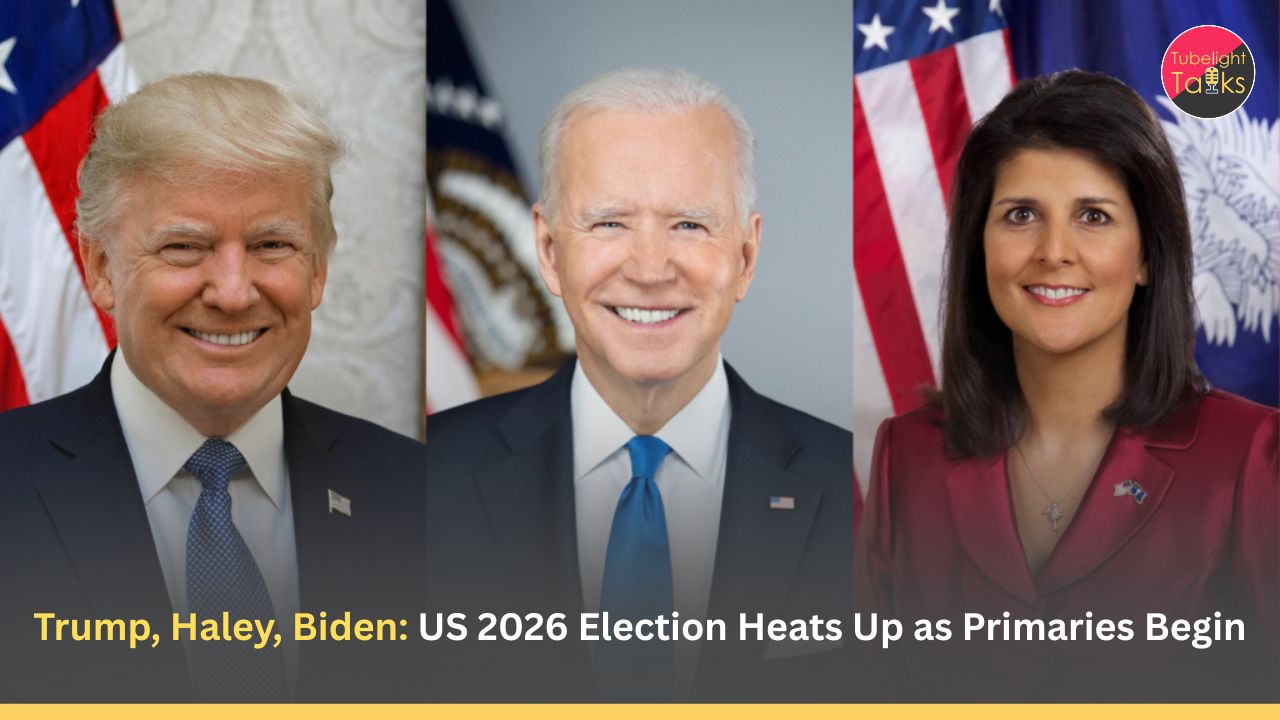
Trump, Haley, Biden: US 2026 Election Heats Up as Primaries Begin
US 2026 Election Heats Up: With the first Republican primary debates concluded and voter sentiment building across key battleground states, the 2026 United States presidential election is gaining momentum. Former President Donald Trump faces a formidable intra-party challenge from Nikki Haley, while incumbent President Joe Biden gears up for a possible second re-election campaign. As party lines sharpen, America’s political future hangs in the balance.
Republican Primaries: Trump vs Haley
Heated Debates and Campaign Trails
The first televised GOP debate saw Donald Trump and Nikki Haley clash on issues ranging from:
- Immigration
- Foreign policy (China and Ukraine)
- Abortion laws
- Economic recovery and inflation
While Trump maintains strong grassroots support, Haley is appealing to moderates and independents.
Recent Gallup poll (Feb 2026):
- Trump: 48%
- Haley: 35%
- Undecided: 17%
(Source:Gallup.com)
Joe Biden’s Re-Election Bid
President Joe Biden has officially filed for re-election, positioning himself as a stabilizing force amid growing polarization.
His campaign focuses on:
- Defending democracy
- Green energy and climate policy
- Affordable healthcare expansion
- Ukraine and NATO support
He faces some dissent within the Democratic Party over age concerns and policy stagnation but remains the clear frontrunner for the nomination.
Also Read: California Voters Approve Proposition 50: Democrats Gain Edge Ahead of 2026 U.S. House Elections
Key Battleground States in Focus
States likely to determine the 2026 outcome include:
- Pennsylvania
- Michigan
- Georgia
- Arizona
- Wisconsin
Both parties are heavily investing in door-to-door campaigns, voter registration, and digital advertising to sway independent voters in these regions.
Voter Sentiment: Deeply Divided
Surveys indicate that:
- 59% of Americans believe the country is on the “wrong track”
- Economic concerns rank highest among voter priorities
- Gun control, abortion rights, and immigration are also top issues
Young voters (ages 18–29) remain the most unpredictable bloc, with a significant percentage showing interest in third-party or independent candidates.
What’s at Stake in 2026?
This election may shape the future of:
- US global leadership
- Climate change commitments
- Federal policy on artificial intelligence and automation
- Domestic unity in a polarized society
Experts warn that turnout levels and independent voter sentiment could dramatically shift final outcomes, as was seen in 2020.
Ethical Leadership in Times of Division
As American voters evaluate political manifestos, debates, and soundbites, a deeper question resonates:
What makes a leader truly worthy?
Ethical leaders aren’t defined by power or slogans, but by their integrity, fairness, and service to the people. In a world overwhelmed by misinformation and division, citizens must choose not just policies, but principles.
History has shown that without ethics and responsibility, even the most powerful democracies can falter.
Now more than ever, the call is clear: vote not just with loyalty, but with conscience.
Call to Action
Lead with Integrity. Vote with Awareness.
As primaries unfold and campaigns intensify, remember—leaders are a reflection of the people’s values.
Demand not just promises, but accountability.
Support leaders who protect truth, justice, and unity—beyond party lines.
In 2026, let’s cast votes not just to elect, but to elevate leadership.
FAQs on US 2026 Election Heats Up
Q1. Who are the top Republican candidates in 2026?
Donald Trump and Nikki Haley are leading the GOP primaries, with Trump currently ahead in early polls.
Q2. Is Joe Biden running again?
Yes, President Joe Biden has filed for re-election and is leading the Democratic race.
Q3. What are key voter concerns?
Top concerns include inflation, healthcare, border control, and national unity.
Q4. Which states are battlegrounds?
Pennsylvania, Georgia, Arizona, Michigan, and Wisconsin are considered crucial swing states.
Q5. Are any third-party candidates running?
Some independent candidates have announced interest, but none currently show significant national traction.
Q6. How important is ethical leadership in elections?
Extremely. Without values like honesty, empathy, and fairness, governance becomes fragile and divisive.
Related Stories










Discussion (0)