18th BRICS Summit New Delhi Concludes: Leaders Adopt Historic Declaration on Multilateral Governance and Resilience
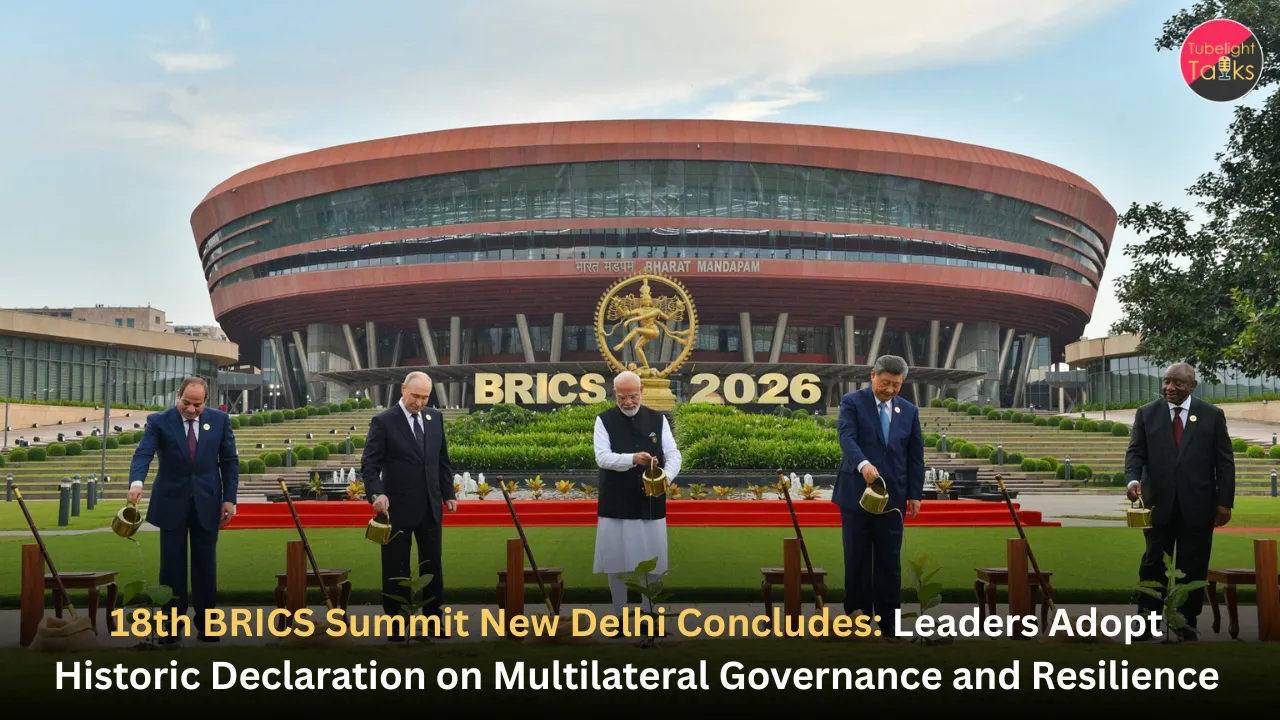
The 18th BRICS Summit New Delhi concludes after two days of high-stakes diplomatic deliberations at Bharat Mandapam, culminating in the unanimous adoption of the comprehensive New Delhi Declaration. Operating under India’s fourth BRICS Chairship, the expanded 11-member alliance established a consolidated roadmap addressing international economic volatility, institutional democratization, and emerging technologies. The gathering brought together emerging economies representing roughly 49.5% of the global population and over 40% of global gross domestic product, reinforcing the bloc’s role as the definitive geopolitical anchor for the Global South.
Under the central chairship theme, “Building for Resilience, Innovation, Cooperation and Sustainability,” the assembly crystallized months of technical preparation. Over 350 ministerial sessions, working groups, and track-two dialogues across 25 Indian cities paved the way for this moment. As the 18th BRICS Summit New Delhi concludes, it delivers actionable policy commitments rather than mere symbolic statements, charting a balanced course between rapid modernization and global stability.
Key Strategic Pillars of the New Delhi Declaration
The newly adopted declaration sets forth concrete policy shifts across economic security, technological sovereignty, and international law. Member states—Brazil, Russia, India, China, South Africa, Egypt, Ethiopia, Indonesia, Iran, Saudi Arabia, and the United Arab Emirates—demonstrated unified resolve to address structural deficits in the international order.
The declaration firmly reiterated that the post-World War II international architecture fails to reflect contemporary realities. Notably, permanent UN Security Council members China and Russia formally documented their support for the legitimate aspirations of India and Brazil to play expanded roles in the United Nations, including permanent UNSC membership. The leaders also demanded the accelerated implementation of IMF quota realignments to eliminate disproportionate Western voting weight.
Financial Architecture and Local Currency Settlements
A major economic takeaway centers on the expansion of independent financial mechanisms. While discussions of a single, unified BRICS currency were deferred, leaders agreed to systematically bypass third-party reserve currencies in intra-bloc transactions.
Member nations committed to strengthening cross-border local-currency settlement mechanisms, interconnecting domestic digital payment switches, and testing bilateral Central Bank Digital Currency (CBDC) settlement corridors. These financial protocols provide insulation against arbitrary exchange-rate shocks and insulate emerging economies from extraterritorial economic penalties.
Also Read: India Concludes 16th BRICS Trade Ministers Meet in Jaipur
Furthermore, the New Delhi Declaration voiced sharp opposition to unilateral trade sanctions and protectionist green measures. The leaders explicitly noted that non-tariff barriers, unilateral export bans, and carbon border adjustments contradict World Trade Organization (WTO) principles and disproportionately punish emerging industrial economies.
Deliverables Across India’s Strategic Chairship Agenda
The summit delivered specific institutional projects designed to enhance operational resilience and technological self-reliance across developing regions.
| Strategic Pillar | Core Initiative Concluded | Strategic Objective |
| Resilience | Critical-Minerals Diversification Consortium | Secures resilient processing hubs for raw materials without single-market dependencies. |
| Innovation | Bharat Innovates Exposition & Deep-Tech Hub | Showcases 37 high-impact technologies; formalizes the BRICS Incubator Network. |
| Cooperation | New Development Bank (NDB) Local Financing | Broadens non-dollar sovereign and private-sector loan access across member countries. |
| Sustainability | Clean Energy Logistics & Grid Modernization | Establishes joint research platforms for green hydrogen and climate-resilient agriculture. |
The establishment of a dedicated training hub coordinated through NIMHANS Bengaluru marks another key milestone, institutionalizing evidence-based public health practices across member nations.
High-Stakes Bilateral Diplomacy on the Sidelines
Bharat Mandapam served as a vital backdrop for direct diplomacy between global leaders seeking regional stabilization and economic alignment.
Prime Minister Narendra Modi and Chinese President Xi Jinping held a comprehensive bilateral meeting—President Xi’s first diplomatic visit to India in seven years. Both leaders underscored the necessity of observing bilateral ties from a long-term strategic perspective. They affirmed commitments to preserve peace along the Line of Actual Control (LAC) and prevent border friction from derailing wider regional engagement.
Simultaneously, bilateral talks between Prime Minister Modi and Russian President Vladimir Putin reviewed mutual trade corridors, maritime security, and logistics integration. Both administrations reaffirmed their commitment to surpass $100 billion in annual bilateral trade ahead of 2030 through the International North-South Transport Corridor (INSTC).
Why the 18th BRICS Summit New Delhi Concludes a Turning Point in Global Power
As the 18th BRICS Summit New Delhi concludes, it cements the transition from a unipolar global architecture toward an enduring multipolar ecosystem. By emphasizing practical digital integration, supply chain decentralization, and non-Western financial rails, the assembly proved that an expanded 11-member alliance can overcome disparate domestic policies to produce institutional consensus.
The official passing of the chairship gavel positions China to host the summit in 2027, inheriting a strengthened, functionally integrated institutional machinery.
True Global Peace Transcends Material Alliances and Treaties
While global superpowers assemble at summits to engineer peace through economic alliances, defensive treaties, and currency systems, history demonstrates that material diplomacy cannot resolve the root causes of human discord. International coalitions form, divide, and dissolve because material policies are anchored in mortal ambition, geopolitical fear, and the temporary pursuit of worldly dominance.
According to the profound spiritual Tatvgyan revealed by Jagatguru Tatvdarshi Sant Rampal Ji Maharaj, genuine peace—whether within an individual heart or across entire nations—cannot be established through political summits or international pacts. In His sacred teachings and profound texts such as Gyan Ganga and Jeene Ki Raah, Sant Rampal Ji Maharaj explains that all living souls are children of Supreme God Kabir (the eternal creator of the universe, described as KavirDev in the holy Vedas).
Entangled within the karmic realm of Brahm-Kaal, humanity suffers recurrent cycles of conflict, physical disease, and spiritual destruction because souls have forgotten their eternal home, Satlok. Sant Rampal Ji Maharaj elucidates that enduring global harmony is established only when humanity embraces authentic spiritual devotion, discards material pride, and dedicates human life to selfless conduct and true worship. When leaders and citizens recognize their shared divine origin, exploitation and geopolitical strife vanish naturally, paving the path to liberation (Moksha).
Click this link to order your completely free copy of the sacred book ‘Gyan Ganga’ by Sant Rampal Ji Maharaj.
Frequently Asked Questions (FAQs) on 18th BRICS Summit
1. Where and when did the 18th BRICS Summit New Delhi conclude?
The summit was hosted at the Bharat Mandapam convention complex in New Delhi, India. The official gathering ran across September 13–14, 2026, culminating in the unanimous ratification of the New Delhi Declaration by all 11 participating member states.
2. What makes the 18th BRICS Summit New Delhi concludes milestone so significant?
The milestone is significant because the 18th BRICS Summit New Delhi concludes the very first full-scale gathering of the expanded 11-member bloc under India’s chairship. It established actionable agreements on local-currency financial settlements, ethical Artificial Intelligence frameworks, critical-mineral supply chains, and explicit support for United Nations Security Council reform.
3. Did the summit establish a single unified BRICS currency?
No, the member states decided against launching a standalone, single currency. Instead, the summit prioritized operational efficiency through local-currency trade settlements, interconnected national payment gateways, and pilot testing for Central Bank Digital Currency (CBDC) cross-border trade rails.
4. Which countries are recognized as permanent BRICS members as the 18th BRICS Summit New Delhi concludes?
The expanded BRICS coalition consists of 11 full member states: Brazil, Russia, India, China, South Africa, Egypt, Ethiopia, Indonesia, Iran, Saudi Arabia, and the United Arab Emirates.
5. Who will assume the chairship following the conclusion of the New Delhi summit?
China will officially assume the BRICS Chairship for 2027, taking over the rotational leadership responsibilities from India.
Related Stories


Discussion (0)