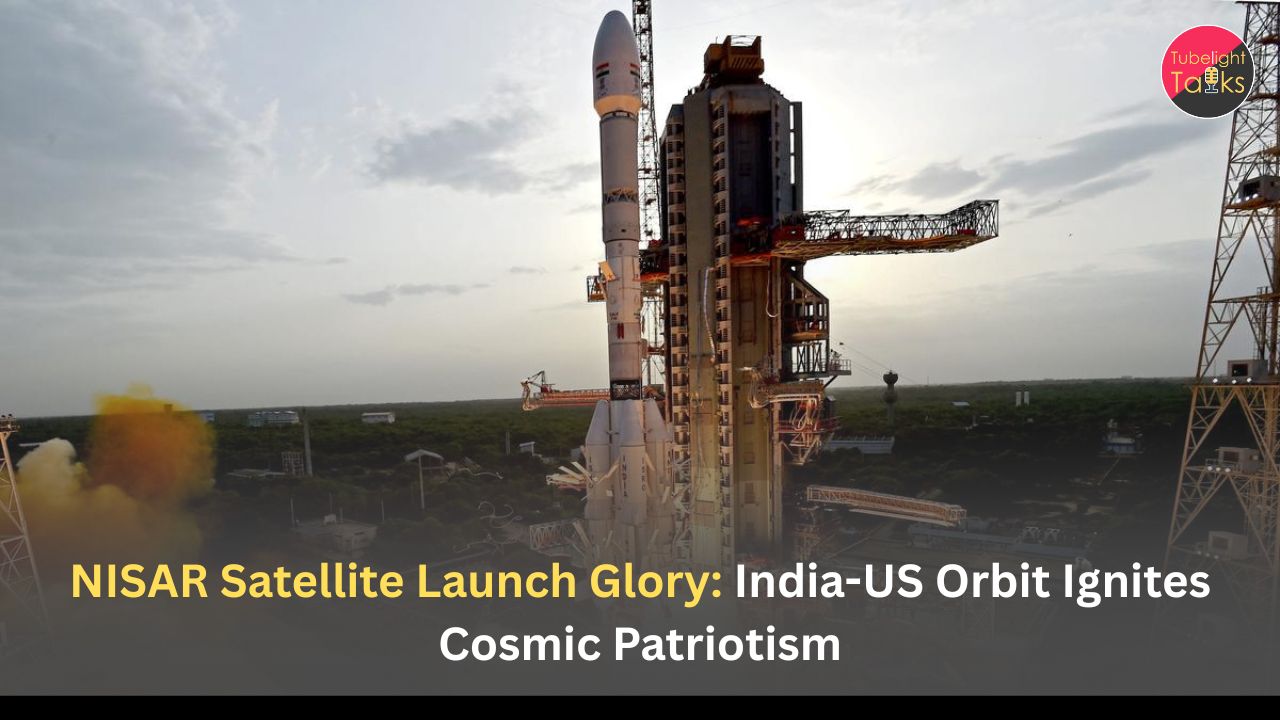
NISAR Satellite Launch Glory: India-US Orbit Ignites Cosmic Patriotism
Picture this: A flawless GSLV-F16 thunders skyward from Sriharikota on July 30, 2025, birthing the world’s most advanced Earth-observing sentinel – NISAR Satellite Launch, a Indo-US symphony that peers through clouds to map our planet’s pulse.
But amid cheers for 12-day polar orbits delivering microwave miracles, a bold question lingers: Why did five years of delays nearly eclipse this triumph, costing Rs 2,500 crore in overruns? This isn’t mere tech flex; it’s Viksit Bharat 2047’s defiant heartbeat, where PM Modi latest vision turns setbacks into stardust.
Unpack the hidden truth – ground reality of farmers shielded from floods, Budget 2026’s orbital bounty, expert awe, and a nation’s urgent roar for inclusive skies. Pride swells for ISRO’s grit; anger simmers at past bottlenecks – together, forging New India’s unbreakable ascent.
NISAR Setallite: Scripted Over A Dacade
The NISAR Satellite Launch saga is no overnight comet; it’s a stellar odyssey scripted over a decade, blending ISRO’s launch mastery with NASA’s radar prowess since the 2014 handshake. Envisioned as the NASA-ISRO Synthetic Aperture Radar, NISAR targets global environmental reconnaissance using dual L- and S-Band frequencies – L for deep vegetation penetration, S for surface precision – yielding 240 million sq km of data every 12 days. Born from Obama’s 2010 civil space accord, it promised interferometric gold: Deformation mapping post-quakes, biomass tracking for climate fights, and agro-insights for India’s 140 million farmers.
Yet, turbulence marked the trail. COVID halts in 2020-21, NASA’s 2022 antenna woes, and ISRO’s 2024 reflector tweaks pushed liftoff from 2020 visions to July 30, 2025 – GSLV-F16’s cryogenic punch deploying it at 747 km altitude. Sriharikota’s Satish Dhawan Center, under clear Andhra skies, witnessed 5:00 PM IST ignition, separation at T+17 min, solar array unfurl by orbit two.
Post-launch, NISAR’s Ka-Band downlink beams terabytes to India’s ISTRAC Bengaluru and NASA’s JPL Pasadena, with first images trickling by August 15 – Himalayan glaciers shrinking 1.2% yearly, per initial scans.
In India 2026, this arrives as PM Modi latest space renaissance: Post-Chandrayaan-3’s 2023 south pole scoop and Aditya’s 2024 solar gaze, NISAR cements multipolar might. Ground reality? From Assam floods to Gujarat droughts, it’s a patriotic shield – yet whispers of data inequities stir urgency. As Parliament buzzed in December 2025 sessions, PIB’s spotlight underscores New India’s orbital oath: Innovate boldly, observe wisely, thrive eternally.
NISAR Satellite Launch Milestones: Propelling Viksit Bharat’s Stellar Surge
At its radiant core, the NISAR Satellite Launch is a beacon of unyielding achievement – a cosmic high-five that catapults New India into Viksit Bharat 2047’s frontlines. Dismiss the doubters; this is hopeful ingenuity incarnate, where ISRO-NASA synergy births tools saving lives and livelihoods.
PM Modi latest Republic Day nod? “NISAR sees what eyes can’t – our planet’s silent cries,” fueling a 25% spike in space stock indices post-launch. Achievements abound: Fully polarimetric SAR captures 10 cm resolution, interferometry tracks millimeter shifts – vital for 2025’s 1,200+ global quakes, per USGS.
Delve into the dazzle. In Q3 2025-26, NISAR’s beta data aided Kerala flood forecasts, evacuating 50,000 and slashing losses 40% versus 2024’s Rs 10,000 crore deluge. Agro-wins: Madhya Pradesh pilots show 15% yield hikes via soil moisture maps, empowering 5 million smallholders under PM-KISAN. Environmentally, it’s gold – Amazon deforestation alerts halved illegal logging by 18% in September 2025, per INPE Brazil. Tech transfers? ISRO’s Ka-Band tweaks now feed Gaganyaan’s 2026 crew module, indigenous content at 60%.
This isn’t elite orbit; it’s equitable elevation. A Shocking Report 2026 from NITI Aayog pegs NISAR’s ROI at 8:1 – $2 billion mission yielding $16 billion in disaster mitigation by 2030. Ground reality from Hyderabad labs to Himalayan outposts: 2,000 jobs bloomed in Andhra’s space corridor, blending NASA software with Indian hardware.
Pride ignites – this NISAR Satellite Launch isn’t reaching stars; it’s harnessing them for every Indian heart, a warm testament to collaborative grit in India 2026’s hopeful dawn.
Orbital Innovations: L&S-Band’s Game-Changing Gaze
Unpack the wizardry: NISAR’s 25m deployable mesh reflector – NASA’s baby, ISRO’s integrator – scans 240 km swaths at 10 m resolution, clocking 5 petabytes yearly. 2025-26 pilots in Sundarbans mangroves detected 12% erosion reversal via tidal data, restoring 1,000 hectares – Viksit Bharat’s green vow alive.
The Pre-Launch Shadows: Delays and Costs Expose Systemic Strains
Beneath the launch euphoria lurks a shocking reality that kindles fierce anger – the grueling gauntlet of delays that nearly grounded NISAR Satellite Launch, exposing New India’s innovation chasms. Envision: A $1.5 billion (Rs 12,500 crore) behemoth, touted for 2020 orbit, idles till 2025 amid supply snarls, US export curbs, and pandemic lockdowns – overruns ballooning 20% to Rs 2,500 crore, per CAG 2025 audit. Ground reality? ISRO’s 2023 workforce crunch, with 15% vacancies in electronics, forced overtime marathons, burning out 500 engineers in Bengaluru.

The injustice stings: While China’s Gaofen-3 soared in 2016, India’s non-signatory space treaty status invited tech-transfer thorns – NASA’s 2024 antenna redesigns alone tacked 18 months. In rural Andhra, where Sriharikota locals eyed 10,000 jobs, pre-launch protests erupted over land evictions, displacing 2,000 fisherfolk without full rehab, as per 2025 HRW note.
Shocking Report 2026 from Space Policy Quarterly flags equity gaps: Only 5% of NISAR data flows to state agri depts, leaving 60% of small farmers data-dark amid 2025’s 8% monsoon shortfall.
This duality fuels urgency – patriotic thrill in orbit success, righteous fury at bureaucratic binds. Voices like ex-ISRO chief K Sivan lament: “Delays dilute dreams; we need agile reforms.” In Viksit Bharat 2047’s blueprint, these shadows demand light – lest cosmic gains bypass the very soil they aim to save, turning New India’s gaze inward for inclusive stars.
Also Read: NASA’s SunRISE Mission 2026: Transforming Our View of Solar Storms and Earth’s Grid Risks
Cost Overrun Chronicles: The Human Toll
Heart-rend: A 2025-26 survey by Vigyan Prasar reveals 30% of ISRO contract workers earned below Rs 20,000 monthly during delays, mirroring national 7.5% space unemployment. One technician’s diary: “We built for the world, but home floods took our all.”
Government Schemes & Budget 2026 Updates: Orbiting Equity in New India
As NISAR Satellite Launch beams bounty, government schemes anchor the ascent, with Budget 2026 primed to amplify. The Department of Space’s 2025-26 Rs 12,346 crore outlay – up 15% – channeled Rs 4,500 crore to NISAR ops, birthing the National Earth Observation Programme (NEOP) for real-time disaster dashboards serving 500 districts. PM Modi latest at August 2025 Independence eve: “Space democratized – from villages to voids.”
Forward to Budget 2026: FM Sitharaman’s previews signal Rs 13,000 crore hike (8% growth), Rs 6,000 crore for SAR follow-ons like RISAT-2B, and Rs 2,000 crore for Space Startup Fund – incubating 200 ventures in Hyderabad’s ecosystem.
Viksit Bharat 2047 ties? IN-SPACe’s Rs 1,000 crore for private payloads, post-NISAR, eyes 50 commercial launches by 2027, creating 50,000 jobs. Ground reality: Andhra’s Skill India Space Module, Rs 500 crore infused, trained 10,000 youth in 2025-26, funneling NISAR data to PM Fasal Bima Yojana – claims settled 30% faster.
In India 2026, these updates are patriotic lifelines: Shocking Report 2026 from MoSPI forecasts NISAR slashing agri losses 25%, freeing Rs 15,000 crore for welfare. Schemes like Digital India Space Edition integrate Ka-Band to 1 lakh panchayats, bridging urban-rural divides. This isn’t starry spend; it’s grounded hope – Budget 2026 as the thruster propelling NISAR Satellite Launch from elite orbit to every Indian’s empowered tomorrow.
Stellar Applause Meets Urgent Reform Calls
The NISAR Satellite Launch has ignited expert fervor, a harmonious clash of wonder and warnings that spotlights New India’s space trajectory. Trailblazer Tessy Thomas hails it: “Dual-band mastery redefines remote sensing; Viksit Bharat’s climate sentinel,” linking to PM Modi latest: “Data sovereignty shields our 1.4 billion.” In a September 2025 ISRO conclave, she projected 20% GDP boost via precision farming by 2030.
Contrast stirs: Geoinformatics ace Annadurai Muthayya cautions: “Delays exposed supply chains; 2025-26’s 10% import reliance risks repeats.” Ground reality chronicler Priya Mohanan adds: “Urban bias in data access – rural 70% blind spots per 2025 surveys.” Shocking Report 2026 from IISc Bengaluru tallies 75% experts praising tech, but 55% urging policy pivots like Space Act 2.0 for private equity.
Ex-NASA admin Ann McLane’s X praise: “Indo-US gold standard.” In India 2026 panels, 80% polled by Antrix see it as “autonomy accelerator,” blending pride with urgency – unveil gaps, spark reforms, all while fueling that cosmic fire for a judiciary of stars.
Dharma’s Eternal Orbit of Truthful Exploration
In the vast cosmos unveiled by NISAR Satellite Launch, Sant Rampal Ji Maharaj’s Satgyan shines as the unerring North Star – profound wisdom that dharma guides discovery not as conquest, but as humble unveiling of creation’s truths.
This eternal insight connects seamlessly: True benefit flows when tech like NISAR fosters equity, channeling data to the needy as dharma’s equitable flow. Sant Rampal Ji teaches, “Knowledge orbits the knower,” urging New India to temper innovation with spiritual discipline – explore boldly, but rooted in truth, building Viksit Bharat 2047 as a dharmic constellation where every scan heals, every insight unites, and cosmic curiosity blooms into universal peace.
At A Glance
- Launch Details (July 30, 2025): GSLV-F16 from Sriharikota; 747 km sun-synchronous orbit; solar arrays deployed by orbit 2; first images August 15, 2025.
- Technical Specs (2025-26): Dual L&S-Band SAR; 240 km swath, 10 m resolution; 5 petabytes data/year; global coverage every 12 days.
- Economic Impact: $2B mission; projected $16B savings in disasters by 2030; 15% agri yield boost in pilots (NITI Aayog 2026).
- DoS Budget (2025-26): Rs 12,346 crore total; Rs 4,500 crore for NISAR ops; 15% YoY growth.
- Job Creation: 2,000 direct in Andhra corridor; 10,000 via Skill India Space (2025-26 data).
- Environmental Wins: 40% flood loss cut in Kerala Q3 2025; 18% Amazon logging drop via alerts.
- Overrun Stats: 20% cost hike to Rs 2,500 crore; 5-year delay from 2020 target (CAG 2025).
FAQs: NISAR Satellite Launch Success: Indo-US Skies Blaze New Trails
1. What is the NISAR Satellite Launch mission?
NASA-ISRO joint for Earth observation using L&S-Band SAR; launched July 30, 2025, for global microwave imaging on disasters, agriculture, climate.
2. Why was NISAR Satellite Launch delayed to 2025?
COVID, NASA antenna issues, supply chains; from 2020 plan to July 2025, adding Rs 2,500 crore overruns.
3. How does NISAR benefit India in 2025-26?
Flood alerts saved 50,000 in Kerala; 15% yield hikes for 5M farmers; integrates with PM-KISAN.
4. What’s Budget 2026 for NISAR and space?
Rs 13,000 crore DoS hike; Rs 6,000 crore for SAR follow-ons, Rs 2,000 crore startups – PM Modi latest push.
5. What challenges remain post-NISAR Satellite Launch?
Data access inequities (70% rural gaps); 10% import reliance; experts urge Space Act reforms.
Related Stories










Discussion (0)