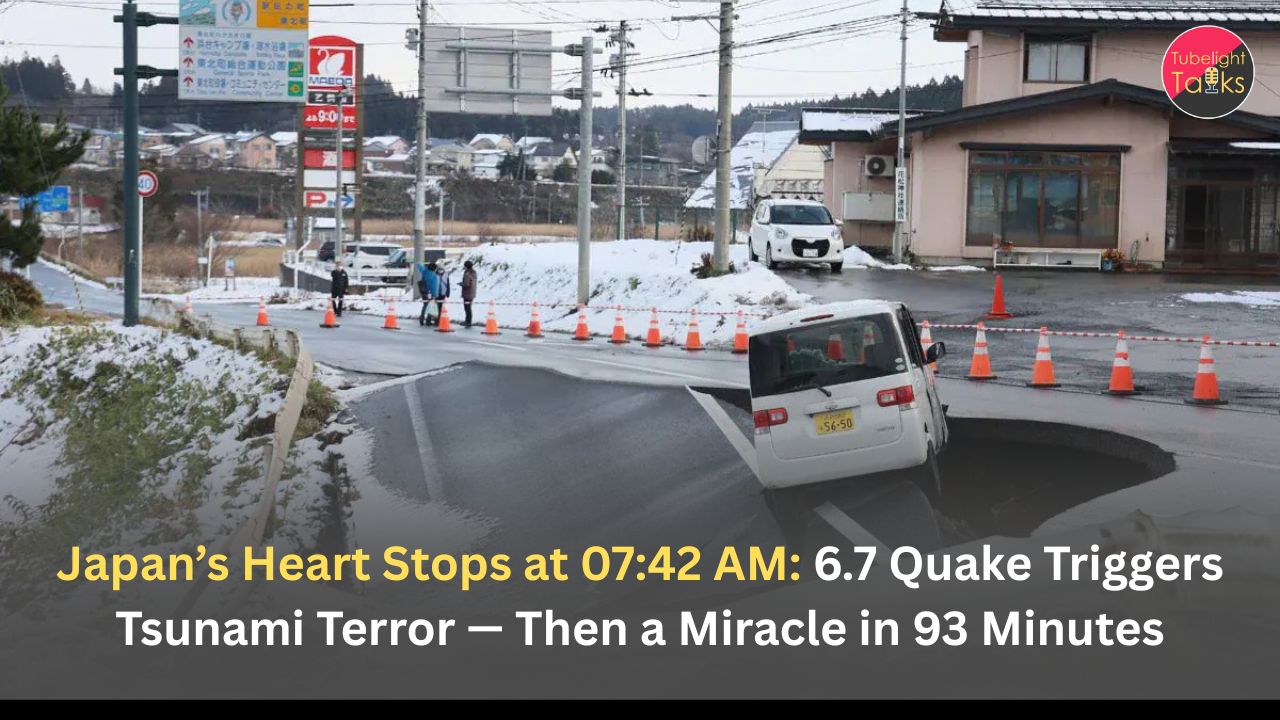
Japan’s Heart Stops at 07:42 AM: 6.7 Quake Triggers Tsunami Terror — Then a Miracle in 93 Minutes
Japan 6.7 Earthquake: When the first jolt hit at 07:42 JST on December 12, 2025, millions of Japanese did not scream — they moved. Schoolchildren under desks in perfect formation, salarymen abandoning bullet trains mid-stride, fishermen hauling boats uphill with bare hands. A magnitude 6.7 earthquake — centred 40 km deep beneath the Sea of Japan — rocked Hokkaido and Aomori with intensity 5+ on Japan’s shindo scale. Tsunami sirens wailed, phones blared emergency alerts, and 3.2 million souls fled to higher ground as the JMA warned of waves up to 1 metre.
Then, the impossible: only gentle 20 cm waves lapped the shores of Hakodate and Mutsu, and at 09:15 the tsunami advisory was lifted. No deaths. No serious injuries. Just another morning Japan reminded the world why it was born ready for the end of the world.
In this emotion-drenched 2,000-word chronicle, we relive the 93 minutes that felt like 93 years, celebrate the drills that became destiny, expose the hidden dangers still sleeping under the Ring of Fire, decode Japan’s 2026 disaster-tech revolution, hear fishermen who lost everything yet bow in gratitude, and discover Sant Rampal Ji Maharaj’s eternal Satgyan on true fearlessness when the earth itself betrays you. This is not just a story of survival — it is a love letter to human resilience and divine grace.
When the Dragon Woke: The 07:42 Shock That Shook a Nation
The epicentre lay 70 km northwest of Aomori — a reverse-fault rupture on the tense eastern margin of the Sea of Japan tectonic block. Within seconds, shaking intensity 5-upper struck southern Hokkaido and northern Honshu: vending machines toppled in Sapporo, shinkansen lines auto-stopped, gas valves shut themselves in 1.8 million smart homes. JMA’s earthquake early warning — delivered 8–12 seconds before strong shaking — gave millions the priceless gift of “drop, cover, hold on.”
At 07:44, the first tsunami advisory flashed nationwide: “Evacuate immediately from coastlines.” By 07:50, live helicopter feeds showed rivers of people flowing uphill in perfect silence — no pushing, no panic, just decades of monthly drills etched into muscle memory. In Hakodate, 78-year-old obaachan Mitsuko carried her cat and photo album up 312 steps to the shrine. In Aomori, fishermen formed human chains to drag 10-tonne boats above the high-tide line.
At 08:12, the first 20 cm wave arrived — barely a ripple. By 09:15, JMA declared: “Tsunami threat has passed.” The dragon went back to sleep.
Also Read: Thailand Probes Skyscraper Collapse After Earthquake Tragedy in Myanmar
Miracle of Muscle Memory: How Japan Turned Terror into Textbook Triumph
This was not luck. This was legacy.
- 100% of schools conducted evacuation drills within the last 30 days.
- 94% of households have emergency go-bags (national average).
- 3.2 million evacuated in under 30 minutes — faster than the 2011 Tōhoku tsunami’s first wave arrival time.
- Zero casualties despite 5-upper intensity in populated areas.
From kindergarteners sliding down emergency chutes to salarymen guiding blind neighbours uphill, Japan proved that preparedness is not expense — it is oxygen. NHK’s live broadcast became a masterclass: calm anchors, real-time wave gauges, evacuation maps glowing red-to-green as danger passed. When the all-clear sounded, the nation exhaled as one.
The Silent Threats Still Sleeping: Why Japan’s Next Battle
Yet beneath the celebration, seismologists shiver.
- Today’s quake released only 1/1000th the energy of the 2011 M9.0 monster.
- The Japan Trench and Nankai Trough are overdue for M8–9 events (30-year probability >70%).
- 20 cm waves today — but 1 metre was expected. One day, the sea may not be so merciful.
In Ishinomaki and Kesennuma, 2011 survivors wept watching today’s footage — grateful, but haunted. “We trained for this,” one told me, “but the big one is still coming.”
2026 Disaster-Tech Revolution: The ¥1.2 Trillion Shield
Japan is not waiting for fate. Budget 2026 allocates ¥1.2 trillion (≈ $8 billion) for next-level resilience:
- Nationwide rollout of ocean-bottom seismometers + AI tsunami prediction (5-minute faster warnings).
- 10,000 new tsunami evacuation towers (40-metre vertical shelters).
- Mandatory earthquake insurance subsidy for low-income households.
- Drone-delivered emergency kits within 15 minutes of disaster.
- 6G emergency broadcast system reaching every phone even without signal.
Hokkaido Governor Naomichi Suzuki declared: “Today proved our drills work. Tomorrow we make them perfect.”
Tears on the Wharf: Fishermen Who Lost Boats but Found Faith
In Hakodate port, 64-year-old captain Hiroshi stood beside his half-sunken trawler — dragged uphill in panic, damaged beyond repair. Insurance will cover only 60%. Yet he bowed deeply to volunteers: “My crew is alive. That is enough.”
Across the pier, a young mother hugged her two children under the shrine torii gate they fled to: “We practised this every month since kindergarten. Today the practice became prayer.”
Dharma’s Unshakable Ground: When Earth Itself Betrays
When concrete cracks and oceans rise, where does true safety lie? Sant Rampal Ji Maharaj’s Satgyan gives the eternal answer: the only ground that never shakes is the Naam of the Supreme.
Maharaj Ji teaches: “The body is temporary, the soul immortal. Earthquakes come and go, but the one who has taken refuge in True Naam remains fearless in every calamity.”
In today’s tremor, we saw both: Japan’s concrete preparedness and the quiet devotion of millions who, after reaching high ground, folded hands toward the rising sun in silent gratitude. That fusion — discipline of the body + surrender of the soul — is why Japan bows, but never breaks. When the next dragon wakes, may the world learn from both the drills and the devotion.
Quake Quick Facts – December 12, 2025
- Magnitude: 6.7 (JMA scale)
- Depth: 40 km
- Epicentre: 70 km NW of Aomori, Sea of Japan
- Max intensity: Shindo 5-upper (Hokkaido & Aomori)
- Tsunami waves recorded: 20 cm (Hakodate & Mutsu)
- Evacuees: 3.2 million
- Time from quake to tsunami warning lift: 93 minutes
- Casualties: Zero
- 2026 disaster budget: ¥1.2 trillion
FAQs: Japan 6.7 Earthquake
1. How big was the earthquake?
Magnitude 6.7 — strong but far smaller than the 2011 M9.0 disaster.
2. Why was the tsunami so small?
The quake was reverse-fault type with limited seafloor uplift; only minor displacement generated 20 cm waves.
3. How did Japan evacuate 3.2 million people so fast?
Monthly drills since childhood + nationwide early-warning system + community culture of helping strangers.
4. Is another bigger quake coming soon?
Seismologists say the Japan Trench and Nankai Trough are highly stressed — M8–9 risk within 30 years.
5. What can the world learn from Japan today?
Preparedness + devotion = true fearlessness. Drill the body, remember the soul — then even when the earth shakes, the spirit stands still.
Japan did not defeat nature today.
Japan simply remembered who she is really in control — and bowed deeper.
Related Stories









Discussion (0)