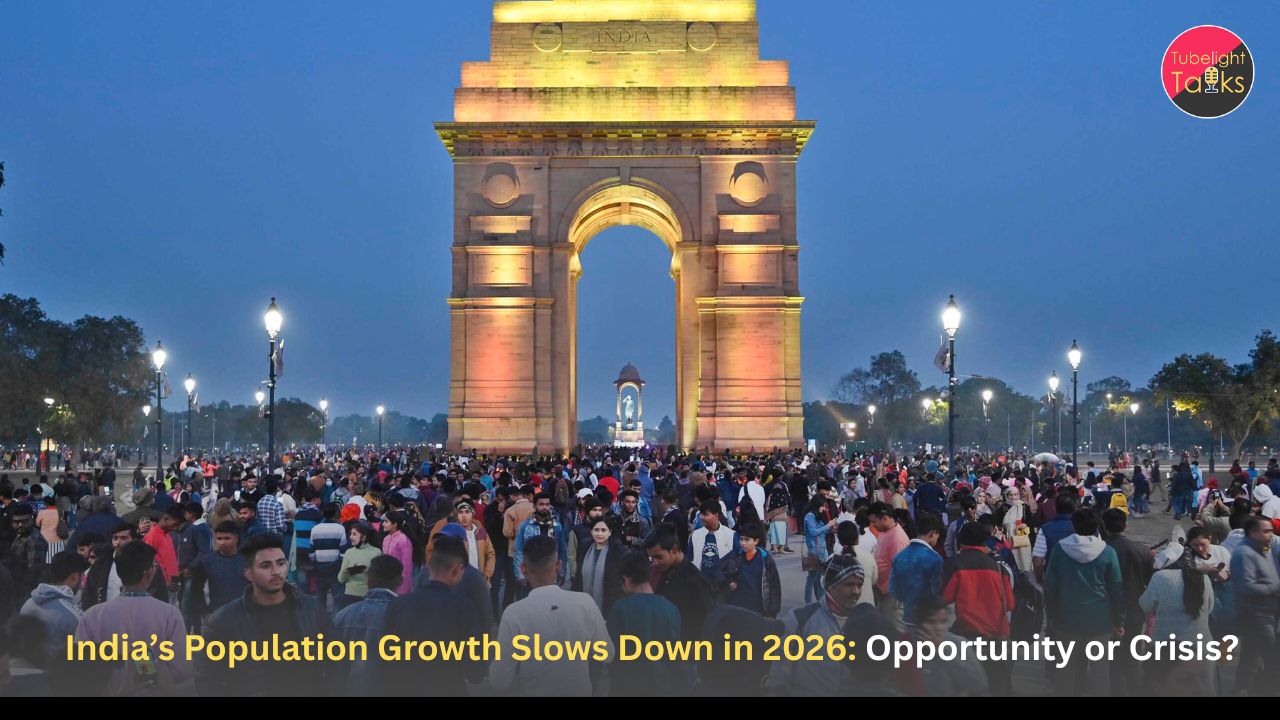
India’s Population Growth Slows Down in 2026: Opportunity or Crisis?
For the first time in its post-independence history, India’s falling fertility rate has below the replacement level, according to the latest National Family Health Survey (NFHS‑6) and the UN World Population Prospects 2026. As the country that recently surpassed China to become the world’s most populous nation, this shift marks a major demographic milestone.
With a fertility rate of 1.9 births per woman, India is now following the trend of developed nations that are grappling with aging populations, labor shortages, and social welfare burdens. Is this demographic transition a chance to stabilize resources and empower society—or the beginning of an irreversible economic and social challenge?
NFHS‑6 and UN Data: India’s Demographic Shift
Key Highlights:
- Fertility Rate (TFR): Dropped from 2.2 in 2019 (NFHS‑5) to 1.9 in 2026.
- Population Growth Rate: Dips below 1% annually for the first time.
- Urban-Rural Divide: Urban areas at 1.7 TFR, rural at 2.1.
- State-wise decline: Kerala (1.6), West Bengal (1.7), Punjab (1.6), Tamil Nadu (1.5) show steep drops.
- Still-growing states: Bihar (2.8), Uttar Pradesh (2.4), Madhya Pradesh (2.2)
The demographic divide between northern and southern India is growing, raising concerns about future regional economic and political imbalances.
Why Is Fertility Falling?
The reasons are multi-dimensional:
- Increased education and employment among women
- Urbanization and rising cost of living
- Access to contraceptives and healthcare
- Changing aspirations and delay in marriage and childbirth
- Government awareness campaigns on family planning
Also Read: India Ageing Population 2036 Glory: 22.74 Cr Elders Ignite New India’s Silver Care Revolution
While these are signs of societal progress, the consequences are not purely positive.
The Opportunity: Tapping the Last Phase of Demographic Dividend
India still has a young median age of 28.6 years, giving it a window to:
- Expand skilled workforce participation
- Improve female labor force engagement
- Focus on healthcare, education, and upskilling
- Implement AI and automation to reduce future labor gaps
According to NITI Aayog, if India manages this transition wisely, the country could become an economic powerhouse by 2040, even with a shrinking birth rate.
The Crisis: Aging, Workforce Decline, and Economic Strain
However, falling fertility also brings challenges:
- By 2045, over 19% of India’s population will be above 60.
- Pressure will mount on pension systems, elderly healthcare, and caregiving infrastructure.
- Youth workforce is already declining in some states like Tamil Nadu and Kerala.
- Labor-intensive sectors (agriculture, construction, MSMEs) will face shortages.
- Intergenerational economic strain: fewer taxpayers, more dependents.
Also Read: Census 2027: After 16 Years of Darkness, India Finally Counts Every Soul – Digitally
Countries like Japan, South Korea, and parts of Europe offer cautionary examples of how mismanaging a demographic decline can hurt economic vitality.
Political Responses: Control vs Incentivization
There is growing debate around:
- Population control laws vs incentives for childbirth
- Some states like Uttar Pradesh and Assam have considered two-child norms
- Others advocate financial incentives, longer maternity leaves, and tax benefits for parents
But critics warn that forced control or artificial stimulation of births can backfire—what’s needed is a balanced, human-centered approach.
International Comparison: India, China, and the West
- China’s fertility has plummeted to 1.2 despite ending its one-child policy, and now faces population shrinkage.
- Japan’s median age is 49, and the government spends billions on elderly care.
- Europe is introducing immigration reforms to balance low fertility.
India is still ahead of this curve—but only for now.
Spiritual Perspective: Societal Imbalance
According to Sant Rampal Ji Maharaj, these trends are not random or political, but signs of spiritual imbalance and deviation from divine laws. He explains through Sat Gyaan that:
“The root of population imbalance, social unrest, and suffering is the disconnection of humanity from true spiritual knowledge.”
In pursuit of material gains, modern societies are experiencing:
- Delayed or denied parenthood
- Mental unrest, broken families, and unnatural lifestyles
- Spiritual ignorance, leading to decisions driven by fear and desire, not truth
Sant Rampal Ji Maharaj emphasizes that true peace and balance come from aligning life with the constitution of God Kabir Sahib, not with policies or personal ambitions. When people adopt Naam Diksha (initiation) and engage in Satbhakti, they experience:
- Mental clarity
- Emotional stability
- Righteous decision-making in family and society
Spiritual wisdom restores inner order, which naturally leads to outer balance—including population and social well-being.
Explore more:
Official Website – www.jagatgururampalji.org
Free Satsang – Sant Rampal Ji Maharaj YouTube
FAQs on India’s Falling Fertility Rate
1. What is India’s fertility rate in 2026?
It has declined to 1.9 children per woman, below the 2.1 replacement level.
2. Which Indian states have the lowest fertility rates?
Tamil Nadu, Kerala, West Bengal, and Punjab are below 1.7.
3. What are the risks of a falling fertility rate?
Workforce shortages, aging population, pension and healthcare stress, and slower economic growth.
4. Can falling population be a good thing?
Yes, if managed properly, it allows for better resource planning, gender empowerment, and quality of life improvements.
5. What does spirituality say about population and societal balance?
According to Sant Rampal Ji Maharaj, societal imbalance arises from disconnection with true worship. Only Satbhakti brings sustainable harmony.
Related Stories










Discussion (0)