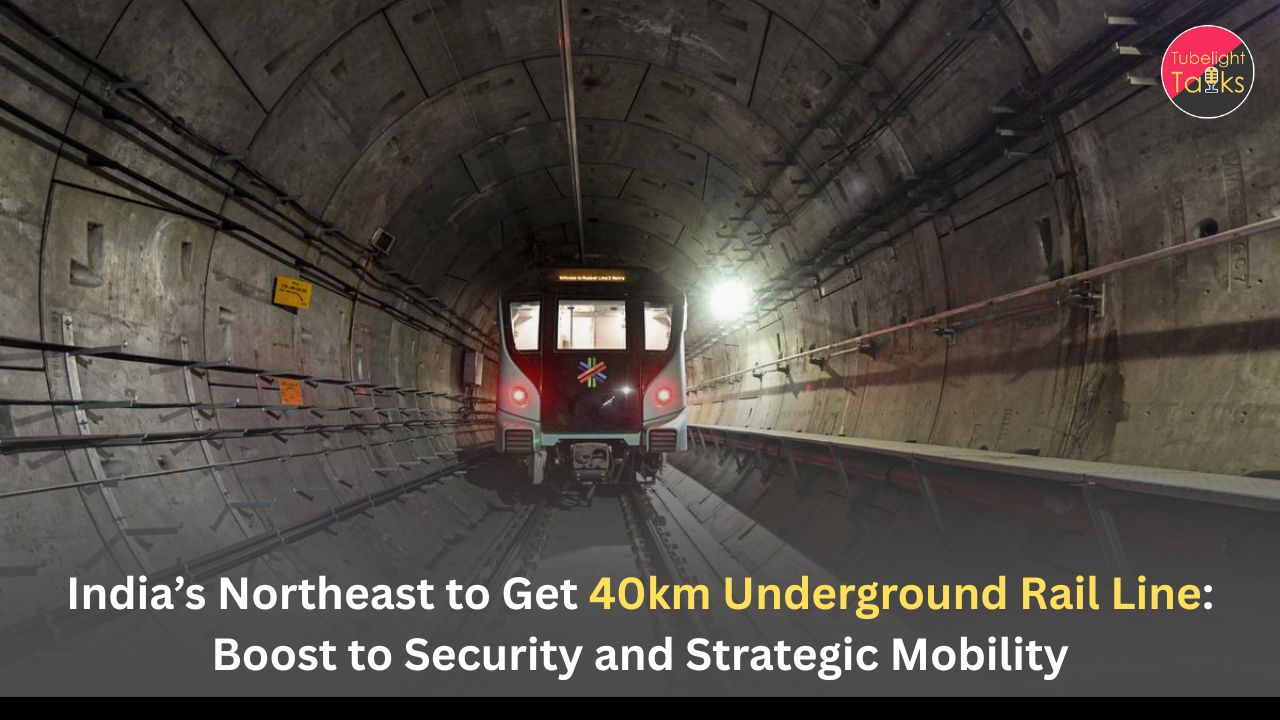
India’s Northeast to Get 40km Underground Rail Line: Boost to Security and Strategic Mobility
In a landmark infrastructure and defense announcement, the Government of India has approved the development of a 40-kilometer underground rail line in the Northeast, aimed at improving strategic connectivity along the Indo-China border. This project is a key part of India’s broader strategy to strengthen national security, economic growth, and regional integration in one of the country’s most sensitive and under-connected regions.
Project Overview: What We Know So Far
Objective
To construct a 40km underground railway tunnel in a sensitive area of the Eastern Himalayan region (likely spanning parts of Arunachal Pradesh and Assam) to:
- Enable rapid troop and equipment movement
- Ensure year-round connectivity regardless of terrain or weather
- Protect infrastructure from aerial surveillance or attacks
Features of the Rail Line
- Underground twin-track corridor
- Advanced electrified rail system with stealth design
- Emergency bunkers, sensor-integrated tunnels
- All-weather, disaster-resilient construction
The Indian Railways and Ministry of Home Affairs are coordinating with the Ministry of Defence and DRDO for tech-enabled implementation.
Why This Project Matters
1. Strategic Border Security
The Northeast shares international borders with China, Bhutan, and Myanmar. With increasing tensions along the Line of Actual Control (LAC), underground logistics corridors offer tactical superiority:
- Safer, faster deployment
- Hidden infrastructure
- Minimal disruption to locals
2. Infrastructure Push in the Northeast
This project adds to a growing list of efforts to uplift the region:
- Trans-Arunachal Highway
- Frontier Rail Lines
- Sela Tunnel & Bogibeel Bridge
It represents Delhi’s commitment to Act East and reduce infrastructural neglect.
3. Civilian Benefits
While security is the top priority, the rail line will:
- Improve access to education, healthcare, and markets
- Support tourism and local trade
- Create jobs in engineering, tunneling, and logistics
National Reactions
Ministry of Railways
Described the project as “India’s boldest engineering challenge in high-risk terrain.”
Defence Analysts
Applauded the move, calling it “future-ready” in the face of growing regional militarization.
Local Voices
While welcoming the project, locals have sought clarity on rehabilitation, ecological safeguards, and local employment guarantees.
Also Read: AI-Based Accident-Prevention System: Indian Railways Starts Trials on Busy Routes
Engineering Against the Odds: A Feat of National Ambition
Constructing an underground rail line in the Eastern Himalayan terrain is not just about laying tracks—it’s about overcoming some of the most complex geotechnical challenges in the world. Engineers will have to navigate fragile mountain strata, high seismic activity zones, and water ingress risks.
The project is expected to leverage advanced technologies such as tunnel boring machines (TBMs), geo-surveillance sensors, and military-grade blast resistance design. This makes the project not only a transportation initiative but also a demonstration of India’s rising capabilities in deep-terrain infrastructure.
Bridging Trust with the Northeast
The underground railway is more than a military asset—it symbolizes Delhi’s growing trust and inclusion of the Northeast in the national development narrative. For decades, residents of Arunachal Pradesh and nearby states have voiced concerns over connectivity, neglect, and regional disparity.
This project, along with parallel investments in education, health, and broadband access, marks a renewed focus on integration over isolation. The railway could become a lifeline for remote communities, bringing goods, services, and national attention to areas once considered too far to reach.
Spiritual Insight: Building Unity Beneath the Surface
Sant Rampal Ji Maharaj’s Teachings on National Strength
While India fortifies its physical borders, Sant Rampal Ji Maharaj reminds us that true national strength begins with internal unity and spiritual alignment.
“A nation built on compassion, truth, and devotion can never be broken—neither by enemies nor crises.”
He teaches that just as underground tunnels offer unseen strength, Naam Diksha and Satbhakti offer spiritual depth that empowers individuals and communities alike. When citizens practice true worship according to holy scriptures, society becomes disciplined, united, and resilient.
Explore the spiritual blueprint for unity:
👉 JagatGuruRampalJi.org
Sant Rampal Ji Maharaj YouTube
Call to Action
Tunnels of Steel, Roots of Spirit
Strengthen the Nation—Both Outside and Within
India’s 40km underground rail is a monumental feat. But let’s not forget the spiritual infrastructure that holds a nation together.
Begin your inner journey with Naam Diksha
Attend free Satsangs and experience peace
Uplift not just the region—but the soul of Bharat
“Where faith builds unity, no force can divide.”
FAQs on the Northeast Underground Rail Project
Q1. Where is the underground rail project being built?
The exact location remains classified, but it is expected to span strategic zones in Arunachal Pradesh and Assam near the China border.
Q2. What is the purpose of this rail line?
It is primarily designed for defense logistics, but it will also enhance regional connectivity and economic activity.
Q3. How long will the project take?
The project is scheduled for phased implementation and is expected to be operational by 2030.
Q4. Will this project impact local communities?
Yes, but the government has assured minimal displacement, ecological assessments, and local job opportunities.
Related Stories








Discussion (0)