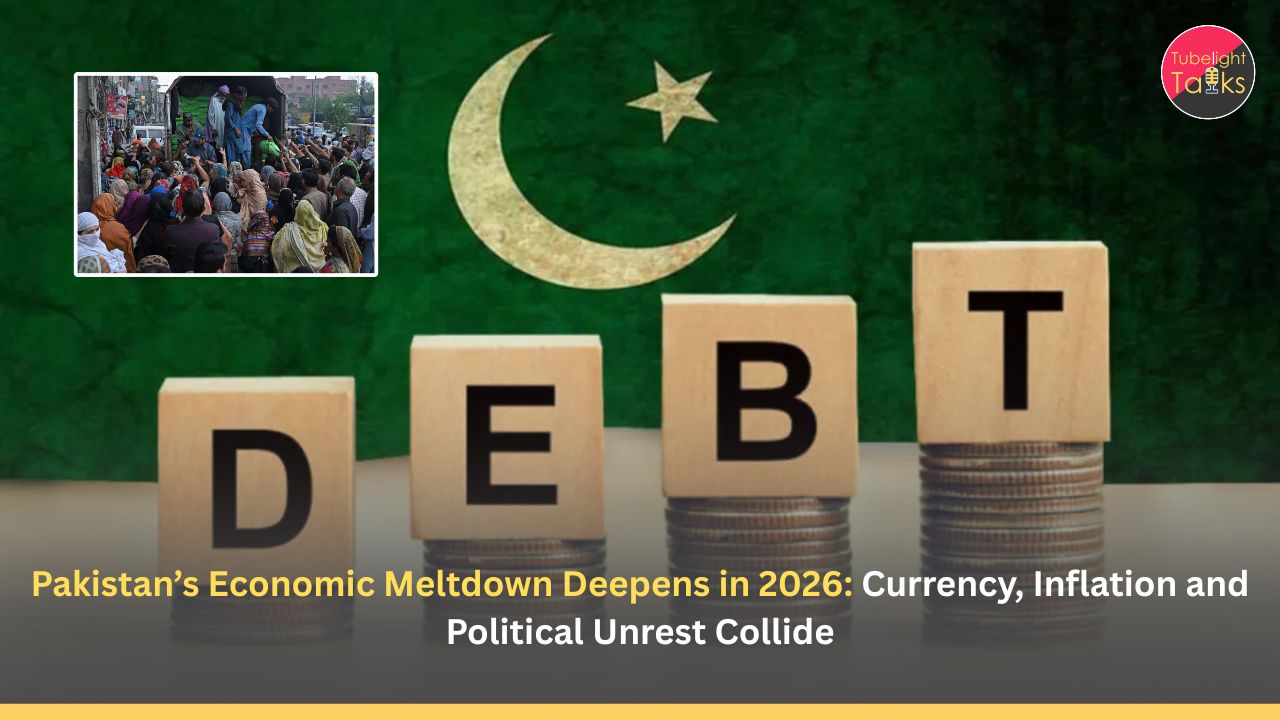
Pakistan’s Economic Meltdown Deepens in 2026: Currency, Inflation and Political Unrest Collide
As of February 2026, Pakistan’s economy stands on the brink of collapse. With the rupee hitting all-time lows, inflation reaching unprecedented double digits, and political instability escalating, the country faces one of its worst financial and social crises in decades. The crisis is not just economic—it’s humanitarian, political, and deeply structural.
Record-Breaking Currency Crash
The Pakistani rupee (PKR) has depreciated to PKR 375 against the US dollar, losing over 18% of its value since January 2026.
- This plunge is driven by falling forex reserves, currently below $3.5 billion
- Delays in IMF bailout reviews and lack of investor confidence have worsened pressure on the currency
According to Bloomberg, foreign direct investment (FDI) fell by 42% in Q4 2025, with global investors pulling out over concerns of economic mismanagement.
Inflation Hits Households Hard
- Food inflation is now above 38%, according to Pakistan Bureau of Statistics
- Electricity bills have doubled, with rolling blackouts across major cities
- Basic medicines are in short supply, and prices have tripled since 2024
Wheat, sugar, fuel, and gas—key household commodities—are now out of reach for much of the population. Protests have erupted in cities like Lahore, Karachi, and Rawalpindi.
Also Read: Pakistan’s Economic Meltdown 2026: A Nation on the Brink
Political Turmoil Fuels the Fire
Prime Minister Shehbaz Sharif faces growing pressure from opposition parties and mass demonstrations.
The government’s inability to negotiate successfully with the IMF for debt restructuring and its failure to implement austerity measures without hurting the poor have eroded public trust.
Violent protests have been reported, with demonstrators demanding:
- Early elections
- Resignation of the finance minister
- Freeze on utility hikes
External Debt Crisis and IMF Uncertainty
Pakistan is due to repay over $4.1 billion in foreign loans by mid-2026. With limited reserves and stalled IMF negotiations, a default risk looms.
The IMF’s latest review, as perThe Express Tribune, has been postponed due to lack of structural reforms, especially in the tax and energy sectors.
Regional and International Impact
A collapsing Pakistan has implications for:
- Regional stability in South Asia, especially near the India-Pakistan border
- Trade routes, as cross-border transport is affected
- Security concerns, with extremist elements potentially exploiting instability
Neighbouring countries are monitoring the situation closely, with India and China maintaining cautious diplomatic distance.
The Deeper Reflection: Ethical Collapse Behind Economic Collapse
As Pakistan’s crisis unfolds, it’s not just about numbers—it reflects a moral and governance failure. Corruption, mismanagement, and lack of accountability have eroded the foundations of society and economy.
Spiritual and ethical thinkers suggest that true reform must begin at the individual and societal level, where values like honesty, fairness, and compassion guide decision-making. Without this, no policy—however sound—can save a nation from collapse.
Ethical transformation, both personal and collective, is the only path that leads out of recurring chaos and into long-term stability.
Call to Action
Economic crashes are often preceded by ethical erosion.
As citizens, leaders, and societies, restoring integrity, empathy, and discipline can stabilize not just markets—but minds.
Let us focus not just on economic survival, but value-based revival.
FAQs on Pakistan’s Economic Meltdown Deepens in 2026
Q1. Why is Pakistan’s economy collapsing in 2026?
Due to a combination of currency devaluation, high inflation, falling forex reserves, and political instability.
Q2. What is the current USD to PKR exchange rate?
As of February 2026, the exchange rate is approximately PKR 375 per USD, the lowest in Pakistan’s history.
Q3. What is the status of IMF negotiations?
The IMF review has been delayed, citing lack of structural reforms. Pakistan risks missing critical loan disbursements.
Q4. How are citizens affected?
Rising prices of essentials, power shortages, and medicine scarcity have made life extremely difficult for average citizens.
Q5. What is the government doing about the crisis?
The government is seeking renewed talks with the IMF, implementing partial subsidy cuts, and calling for calm amid mass protests.
Q6. Can ethical reform impact economic recovery?
Yes. Sustainable recovery needs transparent governance, ethical leadership, and collective accountability from both citizens and institutions.
Related Stories




Discussion (0)