
The “Delhi Declaration”: $250 Billion AI Infrastructure Commitment at the India AI Impact Summit 2026
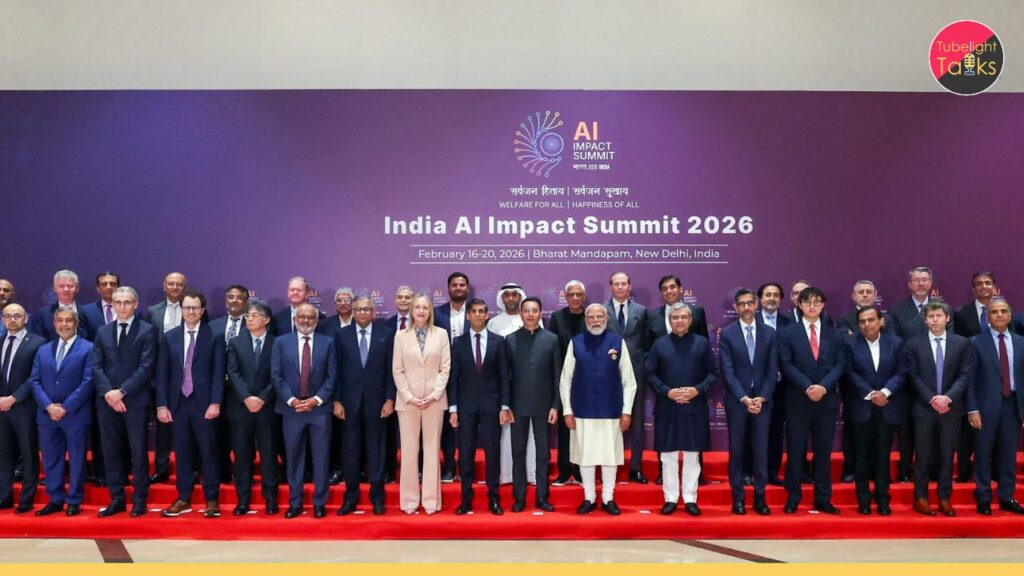
The Delhi Declaration at India AI Impact Summit 2026 emerged as a major global highlight as the summit concluded in New Delhi, drawing attention for two significant outcomes. More than 70 countries backed the Delhi Declaration, while investment commitments for AI infrastructure crossed $250 billion. India’s IT Minister Ashwini Vaishnaw described the summit as a broad success, noting strong international participation and a clear push to position India as a trusted global partner in artificial intelligence development and governance.
The declaration’s contours are expected to be shared publicly, but early reporting suggests it will focus on collaboration, responsible AI, and the hard backbone – compute, data centres, and scalable infrastructure – that will define the next phase of AI competition.
What is the “Delhi Declaration” and why it matters
A multi-country statement in a fast-fragmenting AI world
The “Delhi Declaration” (also referred to in reports as the “New Delhi Declaration”) is the summit’s flagship joint outcome – an attempt to create shared ground on how AI should be built, deployed, and governed at scale. Reports from the summit indicate signatories have crossed 70 countries, with expectations that the number could rise further.
Why this matters: global AI governance is splintering. Different regions are moving at different speeds on safety, data, compute access, and industrial policy. A declaration signed by 70+ countries signals that many governments – especially from the Global South – want a stronger voice in setting the “rules of the road,” not just adopting standards written elsewhere.
What we know so far and what is still pending
A key point repeated in multiple reports is that the declaration’s detailed contours were to be released publicly after the summit, suggesting that while countries have signed on, the final published document may consolidate language on principles, cooperation mechanisms, and implementation pathways.
That timing is important for readers: until the full text is public, the most responsible way to read the declaration is as a direction of travel – toward responsible AI, collaborative frameworks, and infrastructure-first AI capacity building – rather than a final, enforceable treaty.
The $250 billion headline: what “AI infrastructure pledges” actually mean
What counts as “AI infrastructure”
When leaders say “AI infrastructure investment,” they’re rarely talking about one thing. It typically includes:
- Compute (GPUs/accelerators, AI cloud capacity, HPC clusters)
- Data centres (power, cooling, physical security, redundancy)
- Connectivity (high-capacity networks, last-mile upgrades for adoption)
- Platforms and deployment layers (MLOps, secure hosting, inference infrastructure)
- Foundational public goods (datasets, benchmarks, sandboxes, evaluation labs)
At the India AI Impact Summit 2026, multiple outlets reported that AI infrastructure investment commitments crossed $250 billion, alongside additional venture capital/deep-tech commitments in the tens of billions.
Pledges vs. spending: the crucial distinction
The number is big – and it’s trending – because it suggests scale. But it’s also essential to read it correctly. An “investment commitment” at a summit is often:
- A pipeline announcement (multi-year intent)
- A conditional pledge (linked to policy clarity, demand, or partnerships)
- A mix of public and private investment planning
In other words: $250 billion is a signal of momentum, not a receipt. The most practical question now is how much converts into projects – data centres built, compute provisioned, procurement orders placed, and research capacity funded – within 12–24 months.
India’s compute push: GPUs, access, and the IndiaAI Mission
One of the most concrete infrastructure threads at the summit is India’s compute expansion narrative. A PIB release from the event says India will expand compute capacity beyond an existing 38,000 GPUs, adding 20,000 additional GPUs in the coming weeks – positioning this as strategic capacity-building under the IndiaAI Mission.
The same PIB note highlights an affordability angle: GPUs made available at a stated rate (to lower barriers for startups and researchers), reinforcing the idea that infrastructure is not just about owning compute, but also about who gets to use it.
This is where the Delhi Declaration narrative and the $250 billion AI infrastructure investment story connect: it’s not only about attracting global capital, but also about shaping an ecosystem where access and deployment are broad-based.
Why 70+ country signatories is a major signal
Diplomacy meets AI: the value of “alignment”
Even if a declaration is non-binding, it has real-world value: it shapes:
- Procurement preferences and cooperation agreements
- Research partnerships and mobility frameworks
- Shared language on safety, testing, and responsible deployment
- The legitimacy of certain policy directions (like compute democratization)
Reports quoting Minister Ashwini Vaishnaw suggest signatories crossed 70, with expectations of moving past 80.
That is a large alignment footprint. In global negotiations, numbers matter because they signal the size of the coalition that may support similar language at future forums (G20-like discussions, regional AI compacts, or UN-oriented deliberations).
The “Global South” angle and India’s positioning
A recurring theme from summit coverage is that India is positioning itself as a convenor where the Global South participates as a co-author in AI governance and infrastructure development.
This stance is amplified by the summit’s messaging around welfare and inclusion. PIB coverage frames the summit’s theme as “Sarvajan Hitaya, Sarvajan Sukhaya” (welfare and happiness for all), which aligns neatly with a declaration framed as “impact” rather than only “innovation.”
What the summit tells us about India’s AI strategy in 2026
Infrastructure-first, not app-first
Many countries started their AI journey by pushing applications – chatbots, citizen services, productivity tools – then scrambling for compute. India is trying to invert that: build the stack, then scale adoption.
You can see it in three strands surfaced across official notes and reporting:
- Compute scaling (more GPUs and accessible compute)
- Large-scale convening (bringing governments, firms, and researchers together)
- Capital + coalition building (investment commitments and multi-country declarations)
“Grand success” narrative: participation and visibility
Public broadcaster reporting states the minister highlighted the summit’s scale, including over five lakh visitors and participation from many major AI players.
That visibility matters because AI infrastructure investment follows confidence: companies build where they believe policy will be stable, talent will be available, and demand will scale.
Also Read: AI Impact Summit 2026: Why Global Tech CEOs and World Leaders Are Gathering in New Delhi
The geopolitics layer: supply chains, trust, and Pax Silica

Why Pax Silica showed up in the same week
Alongside the Delhi Declaration, PIB reported that India formally joined the Pax Silica coalition at the summit – framed as strengthening strategic technology and supply chain cooperation with the United States, including governance of the “silicon stack” that powers AI.
This matters because AI isn’t only software. It’s chips, fabrication capacity, secure supply chains, cloud infrastructure, and the geopolitics of who controls which layers. If the Delhi Declaration is about the governance and cooperation narrative, Pax Silica represents the hard supply-chain narrative.
A practical takeaway for businesses
For startups and enterprises, this geopolitical layer changes real decisions:
- Where you host models (sovereign cloud vs multi-region)
- Where you source compute
- What compliance expectations look like when selling to government or regulated sectors
- How “trusted” supply chains shape procurement
What the $250B AI infrastructure commitment could mean on the ground
For startups: more compute, more competition, faster iteration
If even a portion of the AI infrastructure investment pipeline converts into real capacity, startups could see:
- Lower compute bottlenecks
- More accelerator programs tied to national missions
- More public sector demand (health, education, agriculture)
- Tighter evaluation and safety requirements as adoption scales
This is the tradeoff: infrastructure opens doors, but it also raises the bar. When a market becomes a global AI hub, “good enough” models stop being good enough.
For large companies: a race to build or partner
Global firms will likely read the summit’s signals as:
- India is inviting infrastructure build-out (data centres, GPU clouds, model deployment ecosystems)
- India is also pushing sovereignty and access – so partnerships may be preferred over pure extraction-style expansion
- Safety, accountability, and responsible AI language will likely get more formal once the Delhi Declaration text is public
For citizens: better services, but governance must keep pace
AI at population scale can improve:
- Healthcare triage, diagnostics support, and resource planning
- Education personalization and multilingual learning support
- Agriculture advisories and weather-linked decision tools
- Faster grievance redressal and document processing
But governance must keep up – especially on data protection, bias, explainability in public services, and accountability when AI outputs influence welfare decisions. A declaration that emphasizes responsible AI can help set expectations – but delivery depends on institutions, audits, and enforcement.
What to watch next: 5 practical signals after the summit
1) The published text of the Delhi Declaration
Multiple reports indicate the text would be shared publicly after the summit. Once it’s published, the key things to scan are:
- Definitions: what counts as “responsible AI,” “harm,” “misuse,” “safety”
- Implementation: working groups, timelines, reporting mechanisms
- Infrastructure language: commitments to compute access and capacity-building
- International coordination: alignment with other global AI frameworks
2) Project announcements that convert pledges into builds
Watch for:
- Data centre MoUs turning into groundbreakings
- GPU cloud capacity additions with clear timelines
- Public procurement frameworks for AI services
- Research infrastructure funds and university partnerships
3) IndiaAI Mission execution details
PIB’s GPU expansion narrative is strong. The next question is execution:
- Procurement and deployment speed
- Pricing and access rules
- Allocation fairness across startups, academia, and public institutions
4) Cross-border research and talent mobility
If 70+ countries are signing common language, the next practical output is often:
- Fellowships and joint labs
- Shared datasets and multilingual benchmark initiatives
- Mutual recognition of evaluation and safety testing
5) A clearer “trust framework” for AI supply chains
With Pax Silica and related supply-chain framing present at the summit, expect more language around:
- Trusted compute
- Secure model deployment
- Hardware provenance and resilience
Ethics that scale with technology
When a country celebrates $250 billion in AI infrastructure investment, it’s easy for the conversation to become only about capacity – more GPUs, bigger models, faster rollouts. But long-term success depends on something quieter: intent and restraint. Teachings shared on Jagatguru Rampal Ji Maharaj’s official platform repeatedly warn that blind pursuit of fame and fortune can deepen greed and reduce humanity, while a meaningful life is built through right conduct and truthfulness.
In the context of the Delhi Declaration and responsible AI, that message fits naturally: if AI is deployed only for advantage, it can widen inequality and conflict; if it’s deployed with discipline and compassion, it can genuinely improve welfare. The same official resources emphasize aligning actions with ethics so progress uplifts society rather than destabilizing it.
Call to Action: Track the declaration, not just the headline number
If you’re a founder, student, policymaker, or working professional, don’t stop at “$250 billion.” Follow the published Delhi Declaration text when it becomes public, and watch which commitments turn into real compute, real data centres, and real access for builders.
Keep an eye on IndiaAI Mission updates (especially compute availability and pricing), and cross-check announcements through official releases and credible reporting. Most importantly, build and adopt AI with responsibility – because in the next phase of global AI governance, trust will be as valuable as infrastructure.
FAQs
Q1. What is the Delhi (New Delhi) Declaration from the India AI Impact Summit 2026?
It’s the summit’s joint outcome statement backed by 70+ countries, intended to align cooperation and principles around AI development and governance.
Q2. How much investment was committed for AI infrastructure at the summit?
Multiple reports cite $250 billion+ in AI infrastructure investment commitments announced during the summit.
Q3. Are these investments guaranteed or immediate?
They are described as commitments/pledges, which often reflect multi-year intent and may depend on policy clarity, partnerships, and project readiness.
Q4. How many countries have signed the declaration so far?
Reporting during the summit said signatories crossed 70, with expectations that the count could rise higher.
Q5. What concrete infrastructure moves were highlighted by the government during the summit?
PIB reported an expansion beyond 38,000 GPUs with an additional 20,000 GPUs to be added, framed as scaling India’s AI compute capacity under national mission efforts.
Q6. What should businesses watch next after the summit ends?
Watch for the published declaration text, project-level announcements converting pledges into builds, IndiaAI Mission execution details, and supply-chain cooperation initiatives highlighted during the summit week.
Related Stories










Discussion (0)