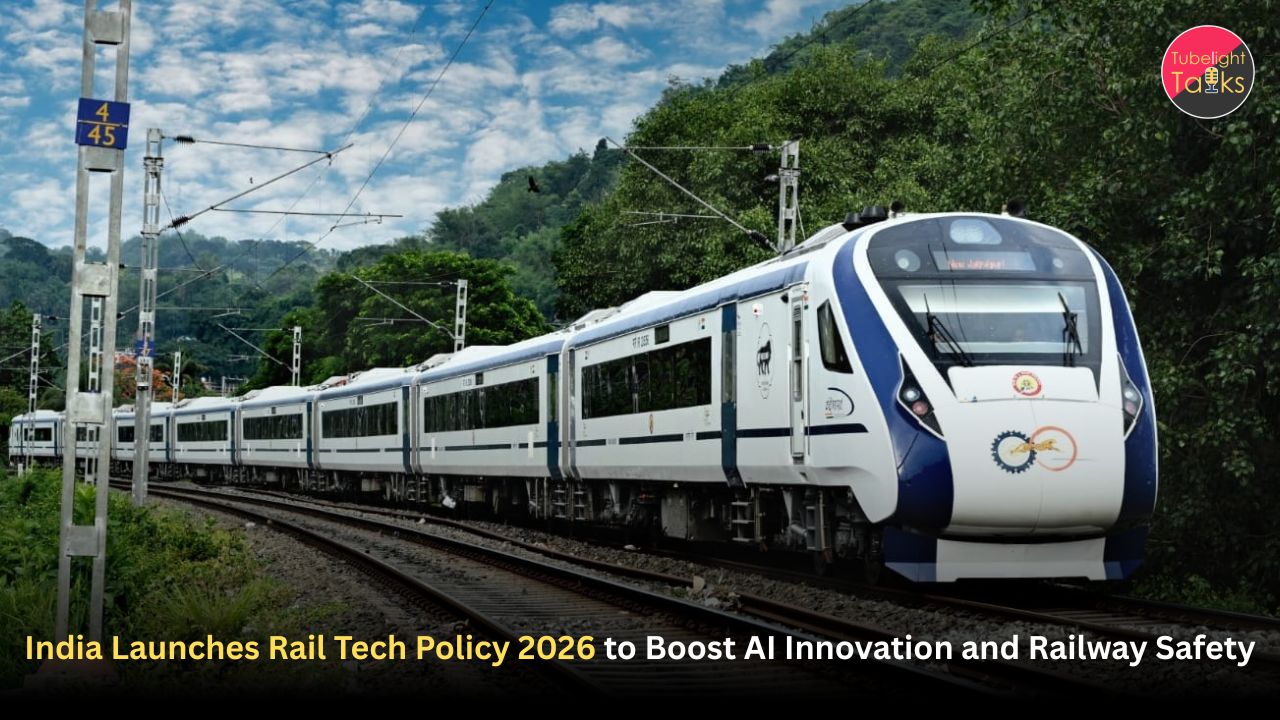
India’s First “Rail-Tech” Policy Launched
India has officially entered a new era of railway innovation with the launch of the Rail Tech Policy 2026. Announced by Union Railway Minister Ashwini Vaishnaw, the policy is designed to harness the power of artificial intelligence, drone surveillance, and startup-led innovation to improve railway safety and efficiency.
By inviting private innovators and offering up to 50% funding support, the government is creating a collaborative ecosystem between public infrastructure and deep-tech entrepreneurship. The focus areas—Elephant Intrusion Detection Systems and drone-based Broken Rail Detection—highlight a unique blend of wildlife protection and passenger safety.
Key Highlights of the Rail Tech Policy 2026
1. AI-Powered Elephant Intrusion Detection Systems
Protecting wildlife and passengers
Train-wildlife collisions, particularly involving elephants, have been a persistent challenge in forested railway corridors. The new policy encourages startups to develop AI-driven detection systems capable of identifying elephant movement near tracks in real time.
Such systems may use:
- Thermal imaging
- Motion sensors
- AI pattern recognition
- Automated alert systems
The goal is to alert loco pilots and railway authorities in advance, reducing accidents and preserving biodiversity.
Also Read: DGCA’s Passenger First Rule: Free Changes within 48 Hours
2. Drone-Based Broken Rail Detection
Preventing derailments
Rail fractures are among the most critical safety risks in railway operations. Traditionally, inspections rely on manual patrols and periodic monitoring.
Under the Rail Tech Policy, innovators are invited to create drone-based solutions that:
- Scan railway tracks using high-resolution cameras
- Detect structural cracks through AI algorithms
- Transmit real-time data to control centers
This proactive detection system can significantly reduce derailment risks.
Government Support: Funding Up to 50%
Encouraging startup participation
One of the most attractive features of the policy is financial backing. The government is offering up to 50% funding for approved projects, reducing financial barriers for startups.
This support aims to:
- Accelerate prototype development
- Enable field testing
- Encourage deep-tech research
- Foster public-private partnerships
Why This Policy Is Trending
Boost for India’s deep-tech ecosystem
The policy has sparked excitement among India’s startup community. Deep-tech founders see it as a rare opportunity to test cutting-edge solutions on one of the world’s largest railway networks.
A rare blend of tech and conservation
Unlike typical infrastructure reforms, this initiative integrates wildlife conservation directly into railway modernization efforts. Protecting elephants while ensuring passenger safety represents a progressive governance approach.
Impact on Indian Railways
Enhancing operational safety
AI-driven monitoring can reduce accidents and improve overall reliability.
Data-driven decision making
With advanced analytics and real-time monitoring, railway authorities can make faster and more informed operational decisions.
Positioning India as a rail-tech innovator
If successful, these technologies could eventually be exported to other countries with large rail networks.
The Broader Significance: Innovation with Responsibility
True technological progress must balance efficiency with ethical responsibility. In spiritual teachings shared by Sant Rampal Ji Maharaj, harmony between human development and nature is emphasized as essential for sustainable progress. Protecting wildlife while modernizing transport systems reflects this balanced vision.
The Rail Tech Policy 2026 is not merely about digital transformation—it represents a thoughtful step toward innovation that safeguards both people and the environment.
FAQs
What is the Rail Tech Policy 2026?
A government initiative inviting startups to develop AI and drone-based railway safety solutions.
What is the Elephant Intrusion Detection System?
An AI-based system designed to detect elephants near railway tracks to prevent collisions.
How will broken rail detection improve safety?
Drone-based systems can identify cracks early, reducing derailment risks.
Is there government funding support?
Yes, up to 50% funding is offered for selected projects.
Why is this policy significant?
It combines technology, conservation, and infrastructure modernization in a single framework.
Related Stories






Discussion (0)