Delhi Protest Today: Capital Locked Down, Metro Stations Shut, and Trains Cancelled Amid CJP Row Over Election Chief
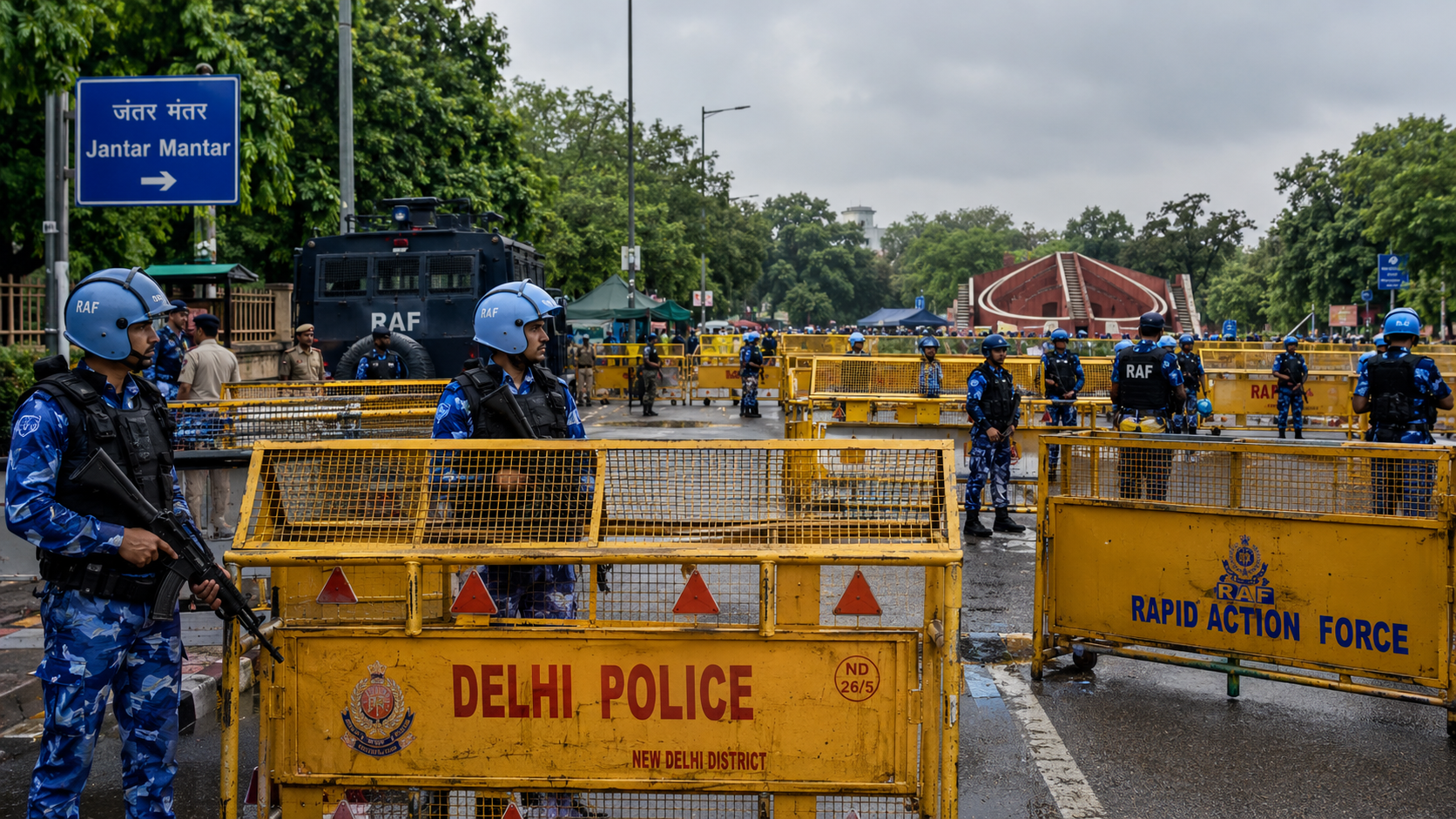
The national capital has witnessed an unprecedented security lockdown as the delhi protest today organized by the Cockroach Janta Party (CJP) and student groups unfolds near Jantar Mantar. Authorities have heavily restricted movement across New Delhi, deploying central forces, suspending internet services in sensitive zones, and halting critical transit options to prevent demonstrators from gathering.
The mobilization has been called to demand the resignation of Chief Election Commissioner (CEC) Gyanesh Kumar over alleged discrepancies tied to electoral rolls. With the administration stepping up enforcement, normal life across the capital region has faced major disruptions.
Also read : https://tubelighttalks.com/delhi-opposition-protest-2026
Unprecedented Security Grid and Transit Shutdowns During Delhi Protest Today
To thwart the massive assembly of youth and political activists, the Delhi Police, backed by the Ministry of Home Affairs (MHA), enforced sweeping preventive measures. Authorities denied official permission for the gathering at Jantar Mantar, citing non-compliance with prior undertakings and potential risks to public order.
Commuters faced severe roadblocks as the Delhi Metro Rail Corporation (DMRC) closed numerous interchange and key stations. Furthermore, Indian Railways cancelled scores of incoming long-distance passenger trains to curb the influx of protesters into the city.
Key Administrative Restrictions Implemented
The table below outlines the primary restrictions and infrastructural shutdowns enforced across the national capital for the demonstration during the delhi protest today:
| Infrastructure / Sector | Extent of Restriction | Official / Administrative Reason |
| Delhi Metro (DMRC) | 57 stations shut or restricted from Friday night | Preventing unruly mob movement towards sensitive zones |
| Indian Railways | Over 170 passenger trains cancelled | Halting group travel of demonstrators into New Delhi |
| Internet Services | Suspended across Lutyens’ Zone and protest radius | Controlling rumor-mongering and maintaining public peace |
| Protest Venue | Permission denied for Jantar Mantar gathering | Enforcing prohibitory orders under Section 163 BNSS |
Political Backlash and CJP Leadership Response
Leaders of the Cockroach Janta Party, including founder Abhijeet Dipke and spokesperson Saurav Das, heavily criticized the state machinery, comparing the lockdown to an internal emergency. Prominent organizers maintained that peaceful protest remains a core constitutional right protected under Article 19 of the Indian Constitution.
“Protesting is our fundamental right. Article 19 grants us the fundamental right to protest in a democratic and peaceful manner, and that is exactly what we intend to do,” stated CJP leadership ahead of reaching the capital.
Despite pre-emptive detentions of individuals with prior records and heavy police vigilance featuring bodycams and drones, organizers pressed forward with their schedule, leading to continuous standoffs at various border checkpoints.
The Impermanence of Earthly Strife and the Path to Eternal Peace
The ongoing confrontation on the streets of New Delhi presents a clear picture of the modern human condition. Around the world, millions of people dedicate their time, energy, and lives fighting against perceived systemic unfairness, political corruption, and societal imbalance. Citizens march, governments impose lockdowns, and societies enter cycles of conflict in pursuit of justice, stability, and peace. Yet, history demonstrates that material solutions, legislative updates, or political restructurings offer only brief, temporary relief. As soon as one crisis is managed, new forms of anxiety, conflict, and hardship emerge.
The reason for this endless cycle lies in a fundamental truth: total peace, absolute justice, and lasting happiness cannot be established within a temporary material world. The physical realm is inherently subject to change, decay, and conflict. Seeking permanent tranquility through worldly institutions is like searching for dry land in the middle of an ocean. True peace is not achieved by changing political leadership or altering external systems, but by addressing the spiritual root of human existence.
Eternal peace and freedom from all suffering are found only through spiritual awakening and true devotion to the Supreme Creator, God Kabir. As explained in sacred scriptures, human souls have become detached from their original, peaceful spiritual home (Satlok) and remain trapped in the cycle of birth, death, and worldly struggle. Worldly problems—whether political unrest, personal stress, economic struggle, or disease—are symptoms of our separation from divine truth.
Under the guidance of a complete Spiritual Master, Sant Rampal Ji Maharaj, individuals learn the correct, scripture-based method of worship (SatBhakti). By engaging in genuine spiritual practice and understanding higher spiritual laws, a person gains an inner strength and mental stability that remains unaffected by external turmoil. True devotion transforms human consciousness, replacing anger, greed, and conflict with compassion, righteousness, and divine protection. Rather than spending a lifetime in temporary, agonizing earthly struggles, embracing true spiritual knowledge guides the soul back to eternal peace.
To discover the deeper purpose of human life and learn the true method of spiritual devotion that brings permanent peace, explore the detailed discourses available on the Official YouTube Channel of Sant Rampal Ji Maharaj.
Frequently Asked Questions (FAQs)
Q1. What triggered the delhi protest today?
The demonstration was called by the Cockroach Janta Party (CJP) and allied student groups to demand the resignation of Chief Election Commissioner Gyanesh Kumar over alleged electoral roll irregularities.
Q2. Why was permission denied for the gathering at Jantar Mantar during the delhi protest today?
Delhi Police denied permission citing non-compliance with conditions agreed upon during previous demonstrations and the necessity to enforce prohibitory orders under Section 163 of the BNSS.
Q3. Which transport services faced major disruptions due to the protest?
Authorities shut 57 Delhi Metro stations, suspended Namo Bharat services at key points, and led to the cancellation of over 170 long-distance passenger trains heading toward the capital.
Q4. Are mobile internet services operational in central Delhi?
No, internet services were ordered suspended within a specified radius around Lutyens’ Zone and the protest venue to prevent spread of unverified information.
Q5. How are commuters navigating the traffic impacts of the delhi protest today?
Commuters faced heavy traffic diversions at key border points and major roundabouts, prompting advisories from traffic police to check alternate routes or utilize work-from-home options.
Related Stories



Discussion (0)