Shocking Delhi Opposition Protest: High-Stakes 2026 Shift
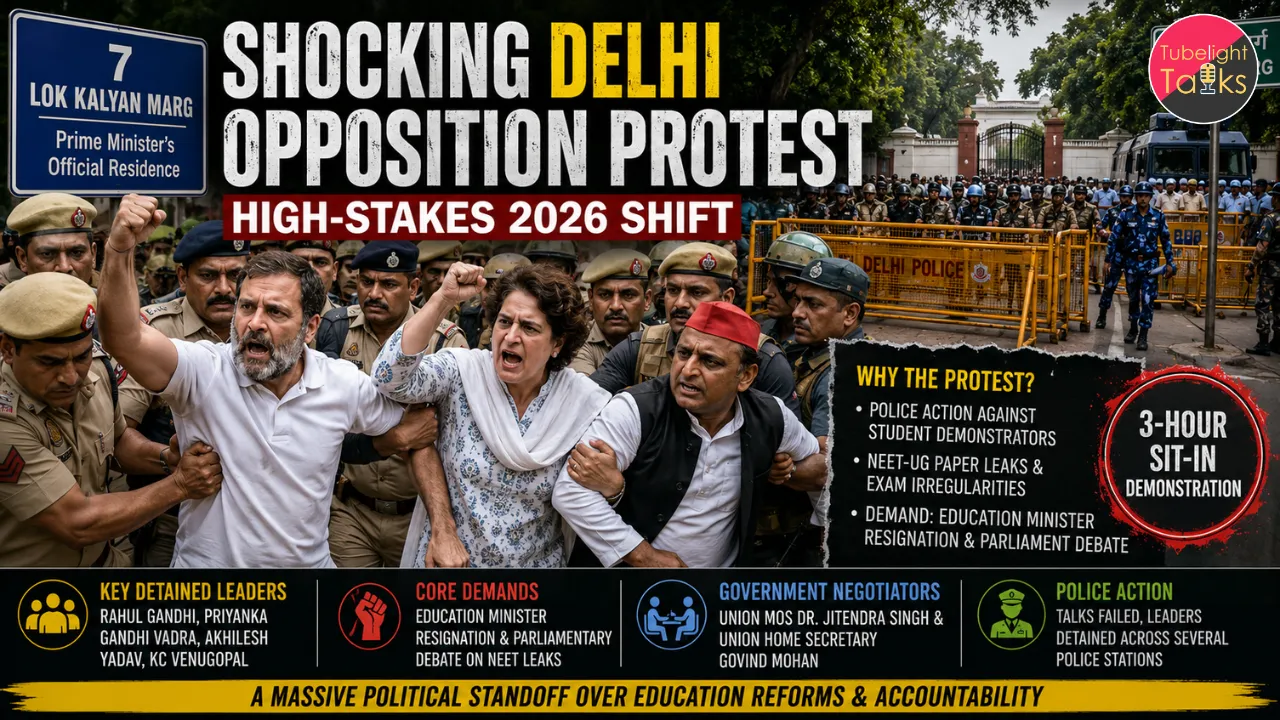
Political tensions in the national capital escalated sharply on July 21, 2026, triggering a massive Delhi opposition protest. Top Opposition figures marched directly to Prime Minister Narendra Modi’s official residence at 7 Lok Kalyan Marg. Led by Leader of the Opposition in the Lok Sabha Rahul Gandhi, Congress MP Priyanka Gandhi Vadra, and Samajwadi Party President Akhilesh Yadav, the delegation staged a dramatic three-hour sit-in demonstration.
This high-profile march followed violent clashes and heavy police action against student demonstrators. The youth were actively protesting over widespread NEET-UG paper leaks and significant examination irregularities.
The unexpected demonstration occurred in one of the capital’s highest-security zones. It prompted an immediate and heavy deployment of Delhi Police alongside paramilitary personnel.
When negotiations between the protesting leaders and government representatives yielded no resolution, security personnel forcibly cleared the site. Authorities subsequently detained the MPs, taking them to separate police stations across New Delhi.
High-Level Negotiations During the Delhi Opposition Protest
The demonstration began shortly after 3:30 PM, when Opposition MPs gathered near Rajaji Marg before marching toward the Prime Minister’s residence. Their primary demand was the immediate resignation of Union Education Minister Dharmendra Pradhan. They also sought an urgent discussion on examination governance inside Parliament.
Also Read: Shocking US Canada Trade Dispute Escalates with 50% Tariffs
To press their demands, the leaders sat directly on the road, blocking critical traffic corridors in the high-security area. Union Minister of State Jitendra Singh and senior Ministry of Home Affairs officials were dispatched to negotiate with the leaders.
However, talks broke down after Opposition MPs refused to vacate the non-designated protest area without explicit commitments from the government. Following this stalemate, security forces physically lifted and carried several prominent leaders to waiting police vehicles.
Political Reactions to the Delhi Opposition Protest
The rapid developments in New Delhi triggered sharp reactions from political parties across India. Opposition leaders described the detentions as a direct attempt to suppress democratic protest and silence public outrage.
Conversely, government representatives maintained that strict security protocols around the Prime Minister’s residence simply could not be compromised. Constitutional experts and political observers noted that this incident is highly likely to intensify parliamentary confrontations. It will undoubtedly shape the national political discourse surrounding education reforms and public demonstrations in the coming weeks.
New Delhi Protest & Detention Matrix (July 2026)
| Operational Parameter | Detail & Ground Reality |
| Protest Location | 7 Lok Kalyan Marg (Prime Minister’s Official Residence Zone). |
| Key Detained Leaders | Rahul Gandhi, Priyanka Gandhi Vadra, Akhilesh Yadav, KC Venugopal. |
| Core Political Demands | Education Minister resignation, parliamentary debate on NEET leaks. |
| Government Negotiators | Union MoS Dr. Jitendra Singh & Union Home Secretary Govind Mohan. |
Broader Impact on Civil Agitations and Education Policy
This high-stakes sit-in near the Prime Minister’s residence coincided with ongoing youth demonstrations led by the Cockroach Janta Party (CJP) at Jantar Mantar. Following the detentions, senior leaders including NCP (SP) chief Sharad Pawar and AAP convener Arvind Kejriwal visited the Jantar Mantar site to extend solidarity to student groups.
Meanwhile, parliamentary proceedings were severely disrupted as Opposition benches repeatedly demanded debates on student welfare and examination integrity. The protests have further intensified the national debate over examination security, recruitment transparency, and accountability within India’s education system.
Also Read: Major Ukraine Military Shakeup: Zelenskyy Sacks Syrskyi, Appoints Drapatyi
Student organizations and education policy experts have renewed calls for stronger safeguards against paper leaks. They demand enhanced digital monitoring of examination processes and comprehensive reforms aimed at restoring public confidence in competitive examinations. The issue is expected to remain a prominent topic during the ongoing parliamentary session.
Service, Humility and Public Duty
The escalating political clashes, police detentions, and public anger over education governance illustrate the profound societal distress that occurs when public trust in national institutions is shaken. Sant Rampal Ji Maharaj’s spiritual guidance reminds us that worldly power and administrative positions are temporary trusts that must be handled with utmost humility, truth, and responsibility.
SatGyan teaches that political friction worsens when leadership allows pride and bureaucratic apathy to overshadow public duty. According to the eternal spiritual laws of Supreme God Kabir, true governance is built not on force or political maneuvering, but on selfless service, absolute truth, and deep compassion for the well-being of the youth and society.
FAQs on the New Delhi Standoff
Why did leaders initiate the Delhi opposition protest on July 21, 2026?
Top political leaders marched to 7 Lok Kalyan Marg to protest recent police action against student demonstrators and demand strict accountability over the massive NEET paper leaks.
Which prominent political leaders were detained during the Delhi opposition protest?
Leader of the Opposition Rahul Gandhi, Congress MP Priyanka Gandhi Vadra, and SP Chief Akhilesh Yadav were among the key figures detained by Delhi Police.
What were the primary demands raised during the sit-in demonstration?
The leaders demanded the immediate resignation of Union Education Minister Dharmendra Pradhan and an explicit, urgent debate on examination reforms in Parliament.
How did the government respond to the demonstration at the PM’s residence?
The government sent Union MoS Dr. Jitendra Singh to negotiate with the leaders. After talks failed, security forces cleared the site, citing strict high-security zone violations.
How are student organizations reacting to the political developments?
Student groups and CJP supporters continued their sit-in at Jantar Mantar, drawing solidarity visits from major regional party leaders who fully support the students’ demands.
Related Stories






Discussion (0)