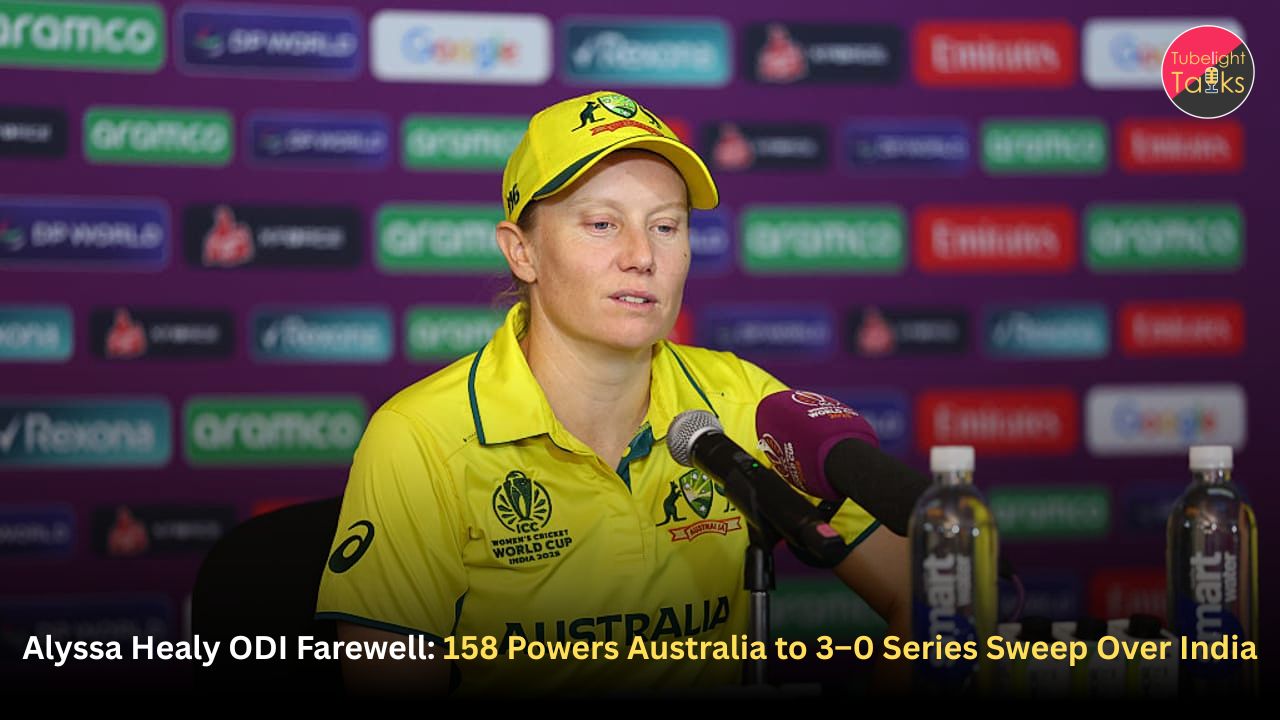
Alyssa Healy ODI Farewell: 158 in Final Career Match Seals 3–0 Sweep Against India
Alyssa Healy ODI Farewell: Sunday, March 1, 2026 delivered a sporting farewell few athletes ever experience. In Hobart, Alyssa Healy signed off in her final ODI with a breathtaking 158 off 98 balls, turning her last appearance into a defining chapter of Australian cricket. Her explosive innings powered Australia to a commanding 409/7 before India were bowled out for 224, handing the hosts a crushing 185-run victory and completing a dominant 3–0 series sweep.
It was not just a win, but a farewell worthy of one of the format’s finest wicketkeeper-batters.
The Farewell Context: Why This ODI Was Heavier Than Most
A last ODI is not just a match, it’s a public reckoning
When an athlete retires, especially a captain, every ball becomes loaded with meaning. Teammates want to give you a win. Opponents want to be the side that spoils your ending. The crowd wants a highlight. The player wants dignity – at minimum.
Healy’s farewell came with all of that pressure and none of the compromise. Cricket Australia’s match report described it as signing off “in style,” “hammering a record-breaking 158” as Australia “thrashed India” in Hobart.
The scene: guard of honour and a stadium that understood the moment
As she walked out for the final time in ODIs, India formed a guard of honour – an act that quietly admitted her stature, even before the first ball was faced.
What followed was not ceremonial. It was ruthless.
The Innings: 158 Off 98 – Anatomy of a Farewell That Hurt
The strike: Healy didn’t “build an innings,” she built inevitability
Healy’s 158 was packed with intent: 27 boundaries and two sixes, according to match coverage.
That boundary count matters because it shows how she controlled the game – relentlessly punishing anything loose, turning good balls into singles, and using bad balls like matches in dry grass.
Cricket Australia noted she reached triple figures from 79 deliveries, then accelerated from 101 to 150 in 16 balls without facing a dot ball – an extraordinary burst that turned a big score into a terrifying one.
The partnership that gave the innings its backbone
Healy didn’t do it alone, and that’s important – because great captains also create space for others to breathe. She shared a 104-run stand with Georgia Voll (who made 62), anchoring the innings after an early wicket.
Later, she stitched a massive stand with Beth Mooney, who finished unbeaten on 106 – ensuring that once Healy detonated the game, Australia still had control and structure behind the chaos.
The dismissal: even the ending was bizarre
Healy’s innings ended on 158, bowled while attempting to reverse a full toss – an almost comedic finish to an innings that had already done its damage.
And yet the dismissal didn’t change the feeling: the match had already moved into inevitability.
Australia’s 409/7: Why This Total Was More Than a Score
409 is a warning sign in ODI cricket
Australia’s 409/7 isn’t just “a big total.” It is the kind of score that changes how a team is perceived for months. It forces opponents to rethink bowling plans, field settings, and risk tolerance. It also tests teams mentally before the toss even happens.
Cricket Australia framed it as Australia reaching 400 at home for the first time and noted it was their second-highest total in the format.
Mooney’s 106* and the cruelty of depth
While Healy provided the violence, Mooney provided the closing certainty – an unbeaten century that ensured India received no mercy after Healy’s acceleration.
Cricket Australia also highlighted a late surge from Nicola Carey (34* off 15) after a mini-collapse, underlining the depth that makes Australia so punishing in ODIs.
When a team can lose momentum and still add 50+ in the final overs, it tells you something about standards and conditioning. This wasn’t only a farewell. It was a system working at full power.
India’s Chase: 224 All Out and the Weight of a Run Mountain
The chase was never only about runs – it was about oxygen
A target of 410 steals oxygen from a batting unit. Every over feels like a negotiation with panic. Early wickets become fatal. Dot balls become disasters.
India were dismissed for 224 in 45.1 overs, leaving Australia winners by 185 runs.
Reports noted that India’s response lacked sustained intent after early damage, with contributions from Sneh Rana (44) and Jemimah Rodrigues (42) not enough to change the direction of the chase.
Also Read: Samson’s Eden Gardens Epic: India Storms into T20 World Cup Semis
Alana King’s 4/33: the bowling that completed the farewell
Healy’s innings gave Australia altitude; the bowling ensured India could not climb. The match report led by Cricket Australia described Alana King (4-33) as spearheading India’s collapse.
When a team posts 400+, the danger is complacency. This attack wasn’t complacent. It was surgical.
The silent damage of “making a game last”
One of the most brutal details in Cricket Australia’s coverage is how India’s lower order “dug in” and stretched the match – not threatening the target, but delaying the inevitable.
That kind of ending can feel hollow for a chasing team. Yet it also shows the psychological effect of a farewell innings: sometimes you’re not even trying to win anymore – you’re just trying to survive what’s happening to you.
Healy’s Words: The Quote That Made the Farewell Human
“Thanks to the cricket gods…”
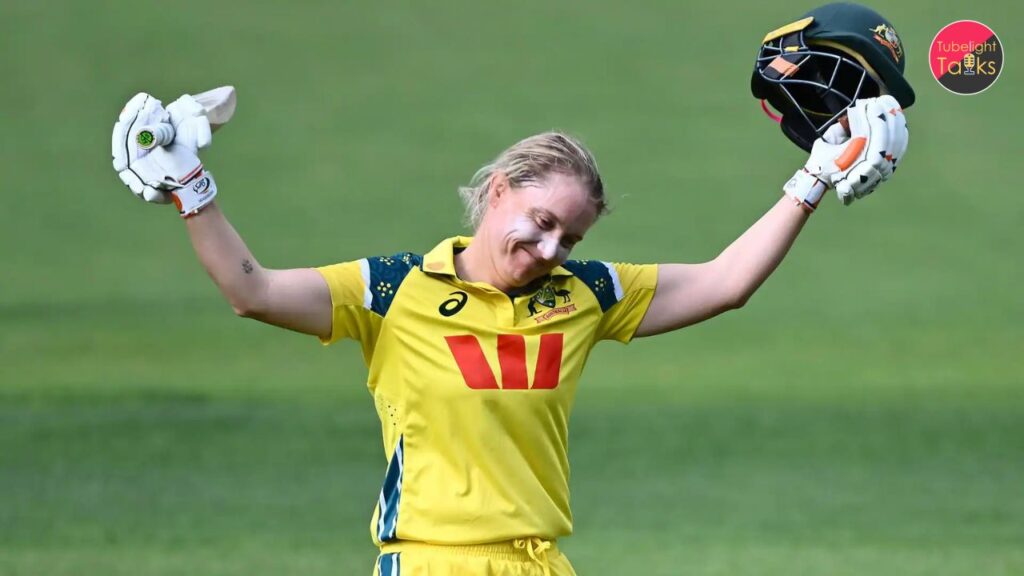
Healy’s post-match quotes are part of why this story feels so widely shared. She called cricket “a ridiculous sport” that can kick you down and then hand you a day like this – before saying:
“So thanks to the cricket gods for that and that’s a nice way to sign off in the yellow.”
It’s a short line, but it carries something heavy: gratitude mixed with disbelief, as if even she didn’t expect the game to give her this kind of ending.
The honesty: milestones can feel like curses
She also admitted she had “hated every milestone match,” and framed this farewell as an opportunity to simply enjoy it.
That honesty matters because elite athletes rarely say it out loud: milestone days often feel like traps, because everyone expects the fairy tale.
A Small Moment That Became Massive: Healy Bowling in Her Final ODI
Why two overs became an entire story
In a moment that made the farewell feel complete, Healy even bowled – something she had never done in international cricket – sending down two overs for 0/12.
It wasn’t about wickets. It was about agency: a captain choosing to experience every part of the game once, before leaving it behind.
And her explanation was pure Healy – laughing, pragmatic, almost mischievous.
That’s what fans love: greatness that still feels human.
What This Means for Healy’s ODI Legacy
Records and numbers that explain the scale
Cricket Australia’s feature piece laid out the numbers that stamp “legend” into fact:
- Eight ODI centuries (behind only Meg Lanning among Australian women).
- 3,777 ODI runs, placing her among Australia’s leading run-scorers.
- A career strike rate that pushed over a run-a-ball (reported as 100.69 after this match).
For women’s ODI cricket, that strike rate is not just impressive – it is disruptive. It changes how teams bowl, how fields are set, and how powerplay plans are written.
The standard she set as a wicketkeeper-batter
Healy is discussed as “one of the greatest” not only because of runs, but because of how she changed expectations for a wicketkeeper’s role. In modern cricket, wicketkeepers are expected to be batters; Healy didn’t just meet the expectation – she weaponized it.
Her farewell 158 was a reminder: the best wicketkeeper-batters don’t simply add value; they decide matches.
Why This Story Is Trending as “End of an Era”
Because it was a perfect ending in an imperfect sport
Most athletes don’t get a clean closing chapter. Injuries, selection, loss of form – something interrupts the script. Healy’s farewell was the rare exception: dominant, emotional, victorious, record-setting.
Because it carried a deeper message: retire on your terms
The Cricket Australia feature opened with Healy reflecting that very few athletes retire on their own terms – “even fewer” get a fairytale finish.
Then she did exactly that. That’s why it’s resonating beyond cricket.
The Wider Lesson: Greatness Is Also How You Leave
A farewell can teach a younger generation what excellence looks like
For young players watching – especially wicketkeepers and aggressive openers – this match becomes a template:
- train for brutality, but carry yourself with grace,
- chase records, but stay loyal to the team result,
- accept emotion, but don’t let it weaken execution.
This is the deeper reason farewell innings go viral: they’re not only highlights. They’re lessons.
Strength That Doesn’t Need Noise
Real greatness doesn’t only live in big scores – it lives in the attitude that comes with them. In the teachings shared by Sant Rampal Ji Maharaj, there is emphasis on humility, disciplined conduct, and living with dignity rather than ego – so that success doesn’t corrupt character.
Healy’s farewell carried that same undertone: she laughed at her own chaos, credited her teammates, spoke honestly about pressure, and valued the win even above the innings.
That is why this moment feels bigger than cricket. It shows that even at the peak – when the world is clapping – true strength is staying grounded, grateful, and responsible.
FAQs: Alyssa Healy’s “Fairytale Finish” – 158 in her final ODI game.
1. What did Alyssa Healy score in her final ODI?
She scored 158 off 98 balls.
2. What was the match result?
Australia made 409/7, India were 224 all out, and Australia won by 185 runs.
3. Where was the match played?
At Bellerive Oval, Hobart.
4. Did Australia win the series?
Yes, Australia completed a 3–0 ODI series sweep over India.
5. What did Healy say after her farewell innings?
She thanked the “cricket gods” and called it “a nice way to sign off in the yellow.”
Related Stories










Discussion (0)