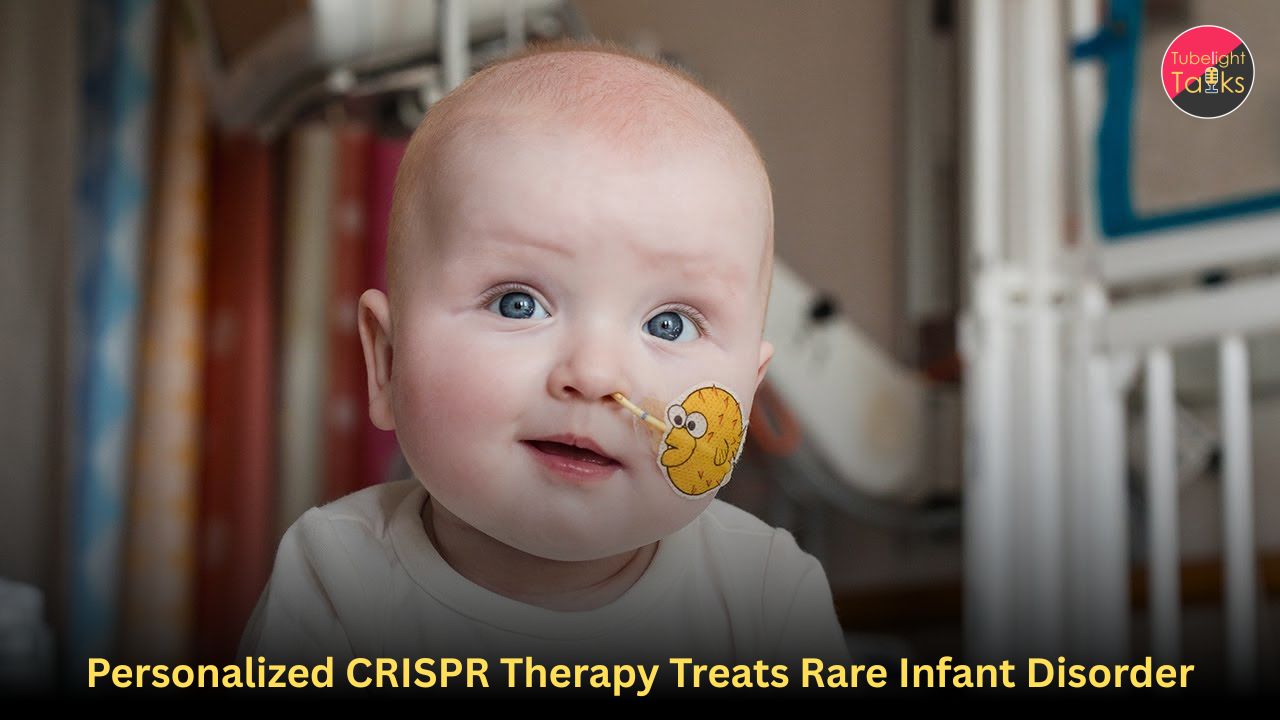
Personalized CRISPR Success: First Patient Receives Customized Gene-Editing Therapy for Rare Genetic Disorder
Scientists and doctors have documented a historic breakthrough in personalized medicine: an infant with a rare and life-threatening genetic disorder received a customized CRISPR gene-editing therapy. The child, known as KJ, was born with severe carbamoyl phosphate synthetase 1 deficiency, or CPS1 deficiency. Children’s Hospital of Philadelphia and Penn Medicine announced in 2025 that the therapy was developed and delivered for the child in a landmark first-of-its-kind case.
What Makes This Case Historic
This case is considered the first known personalized CRISPR-based medicine administered to a single patient. Instead of using a standard therapy for a common disease, scientists designed a treatment specifically for the child’s unique genetic mutation. That makes it a powerful example of “N-of-1” medicine, where a therapy is built for one individual.
The Disease: CPS1 Deficiency
CPS1 deficiency is a rare metabolic disorder that affects the body’s ability to process nitrogen waste from protein breakdown. This can lead to dangerous ammonia buildup in the blood, causing severe neurological damage or death if not controlled. NIH described the condition as life-threatening and incurable, and reported that the infant responded positively to the personalized gene-editing treatment.
Also Read: Cancer Treatment Breakthrough: Pfizer to Showcase Next-Generation Oncology Pipeline at ASCO 2026
How Fast the Therapy Was Developed
The Innovative Genomics Institute reported that a team of physicians and scientists developed and delivered the personalized in vivo CRISPR therapy in just six months. The patient, KJ, had a disease affecting about 1 in 1.3 million newborns. This rapid development timeline is one of the most important aspects of the breakthrough.
Published Scientific Evidence
The New England Journal of Medicine published the scientific report describing a workflow for rapid development of customized corrective gene-editing therapies for patients with ultrarare or unique genetic variants. This gives the breakthrough strong peer-reviewed medical importance.
Hope and Limitations
This breakthrough does not mean personalized CRISPR is ready for every rare disease patient. Nature reported that the treatment seemed effective, but questions remain about whether such bespoke therapies can be widely applied. Cost, safety testing, manufacturing timelines, regulatory pathways and long-term monitoring remain major challenges.
Future of Personalized Medicine
If the model becomes safer, faster and more scalable, it could transform treatment for ultra-rare genetic disorders. Many families struggle because rare diseases affect too few patients to attract traditional drug development. Personalized gene editing could change that by creating targeted therapies for individual mutations.
A New Direction for Rare Disease Families
For families facing rare genetic disorders, time is often the biggest enemy. Traditional drug development can take years, but children with severe inherited diseases may need help within months. This personalized CRISPR success shows a future where medicine may become faster, more flexible and more compassionate for patients who were previously considered untreatable.
Science Must Move With Responsibility
Gene editing has enormous power, but it also carries ethical responsibility. Every personalized therapy must be tested carefully for safety, unintended edits and long-term effects. The breakthrough should inspire hope, but also humility, because human biology is complex and every intervention must protect the dignity and safety of the patient first.
A New Hope for Ultra-Rare Diseases
Personalized CRISPR therapy represents a major shift in how medicine may treat ultra-rare genetic disorders. Many rare diseases affect only a small number of patients, which often makes traditional drug development slow and commercially difficult. A customized therapy designed for one patient’s exact mutation shows that future medicine may become more precise, faster, and more compassionate for families who currently have very limited options.
Ethical Responsibility in Gene Editing
Gene-editing breakthroughs bring hope, but they also demand strong ethical safeguards. Every personalized therapy must be tested for safety, accuracy, unintended changes, and long-term impact. Scientists, doctors, regulators, and families must work carefully so that innovation does not move faster than patient safety. This breakthrough should inspire confidence in medical science while reminding society that powerful technologies must be used responsibly.
Healing Beyond the Body
Medical science can correct defects in the body, but spiritual wisdom addresses the deeper suffering of the soul. Sant Rampal Ji Maharaj’s teachings explain that true worship gives strength in hardship and guides human beings toward salvation. His official teachings state that true worship is important because real mantras given by an authorized saint protect devotees in this uncertain world.
Call to Action
Support Rare Disease Research
Governments, hospitals and research institutions should build faster pathways for diagnosing and studying rare genetic diseases.
Trust Qualified Medical Guidance
Families should rely on genetic specialists, clinical trials and regulated medical systems rather than unverified gene-therapy claims.
FAQs: Personalized CRISPR Therapy Treats Rare Infant Disorder
1. What was the personalized CRISPR breakthrough?
Doctors developed and safely delivered a customized CRISPR therapy for an infant with CPS1 deficiency.
2. Who was the patient?
The patient was an infant known as KJ, born with severe CPS1 deficiency.
3. What is the CPS1 deficiency?
It is a rare metabolic disorder that prevents the body from properly processing nitrogen waste, leading to dangerous ammonia buildup.
4. Was this the first personalized CRISPR case?
It is reported as the first known personalized CRISPR-based medicine administered to a single patient.
5. Is personalized CRISPR widely available now?
No. It remains a highly specialized medical breakthrough requiring further safety, regulatory and scalability work.
Related Stories










Discussion (0)