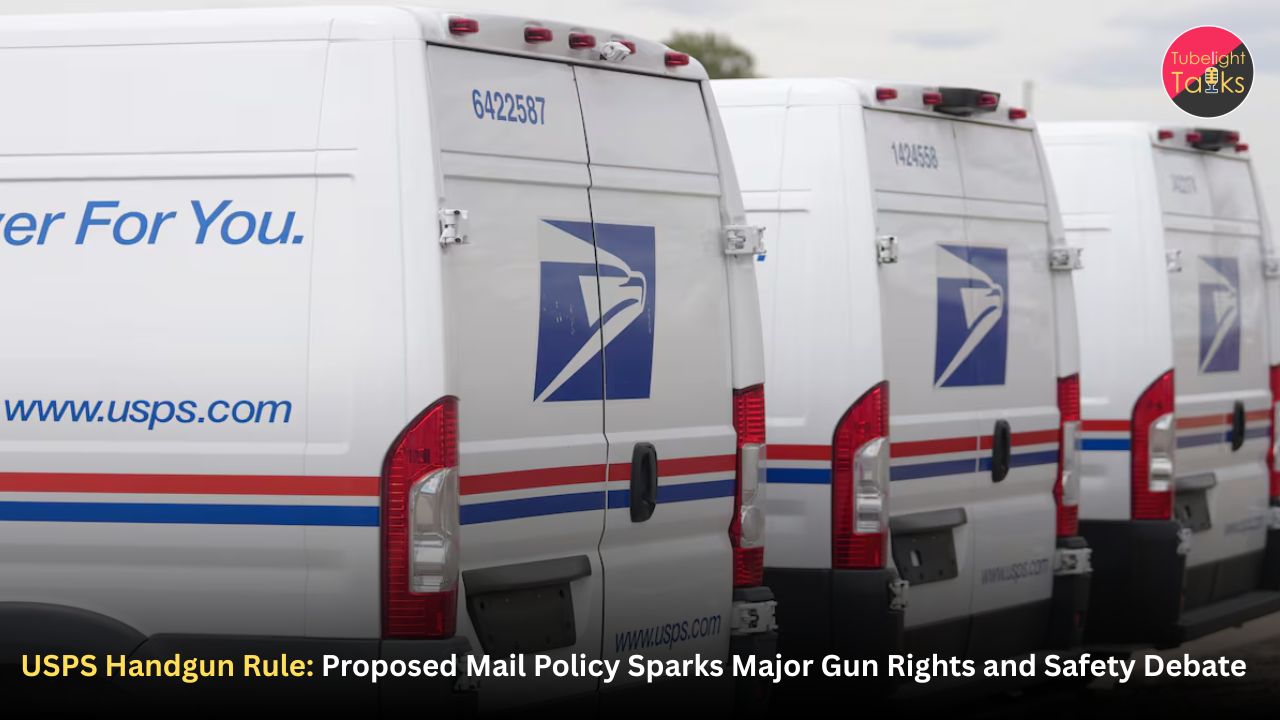
USPS Handgun Rule: Proposed Mail Policy Sparks National Debate Over Gun Rights, Safety and State Laws
The U.S. Postal Service is reviewing a controversial proposed rule that could allow handguns such as pistols and revolvers to be mailed through USPS for the first time since 1927. The proposal does not appear to be a final rule yet; USPS has said the public comment period ended on May 4 and that it is reviewing comments before making final changes.
The rule follows a January Department of Justice position that the nearly century-old ban on mailing concealable firearms is unconstitutional under the Second Amendment. Supporters say the change would bring handgun mailing rules closer to those for long guns and protect lawful firearm transport. Opponents, including attorneys general from about two dozen states, warn that the proposal could undermine state laws, complicate background-check enforcement and create new public-safety risks.
USPS Handgun Rule: What Is Being Proposed?
A Nearly 100-Year Ban Could Change
Since 1927, federal law has generally barred the mailing of concealable firearms through USPS except in limited circumstances involving licensed dealers, manufacturers, importers and certain official users. The proposed change would significantly expand who may mail mailable firearms, including concealable firearms, under revised standards. CBS, citing AP reporting, said handguns could be mailed through USPS for the first time in nearly 100 years if the proposed Trump administration rule takes effect.
USPS published the proposal in the Federal Register on April 2, 2026, under “Revised Mailing Standards for Firearms.” The document says mailers must comply with federal firearms regulations as well as state and local laws, and that USPS may require confirmation that the firearm is unloaded and eligible for mailing. It also describes conditions for intrastate shipments, shipments involving licensed firearms dealers, and other limited categories.
The proposal is therefore not a simple “mail any handgun anywhere” policy. It would still operate within federal, state and local legal requirements. However, critics argue that the practical difficulty of verifying compliance could make enforcement weak.
Not Yet Final
The most important clarification is that this is a proposed rule, not a fully finalized policy. USPS spokesperson David Walton told CBS News that the rule was proposed on April 2 to conform with the Department of Justice Office of Legal Counsel opinion on the constitutionality of 18 U.S.C. Section 1715, and that the public comment period ended close of business May 4. USPS said it is reviewing comments.
This means the final shape of the rule may still change. USPS could adopt it as proposed, revise it, delay it, or face further legal and political challenges before implementation.
Why the Justice Department’s Position Matters
DOJ Says the Old Ban Violates the Second Amendment
The change was triggered by a Department of Justice view that the 1927 restriction on mailing concealable firearms is unconstitutional. AP reported that DOJ argued the Second Amendment prevents the government from refusing to ship constitutionally protected firearms to and from law-abiding citizens simply because they are not licensed manufacturers or dealers.
This is the central legal argument behind the rule. The Trump administration’s position is that if USPS operates a parcel service and already permits some firearm shipments under restrictions, then a broad ban on concealable firearms unfairly burdens lawful gun ownership and transport.
Gun-rights supporters see the proposal as a correction to an outdated law. They argue that legal gun owners should not be forced into expensive or complicated alternatives when they need to ship firearms for lawful purposes.
Critics Say DOJ Cannot Override Congress
Opponents argue that the executive branch cannot simply decide not to enforce a law Congress passed. Nevada Attorney General Aaron Ford, who joined a multistate letter opposing the proposal, said the 1927 statute has stood for nearly a century without any court finding it invalid and that the executive branch cannot unilaterally permit conduct Congress prohibited.
This sets up a constitutional and administrative-law fight. One side frames the proposal as protecting a constitutional right. The other frames it as executive overreach and a threat to public safety.
What the Proposed Rule Would Allow
Intrastate Mailing Under Conditions
The Federal Register proposal says that mailable firearms intended for delivery within the same state may be shipped within that state, subject to state, territory or district regulations, and using services that provide tracking and signature capture.
This is why the rule has drawn attention around intrastate handgun mailing. Supporters argue that it would give lawful owners another transport option within their own state. Critics argue that the rule places too much trust in mailers to comply with complex state laws.
Out-of-State Situations Raise More Questions
The proposal also describes certain out-of-state mailing situations by non-licensed owners, including mailings related to lawful activities. The Federal Register text includes conditions, but opponents say USPS may not have a reliable way to ensure that packages comply with each state’s laws and eligibility rules.
This is one of the most controversial parts of the debate. State attorneys general warn that if handguns move through the mail in ways that state authorities cannot easily track, enforcement of background checks, waiting periods, licensing rules or possession restrictions could become harder.
Why State Attorneys General Are Opposing It
Public Safety Concerns
Attorneys general from about two dozen states have urged USPS to withdraw the proposed rule. AP reported that the state officials argue the proposal could make it easier for dangerous individuals to access firearms, undermine state gun laws and increase gun trafficking risks.
Nevada Attorney General Aaron Ford said the proposal would undo work states have done to curb gun violence and would make it easier for criminals and abusers to access firearms. His office said the multistate letter argued that the rule would harm public safety and state budgets.
These objections reflect broader concern about how firearms are regulated in a federal system where state laws differ widely. A rule that appears manageable in one state may create enforcement problems in another.
Enforcement Burden on States
Opponents say the proposed rule could place new burdens on state and local law enforcement. If firearms are mailed in ways that bypass local systems, police may need more tracking, investigation and coordination to determine whether a shipment was lawful. State officials also warn that illegal shipments could complicate gun-crime investigations.
This is not only a legal issue; it is an administrative issue. Laws are only as strong as enforcement systems. If the rule changes but enforcement does not improve, critics fear a gap between paper safeguards and real-world safety.
Gun-Rights Supporters See a Constitutional Win
Equal Treatment With Long Guns
Gun-rights groups argue that USPS already allows certain long guns, such as rifles and shotguns, to be mailed under strict conditions. They say handguns should not be treated differently if law-abiding citizens follow the law. AP reported that gun-advocacy groups support the change as a Second Amendment victory.
Supporters also argue that private carriers can be expensive, inconsistent or restrictive, making lawful firearm transport more difficult. They view USPS access as a fairness issue.
Practical Transport Argument
The Justice Department’s reasoning also includes the idea that lawful gun owners may need to transport firearms for recreational or lawful purposes. Some supporters say mailing can be safer than carrying firearms personally through multiple jurisdictions, especially when state transport laws are confusing.
Opponents respond that the same complexity is exactly why USPS should not expand mailing access without stronger verification.
The Core Debate: Rights Versus Risk
Second Amendment Argument
The constitutional argument is that lawful gun owners should not face a broad federal postal ban on mailing constitutionally protected firearms. Under this view, restrictions may be permitted, but a near-total ban on concealable firearms through USPS goes too far.
Public Safety Argument
The public safety argument is that handguns are easily concealable and frequently used in violent crime, so expanding mailing access could increase risk. Critics argue that even if most mailers comply, the policy may create opportunities for illegal diversion, straw purchases or shipments to prohibited persons.
State Authority Argument
State officials also argue that firearm rules differ by state because communities make different policy choices. A national postal rule, they warn, could weaken those choices by creating a transport channel that local authorities cannot easily monitor.
What Happens Next?
USPS Reviews Comments
USPS is now reviewing public comments after the May 4 deadline. The final decision could include revisions responding to state objections, gun-rights arguments, operational concerns or legal risk.
Possible Legal Challenge
If USPS finalizes the rule, legal challenges are likely. Opposing states may argue that USPS and DOJ exceeded executive authority by attempting to bypass a statute passed by Congress. Supporters may argue that the old statute cannot stand under current Second Amendment doctrine.
Congress Could Intervene
Because the original ban came from Congress, lawmakers may enter the debate. Congress could amend the law, clarify restrictions, impose new verification requirements or defend the old statute.
Law Enforcement Will Watch Closely
Police and prosecutors will watch whether the final rule gives them enough tools to detect illegal shipments, trace firearms and enforce state restrictions.
Also Read: Trump Media’s $400M Loss: Truth Social Parent Reports Massive Q1 Hit From Digital Asset Holdings
Why This Story Matters Beyond USPS
Postal Policy Becomes Gun Policy
At first glance, this may look like a postal-service rule. In reality, it is a national gun-policy fight. The question is not only whether USPS can carry a package. It is who controls firearm movement, how state laws are enforced, and how constitutional rights are balanced against public safety.
Federalism Is at the Centre
The dispute also highlights tension between federal authority and state law. Firearm policy in the United States varies widely by state. A national postal rule could affect how those state systems function.
Public Trust Is the Key Issue
Whether one supports or opposes the proposal, public trust is central. Citizens must trust that lawful rights are respected, dangerous people are blocked, and enforcement is real. If any part of that balance fails, the policy will remain controversial.
Law, Responsibility and Human Safety
The USPS handgun debate shows how deeply public policy depends on responsible human conduct. A law may define what is permitted, but safety depends on whether people act with honesty, restraint and respect for human life. Sant Rampal Ji Maharaj’s guidance on non-violence, truthful conduct, freedom from harmful habits and rejection of ego offers a serious moral reflection for this issue.
SatGyan teaches that power without discipline can become destructive, and the same applies to weapons, rights and public systems. A society may debate constitutional protections and state authority, but no right should be separated from responsibility. The real aim of governance should be to protect innocent lives while ensuring that rules are not misused through greed, anger, deception or negligence.
FAQs on USPS Handgun Rule
1. Has USPS finalized the handgun mailing rule?
No. USPS has proposed the rule and is reviewing public comments after the May 4 deadline. It has not been confirmed as a final rule in the latest verified reports.
2. Why is the rule controversial?
The rule is controversial because it could allow handguns to be mailed through USPS for the first time since 1927, raising debate over Second Amendment rights, public safety, gun trafficking and state-law enforcement.
3. Why did USPS propose the change?
USPS proposed the rule after the Department of Justice Office of Legal Counsel concluded that the federal ban on mailing concealable firearms is unconstitutional under the Second Amendment.
4. What does the Federal Register proposal say about state laws?
The proposal says mailers must comply with federal firearms regulations as well as applicable state and local laws.
5. Who is opposing the proposal?
Attorneys general from about two dozen states have opposed the proposal, warning that it could undermine state gun laws, increase trafficking risks and burden law enforcement.
6. What could happen next?
USPS may revise, finalize or delay the rule after reviewing comments. If finalized, the rule could face legal challenges from states or further action by Congress.
Related Stories










Discussion (0)