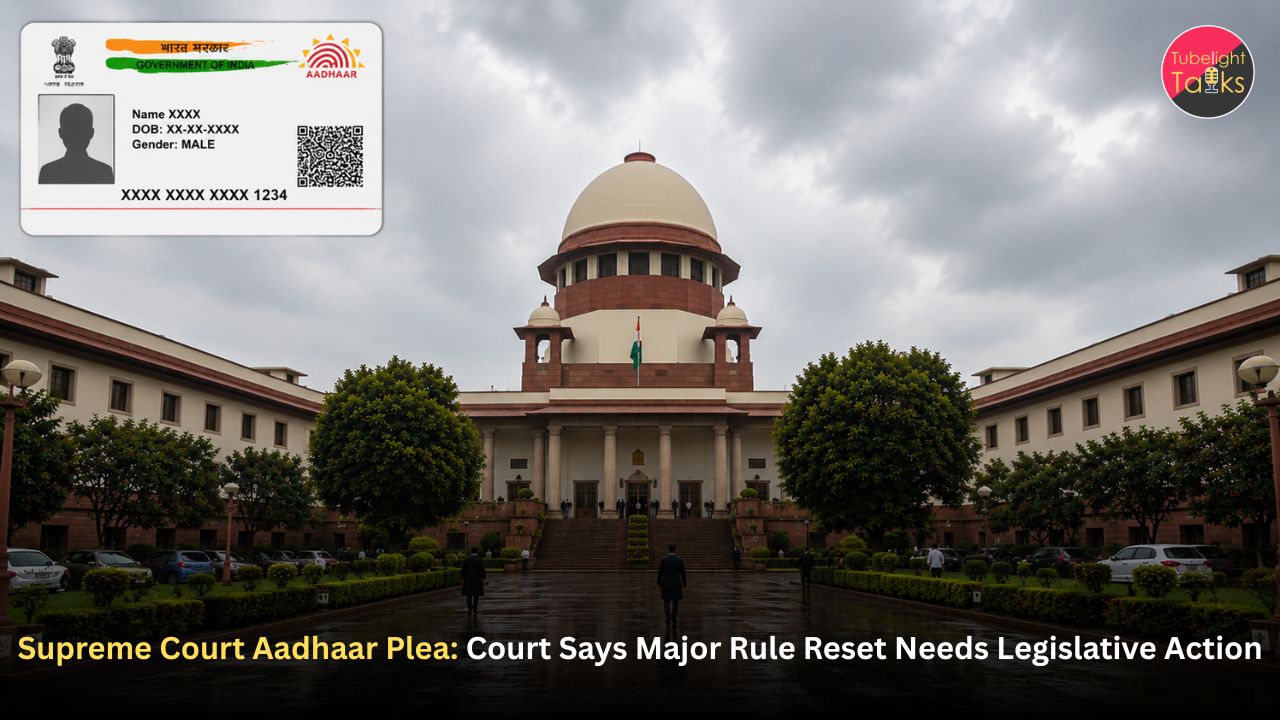
Supreme Court Aadhaar Plea: Court Says Rule Reset Requires Legislative Intervention, Not Direct Judicial Orders
The Aadhaar debate has returned to national focus after the Supreme Court considered a Public Interest Litigation seeking stricter rules for issuing Aadhaar numbers to adolescents and adults. The petition asked for new Aadhaar issuance to be restricted only to children up to six years of age and urged stronger verification norms for older applicants to prevent misuse by non-citizens.
The Supreme Court, however, said the reliefs sought would require legislative intervention and appropriate amendments to the existing legal framework. The court disposed of the petition without expressing an opinion on merits and directed that it be treated as a representation. UIDAI’s official position remains clear: Aadhaar is a proof of identity, but it does not confer citizenship or domicile rights.
Aadhaar Plea: What Was the Case About?
Petition Sought Stricter Issuance Rules
The petition was filed by advocate Ashwini Upadhyay through advocate Ashwani Dubey. It sought directions to the Unique Identification Authority of India to issue new Aadhaar numbers only to children up to six years of age. For adolescents and adults, the petition asked for stricter guidelines before enrolment. The stated concern was that weak verification may allow infiltrators to obtain Aadhaar and then use it to secure other documents such as ration cards, domicile certificates, driving licences and voter identity cards.
The plea argued that Aadhaar, originally designed as an identity document, has increasingly become a foundational document in everyday life. It is used for welfare delivery, bank accounts, mobile connections, subsidies and multiple public-service processes. Because of this wide use, the petitioner claimed that any misuse at the Aadhaar stage can create a chain effect across other identity and welfare systems.
Display Boards at Enrolment Centres
The PIL also sought directions for display boards at common service centres and enrolment locations stating that Aadhaar is only proof of identity and not proof of citizenship, address or date of birth. This demand reflects a larger public confusion: many people treat Aadhaar as an all-purpose identity, residence and citizenship document, even though official rules do not support that interpretation.
UIDAI’s own explanation says Aadhaar is a 12-digit random number issued to residents of India after verification, and any individual resident, irrespective of age and gender, may voluntarily enrol by providing demographic and biometric information. UIDAI also states that Aadhaar does not confer citizenship or domicile rights.
What the Supreme Court Said
Legislative Intervention Needed
A bench of Chief Justice Surya Kant and Justice Joymalya Bagchi said the nature of the reliefs sought in the plea required legislative intervention and appropriate amendments in the existing legal framework. The court told the petitioner that the issues should be raised before Parliament and the government, which could take appropriate steps.
This is important because the court did not reject the concerns as meaningless. Instead, it said the remedy sought was not something the court could directly impose through judicial directions without changes to law. Aadhaar issuance is governed by statute, rules and executive frameworks. If the eligibility structure or age-based enrolment system is to be changed substantially, Parliament and government agencies would have to act.
Petition Treated as Representation
The Supreme Court disposed of the petition with a direction that it be treated as a representation on behalf of the petitioner. This means the matter has effectively moved from the judicial forum to the executive and legislative policy space. The court did not give a ruling that Aadhaar issuance must be limited to children, nor did it direct immediate restrictions on adolescents or adults.
That distinction matters. Some public discussions may present the case as if Aadhaar rules have already changed. They have not. As of the latest verified position, Aadhaar enrolment rules remain governed by the existing framework unless the government or Parliament introduces changes.
Aadhaar Is Identity Proof, Not Citizenship Proof
UIDAI’s Official Position
UIDAI states that Aadhaar is proof of identity and that it does not confer any right of citizenship or domicile. This is one of the most important points in the debate. Aadhaar can help verify that a person is linked to a unique biometric identity, but it does not prove that the person is an Indian citizen.
This distinction is essential for government departments, banks, telecom companies, welfare bodies, schools, local administrations and citizens. If Aadhaar is wrongly treated as proof of citizenship, it can create legal and administrative confusion.
Resident-Based Identity System
Aadhaar is resident-based, not citizenship-based. UIDAI explains that any resident of India may voluntarily enrol after satisfying the verification process laid down by the authority. The enrolment process collects demographic information such as name, date of birth or age, gender and address, along with biometric information such as fingerprints, iris scans and facial photograph.
This resident-based design was meant to support welfare delivery, financial inclusion and identity verification. It was not designed as a citizenship register.
Also Read: Aadhaar Finally Reflects Ladakh Separately, Ending a Long Administrative Mismatch
Why the PIL Raised Public Concern
Aadhaar as a “Foundational Document”
The petition argued that Aadhaar has become a foundational document because it helps people obtain other documents and services. This is where the concern becomes serious. If a person obtains Aadhaar through weak verification, the number may later be used as supporting identity for other documents. The petitioner claimed this could allow non-citizens to become indistinguishable from citizens in administrative systems.
The concern is not only about one document. It is about document layering. One identity proof can help obtain another, which then helps obtain another. Over time, a weak first step may create a strong-looking identity chain.
Welfare Delivery and Public Resources
The plea also raised concerns that Aadhaar misuse could undermine targeted welfare delivery and divert public resources. Aadhaar is used for subsidies, direct benefit transfers, ration systems and other government schemes. If identity verification is weak, welfare benefits may be claimed by ineligible persons, while genuine beneficiaries may suffer.
At the same time, policymakers must avoid overcorrection. Any tightening of Aadhaar rules must not make it harder for poor, homeless, migrant, elderly or marginalized residents to access legitimate identity and welfare services. The challenge is to prevent misuse without excluding genuine residents.
The Balance Between Security and Inclusion
Need for Stronger Verification
The Aadhaar debate highlights a real governance challenge: India needs secure identity systems that prevent fraud, duplication and misuse. Better verification, stronger audit trails, document checks, local accountability and fraud detection can improve trust in the system.
If enrolment agencies accept weak or forged documents, the entire identity chain becomes vulnerable. Better training, digital verification and penalties for fraudulent enrolment can help.
Avoiding Exclusion of Genuine Residents
But strict rules must be designed carefully. Many Indians lack perfect documentation, especially poor families, migrants, disaster-affected people, elderly citizens, orphaned children and people living in informal settlements. A system that becomes too rigid may exclude the very people Aadhaar was meant to help.
Therefore, the correct policy response is not simply “make it harder.” It must be “make it accurate, fair and accessible.”
What Parliament and Government May Consider
Clearer Legal Distinction
The government may consider stronger public communication that Aadhaar is not citizenship proof. UIDAI already states this, but many agencies and citizens still misunderstand it. Display boards, official forms and digital portals can repeat the distinction clearly.
Stronger Adult Enrolment Checks
For adolescents and adults, verification could be strengthened through better document authentication, local verification protocols, fraud-risk scoring, audit reviews and stricter action against enrolment operators who accept false documents.
Separate Citizenship Verification
If a service requires citizenship, Aadhaar alone should not be accepted. That service should require documents legally recognized for citizenship or eligibility. This distinction can reduce misuse while preserving Aadhaar’s identity function.
Fraud Penalties
False enrolment, document forgery and collusion by officials or enrolment agents should carry strong penalties. Fraud prevention must target the network, not only the applicant.
Privacy Protection
Any stricter verification system must also protect privacy. India’s digital identity system handles sensitive personal and biometric information. Stronger rules should not create unnecessary surveillance or data misuse.
Why This Matters for Citizens
Aadhaar Still Remains Useful
Citizens and residents should understand that Aadhaar remains a valid identity document for many services. It is widely used for authentication, financial inclusion, welfare delivery and digital governance. UIDAI says Aadhaar can be freely used to prove identity and conduct transactions, while advising people not to share it openly on public platforms such as social media.
Aadhaar Should Not Be Shared Carelessly
People should treat Aadhaar with the same caution as bank details, PAN, debit cards or other sensitive identifiers. Sharing copies unnecessarily, posting Aadhaar online or giving it to unknown agents can create risk.
Citizens Should Know Its Limits
Aadhaar does not prove citizenship, domicile or date of birth. Knowing this helps citizens avoid administrative confusion and prevents institutions from misusing Aadhaar beyond its legal purpose.
Also Read: UIDAI Aadhaar Photocopy Ban 2025 Glory: QR Scans Shield New India’s Digital Soul
Legal Importance of the Court’s Approach
Court Avoids Policy Overreach
The Supreme Court’s approach reflects judicial restraint. Instead of rewriting Aadhaar policy through a direct order, it said the matter needs legislative and executive consideration. This preserves the separation of powers: courts interpret law, while Parliament and government make major policy changes.
Concern Moves to Policy Table
The issue is not closed in public policy terms. The petition has been treated as representation, meaning the government can examine it. Ministries, UIDAI and Parliament may consider whether the existing system requires changes.
No Immediate Rule Change
For the public, the most practical takeaway is that Aadhaar rules have not been suddenly reset. Any future change would require official notification, legislation or policy amendment.
Honest Identity and Public Trust
The Aadhaar debate is ultimately about trust: trust in documents, trust in welfare delivery, trust in citizenship processes and trust that public resources reach the right people. Sant Rampal Ji Maharaj’s guidance on honest living, rejection of cheating and corruption, and disciplined public conduct fits naturally into this issue because identity fraud is not only a legal violation; it is also a moral failure.
A person who secures documents through falsehood harms genuine beneficiaries and weakens public systems. At the same time, governance must remain compassionate so that poor and document-less residents are not unfairly excluded. A clean identity system requires both strong law and truthful conduct. When citizens, officials and institutions act honestly, digital governance becomes a tool of service rather than misuse.
FAQs on Supreme Court Aadhaar Plea
1. What was the Aadhaar PIL about?
The PIL sought directions to restrict new Aadhaar issuance to children up to six years of age and to create stricter guidelines for adolescents and adults to prevent misuse by infiltrators.
2. What did the Supreme Court say?
The Supreme Court said the reliefs sought required legislative intervention and appropriate amendments in the existing legal framework.
3. Did the Supreme Court change Aadhaar rules?
No. The court did not change Aadhaar rules. It disposed of the petition and directed that it be treated as a representation.
4. Is Aadhaar proof of citizenship?
No. UIDAI states that Aadhaar is proof of identity, but it does not confer citizenship or domicile rights.
5. Why did the petitioner raise concern?
The petitioner argued that weak verification could allow non-citizens to obtain Aadhaar and then use it to secure other documents and welfare benefits.
6. What may happen next?
The issue may now be considered by Parliament, the Union government, UIDAI and other stakeholders if they choose to examine stricter verification or legal amendments.
Related Stories








Discussion (0)