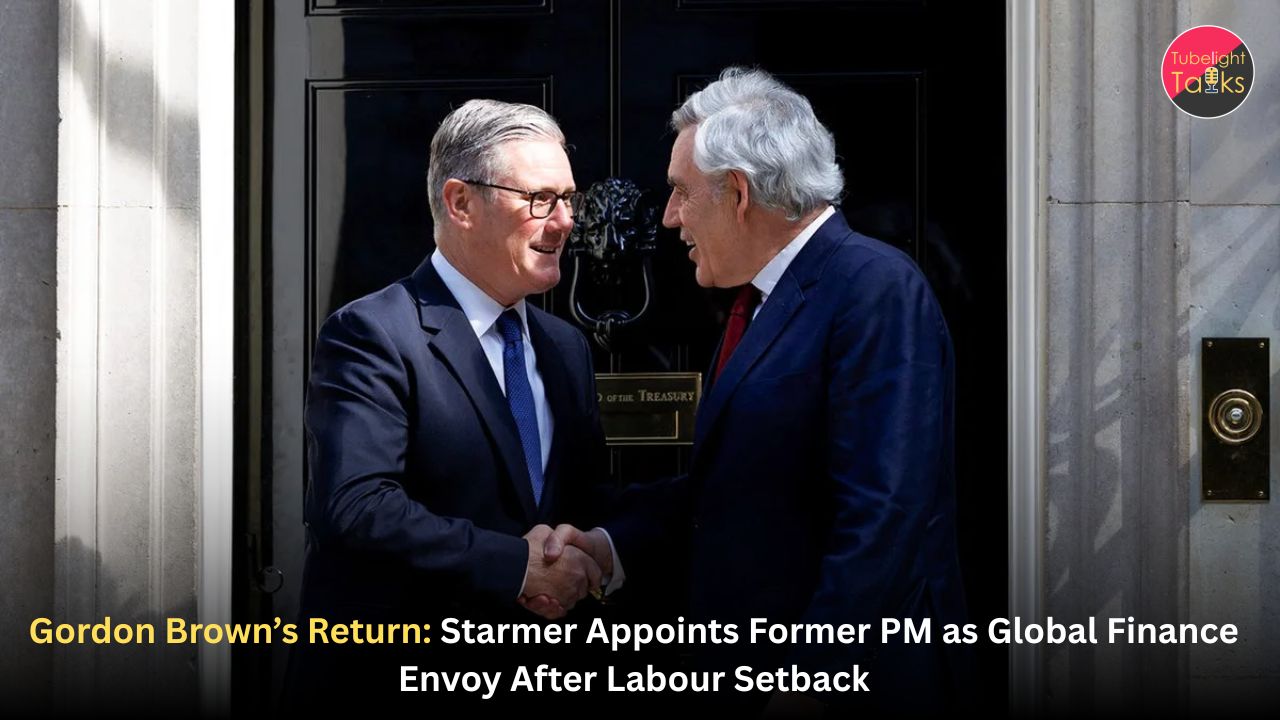
Gordon Brown’s Return: Keir Starmer Appoints Former PM as Global Finance Envoy After Labour’s Election Struggles
Former UK Prime Minister Gordon Brown has returned to a prominent public role after Prime Minister Keir Starmer appointed him as a special envoy on global finance and cooperation. The appointment comes at a politically difficult moment for Starmer, whose Labour government is facing pressure after heavy local election losses and growing concern among MPs about the party’s direction. Brown’s role will focus on strengthening international finance partnerships, exploring funding mechanisms linked to defence and global cooperation, and preparing for the UK’s 2027 G20 presidency.
Starmer has also brought in former deputy Labour leader Harriet Harman as an adviser on women and girls. Together, the appointments signal an attempt to steady Labour with veteran experience, economic credibility and policy direction after a bruising electoral setback.
Gordon Brown Returns to Labour’s Inner Policy Circle
Special Envoy on Global Finance and Cooperation
Gordon Brown’s new role is not a return to elected office or a ministerial post. He has been appointed as a special envoy on global finance and cooperation, an unpaid advisory position focused on international economic engagement. Reports say Brown will work on developing finance partnerships, strengthening Britain’s global role and supporting preparations for the UK’s 2027 G20 presidency.
This appointment fits Brown’s public profile. As Chancellor from 1997 to 2007 and Prime Minister from 2007 to 2010, he built his reputation around economic management, global financial coordination and crisis response. He was a central figure during the 2008 financial crisis and remains associated with multilateral economic cooperation.
For Starmer, bringing Brown back sends a message that the government wants serious economic experience at a time when voters are questioning Labour’s direction. It also signals that international finance, defence spending and global cooperation will remain central to the government’s next phase.
Harriet Harman Also Brought In
Brown is not the only Labour veteran being brought back. Starmer also appointed Harriet Harman as an adviser on women and girls. Anadolu reported that Starmer moved to shore up his leadership by naming Brown as special envoy on global finance and Harman as adviser on women and girls after Labour’s poor election performance.
The dual appointments show that Starmer is leaning on experienced Labour figures who carry institutional memory. Brown brings economic and global-finance credibility. Harman brings long-standing authority on equality, women’s rights and party experience.
However, this strategy also carries risk. Some Labour MPs and critics may see the move as reaching backward to old New Labour figures rather than producing a fresh political offer.
Why Starmer Made the Move Now
Labour Hit by Local Election Losses
The timing is important. Starmer’s appointments came after Labour suffered major local election setbacks. Reuters described the results as the worst losses for a governing party in municipal elections since 1995, while also reporting that pressure on Starmer had intensified inside Labour.
The losses have triggered serious political anxiety. A governing party expects mid-term pressure, but the scale of Labour’s setback appears to have shaken confidence in Starmer’s leadership and strategy. Reports say some Labour lawmakers have called for him to resign or set out a departure timetable, while others are demanding a major policy reset.
In that environment, Brown’s appointment is not only technical. It is political damage control. Starmer is trying to show that he has heard the warning and is strengthening his team.
Leadership Pressure Grows
Reuters reported that former minister Catherine West said she would challenge Starmer for the leadership if no stronger candidate stepped forward, while more than 20 Labour lawmakers had called for his resignation. Starmer, however, has said he will not walk away.
That makes Brown’s return part of a broader survival strategy. Starmer needs to reassure three groups at once: voters, Labour MPs and international partners. Voters need to see a government with direction. MPs need to see a leader responding to political danger. International partners need to see stability in Britain’s government.
Brown’s appointment may help with credibility, but it will not automatically solve Labour’s political problem. The public will judge Starmer by delivery, not personnel announcements alone.
What Brown Is Expected to Do
Global Finance Partnerships
Brown’s role will focus on building international finance partnerships. This may include working with allies, multilateral institutions and global economic forums to support Britain’s priorities. Financial Times reporting described the appointment as part of efforts to develop international finance partnerships and strengthen preparation for the UK’s 2027 G20 presidency.
The G20 angle matters because it gives Brown a future-facing diplomatic task. Britain will want to shape discussions around global growth, debt, climate finance, defence resilience, AI-related investment and financial stability.
Brown’s experience in global economic crisis management could be useful, especially if Starmer wants Britain to play a more active international coordination role.
Defence Funding Ideas
Reports also say Brown may explore multilateral funding mechanisms linked to defence spending. This is politically sensitive because Chancellor Rachel Reeves has resisted pressure to move defence funding outside the Treasury’s fiscal rules, though she has publicly supported Brown’s appointment.
This could become one of the most delicate parts of Brown’s work. Defence spending is rising as Europe faces security concerns linked to Russia, Ukraine and wider geopolitical instability. But public finances remain tight. Finding credible funding models without undermining fiscal discipline will be difficult.
Brown’s challenge will be to propose serious options, not headline ideas that collapse under Treasury scrutiny.
A Strategic Reset or Symbolic Gesture?
Why Supporters Welcome Brown
Supporters of the appointment will argue that Brown brings seriousness, experience and credibility. He understands financial markets, international institutions and economic crisis management. At a time when Labour is under pressure, an experienced former Prime Minister can help project stability.
Brown also has moral and policy authority in areas such as child poverty, global development and economic justice. If Starmer wants to reconnect Labour with its social mission, Brown’s voice may help.
Why Critics Are Skeptical
Critics may argue that bringing back Brown and Harman looks like a defensive move rather than a bold renewal. Some Labour MPs reportedly view the appointments as inadequate responses to the scale of the election losses.
The criticism is understandable. Voters who punished Labour in local elections may not be persuaded by advisory appointments. They may want lower living costs, better public services, stronger leadership, clearer migration policy, housing solutions and economic growth.
Brown can advise. He cannot substitute for political direction.
Labour’s Deeper Problem
Voter Trust Is Weakening
Local election losses often reveal public frustration before a general election crisis arrives. Labour’s setback suggests voters may be dissatisfied with delivery, communication or policy choices. Reform UK, Conservatives, Liberal Democrats and others may all be taking advantage of Labour’s weakness in different regions.
Starmer must now identify whether the problem is policy, personality, communication, economic pain, local government fatigue or a broader loss of confidence. Brown’s appointment addresses credibility, but Labour still needs a stronger message to voters.
Party Unity Under Strain
Leadership pressure creates internal instability. If MPs believe Starmer cannot recover, speculation may grow. If Starmer survives but does not change direction, resentment may continue. If he changes too sharply, he may look weak.
Brown’s return may calm some MPs, but others will ask for more: cabinet changes, policy shifts, public-service plans, tax clarity, housing action, migration policy or a new economic narrative.
Brown’s Legacy and Political Weight
Economic Crisis Experience
Brown’s biggest strength is his experience during financial crisis. As Prime Minister during the 2008 crash, he played a visible role in international banking coordination and fiscal response. Whether voters admire or criticize that record, few deny that he understands global finance.
That background makes him suitable for a role focused on international finance and cooperation.
Labour Moral Tradition
Brown also represents an older Labour tradition focused on poverty reduction, public responsibility and social justice. If used well, his return could help Starmer connect economic policy with moral purpose.
But Brown is also a figure from the past. Starmer must ensure that his government does not appear dependent on yesterday’s leaders to survive today’s crisis.
Also Read: Trump Media’s $400M Loss: Truth Social Parent Reports Massive Q1 Hit From Digital Asset Holdings
What This Means for UK Politics
Starmer Is Trying to Stabilise
The appointment shows that Starmer is trying to act before internal pressure becomes unmanageable. He is not resigning, but he is adjusting his political team and bringing in respected veterans.
Opposition Parties Will Attack
Opposition parties are likely to frame the move as panic after election losses. They may argue that Starmer is recycling old Labour figures because his current government lacks direction.
Labour MPs Will Watch Delivery
The next few weeks will matter. If Brown’s appointment is followed by clear policy action, it may help. If nothing changes beyond headlines, criticism inside Labour may return quickly.
Leadership, Experience and Public Trust
Gordon Brown’s return shows that political leadership is tested most sharply after public disappointment. In such moments, experience can help, but only when it is joined with humility, honesty and service. Sant Rampal Ji Maharaj’s guidance on truthful conduct, rejection of corruption and disciplined responsibility speaks meaningfully to public life because citizens lose faith when leaders treat power as status instead of duty.
SatGyan reminds people that ego and greed weaken judgment, while humility and righteous action strengthen trust. For Starmer, Brown and Labour, the real test is not whether senior names are appointed, but whether governance becomes more honest, compassionate and useful for ordinary people facing economic pressure.
FAQs on Gordon Brown’s Return
1. What role has Gordon Brown been given?
Gordon Brown has been appointed as a special envoy on global finance and cooperation by UK Prime Minister Keir Starmer.
2. Why has Brown been appointed now?
The appointment comes after Labour suffered heavy local election losses and Starmer faced growing pressure inside the party to reset his leadership and policy direction.
3. What will Brown focus on?
Brown is expected to focus on international finance partnerships, defence-related funding ideas and preparations for the UK’s 2027 G20 presidency.
4. Is Gordon Brown returning as a minister?
No. Reports describe his role as a special envoy/adviser, not a cabinet or ministerial position.
5. Who else has Starmer appointed?
Starmer has also appointed former deputy Labour leader Harriet Harman as an adviser on women and girls.
6. Will Brown’s appointment solve Labour’s crisis?
Not by itself. It may add economic credibility and experience, but Labour’s recovery will depend on policy delivery, voter trust, party unity and Starmer’s ability to respond to the election setback.
Related Stories







Discussion (0)