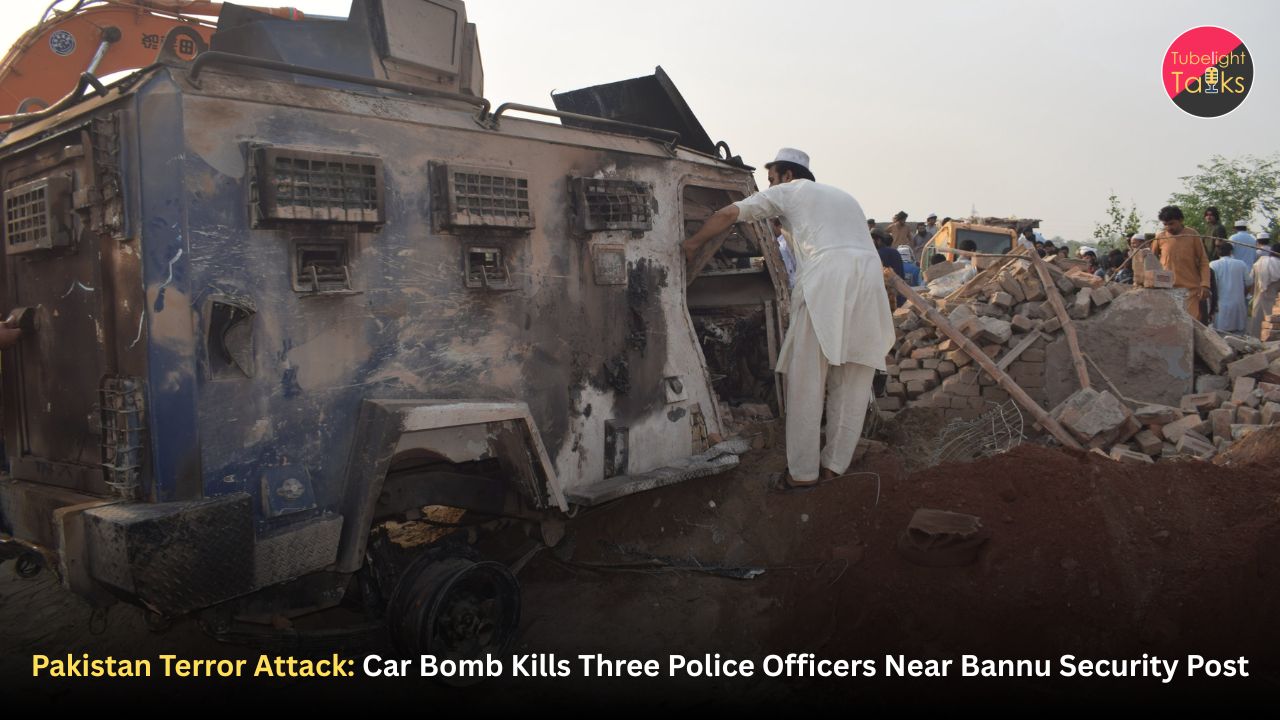
Pakistan Terror Attack: Car Bomb at Security Post Kills Three Police Officers in Northwest Pakistan
At least three police officers were killed in northwest Pakistan after a suicide bomber and armed militants attacked a security post near Bannu in Khyber Pakhtunkhwa, close to the Afghan border. Initial trending briefs linked the attack to the wider North Waziristan militancy belt, but the latest agency reports place the strike on the outskirts of Bannu, a district that has repeatedly faced militant violence. Officials said an explosives-laden vehicle was detonated near the police post, causing the structure to collapse and triggering fears that more personnel may be trapped under rubble.
A gunfight followed the blast as militants reportedly ambushed police reinforcements rushing to the site. No group immediately claimed responsibility, but officials suspect the Tehrik-e-Taliban Pakistan, known as the Pakistani Taliban.
Bannu Security Post Attack: What Happened?
Suicide Car Bomb Followed by Gunfire
The attack took place late Saturday near a police security post on the outskirts of Bannu. Police officials said a suicide bomber detonated an explosives-filled vehicle near the post, creating a powerful blast that destroyed the installation and damaged nearby structures. AP reported that multiple explosions were heard after the first blast and that the security post collapsed due to the force of the explosion.
Reuters reported that the car bombing was followed by an ambush on police personnel who were rushing to the scene to provide backup. This pattern suggests a coordinated attack, not a single isolated explosion. Militants appear to have used the car bomb to destroy the post and then opened fire to target responding officers.
Such tactics are familiar in militant attacks across the Afghanistan-Pakistan border region. A large blast creates chaos, collapses infrastructure and blocks immediate response. Armed attackers then exploit confusion to inflict further casualties or delay rescue operations.
At Least Three Police Officers Killed
At least three police officers were confirmed dead. Security officials warned that the toll could rise because many officers were believed to have been inside or near the post when the blast occurred. Reuters cited police official Sajjad Khan as saying that most of the 15 officers on duty at the post were feared dead, while AP reported that others may have been trapped or wounded under rubble.
The uncertainty around the casualty count reflects the severity of the blast. When a police post collapses, rescue teams must first secure the area from further militant fire before searching debris. That delay can increase the danger for trapped personnel.
Counter-Insurgency Operation Underway
Security Forces Continue Search and Clearance
Police and security forces launched an operation after the attack. AP reported that a fierce gunfight followed the explosion and that operations were still ongoing, according to police official Zahid Khan. This indicates that authorities were not treating the incident as a finished blast scene but as an active militant engagement.
Counter-insurgency operations after such attacks usually involve several urgent steps: clearing the area, searching for surviving militants, evacuating the wounded, checking for secondary explosives, securing roads, collecting forensic evidence, and tracing the attackers’ route. In areas like Bannu, security forces must also consider whether militants have withdrawn toward remote terrain or cross-border routes.
Backup Teams Targeted
The reported ambush on backup personnel is particularly concerning. It suggests that attackers may have anticipated the police response and positioned themselves to strike rescuers and reinforcements. This is a common high-impact militant tactic designed to increase casualties and slow emergency response.
For police forces, this raises operational challenges. Emergency response must be fast, but rushing blindly into a secondary ambush can be deadly. The attack will likely lead to reviews of how backup teams move toward blast sites in high-risk districts.
Why Bannu and the Border Region Remain Vulnerable
Strategic Location Near Militant Activity
Bannu lies in Khyber Pakhtunkhwa, close to Pakistan’s former tribal belt and near areas historically affected by militant networks. North Waziristan, South Waziristan, Lakki Marwat, Karak, Bannu and other districts in the region have seen repeated attacks on police, army personnel, security posts and checkpoints.
The terrain, proximity to the Afghan border, local militant mobility and long-running instability make the region difficult to secure. Militants can use remote areas, local sympathizers, cross-border links and rugged routes to plan attacks and escape.
Rise in Militancy Since Afghan Taliban Return
Pakistan has seen a rise in militant attacks in recent years, especially in Khyber Pakhtunkhwa and Balochistan. AP noted that suspicion often falls on the Pakistani Taliban because of its history of similar attacks and its links to the Afghan Taliban, though the TTP is a separate group. Pakistan has repeatedly accused Afghanistan’s Taliban authorities of sheltering TTP militants, while Kabul denies supporting attacks inside Pakistan.
This regional tension has made Pakistan’s internal security problem harder. Even when attacks occur inside Pakistan, the militant ecosystem is often connected to cross-border politics, safe havens, smuggling routes and ideological networks.
No Immediate Claim, But TTP Suspected
Why Suspicion Falls on Pakistani Taliban
No militant group immediately claimed responsibility for the Bannu attack. However, AP reported that suspicion fell on the Pakistani Taliban because of the group’s record of attacks on police and security forces. The TTP has frequently targeted police stations, checkpoints, convoys and security installations in northwest Pakistan.
The Pakistani Taliban has used suicide bombings, gun attacks, roadside explosives and coordinated assaults in the past. Its goal has often been to weaken state authority, punish security forces and create fear among local communities.
Claim May Come Later
Militant groups do not always immediately claim attacks. Sometimes they delay announcements for propaganda reasons, verification, internal communication or strategic ambiguity. In other cases, splinter groups may be involved, making attribution more complicated.
Authorities will likely examine forensic evidence, vehicle remains, explosive material, phone intercepts, militant movement, CCTV footage, intelligence reports and past threat patterns before assigning formal responsibility.
Police as Frontline Targets
Local Police Bear Heavy Risk
In Pakistan’s militancy-hit districts, police officers often face the first line of danger. They operate checkpoints, guard posts, escort convoys, respond to attacks and maintain local intelligence networks. Unlike army units, local police may be more exposed and less heavily equipped.
The Bannu attack again shows how militant groups target police to weaken everyday state control. If police posts become unsafe, ordinary citizens lose confidence in law enforcement and militants gain psychological advantage.
Morale and Protection Matter
The deaths of three officers will affect morale across the region. Police forces need better protective infrastructure, blast-resistant posts, surveillance systems, armored mobility, intelligence support and rapid medical evacuation. Officers stationed in high-risk zones must not feel abandoned.
At the same time, public recognition matters. Police personnel killed in such attacks leave behind families, children and communities. Their sacrifice should not disappear behind security statistics.
Civilian Impact and Local Fear
Nearby Areas Damaged
Al Jazeera, citing AP and Reuters, reported that nearby civilian areas also suffered severe damage due to the blast and that civilians were injured. Such attacks do not affect only security personnel. Explosions near posts can damage homes, shops, roads, vehicles and public infrastructure.
For local residents, the psychological impact is deep. A sudden explosion at night, followed by gunfire, creates fear that can last long after the attack ends. Families may avoid markets, children may miss school, and daily life may slow under security restrictions.
Militancy Hurts Local Development
Regions affected by repeated attacks often suffer economically. Businesses hesitate to invest, schools may face closures, health workers feel unsafe, and government development projects slow down. Terrorism weakens not only security but also education, employment and social confidence.
That is why counter-terrorism must include both force and development. Security operations are necessary, but long-term stability also requires jobs, education, roads, justice, health services and trust between communities and the state.
Also Read: New Orleans Terror Attack: Unveiling the Life of Shamsud-Din Jabbar
Pakistan-Afghanistan Tensions in the Background
Cross-Border Accusations Continue
The Bannu attack comes during a period of persistent Pakistan-Afghanistan tension. AP reported earlier this week that Afghanistan accused Pakistan of cross-border attacks in Kunar province, while Pakistan rejected the allegations and pointed to previous cross-border shelling from Afghanistan into Bajaur.
Pakistan blames the Afghan Taliban government for failing to act against TTP militants operating from Afghan soil. Afghanistan denies the accusation. This mutual blame has repeatedly strained relations and sometimes triggered border clashes.
Counter-Terrorism Needs Regional Coordination
Militant violence cannot be solved only by local policing if attackers benefit from cross-border movement. Pakistan and Afghanistan need intelligence sharing, border management, action against safe havens and mechanisms to prevent retaliatory escalation.
However, cooperation remains difficult because trust is low. Each side accuses the other of allowing hostile elements to operate. Militants benefit from that distrust.
What Authorities May Do Next
Intensify Security Operations
Security forces are likely to expand operations in Bannu and nearby districts. This may include raids, checkpoints, search operations, intelligence sweeps and tracking of suspected militant facilitators.
Review Police Post Security
The destruction of the post may lead to a review of vulnerable installations. Authorities may reinforce barriers, change perimeter layouts, install cameras, improve night surveillance and restrict vehicle access near posts.
Trace the Vehicle and Explosives
Investigators will try to identify where the explosives-laden vehicle came from, who prepared it, who drove it, and whether local facilitators helped. Vehicle identification can be crucial in tracing the network.
Protect Rescue Responders
Because backup teams were reportedly ambushed, police may revise emergency response drills to reduce vulnerability after blasts.
Why the Attack Matters Regionally
Militant Confidence Signal
A successful car bombing against a police post sends a propaganda signal for militants. It shows capability, planning and willingness to target state security infrastructure.
Pressure on Pakistan’s Security Policy
The attack increases pressure on Pakistan’s government and security establishment to show results. Public anger grows when attacks continue despite repeated operations.
Risk of Retaliatory Escalation
If Pakistan links the attack to cross-border sanctuaries, pressure may rise for tougher action near or across the Afghan border. That could further strain Pakistan-Afghanistan relations.
Courage, Peace and the Value of Human Life
This attack is another painful reminder that terrorism destroys far more than buildings; it tears families apart, spreads fear and hardens society into cycles of revenge. Sant Rampal Ji Maharaj’s teachings against violence, intoxication, corruption, cruelty and moral decline offer a necessary reminder at such moments. SatGyan places value on righteous conduct, compassion and the understanding that every human life is precious.
A society facing terrorism needs strong security action, but it also needs moral reform so that young minds are not pulled toward hatred, bloodshed or extremist influence. The families of the slain police officers need justice and support, while the wider region needs a path where courage is joined with restraint, and security is joined with humanity.
FAQs on Pakistan Terror Attack
1. Where did the Pakistan terror attack take place?
The attack took place near a police security post on the outskirts of Bannu in Khyber Pakhtunkhwa, close to the Afghan border.
2. How many police officers were killed?
At least three police officers were confirmed killed, though officials feared the toll could rise because more personnel were believed to be trapped or wounded.
3. What type of attack was it?
Officials said a suicide bomber detonated an explosives-laden vehicle near the police post, after which armed militants opened fire and ambushed responding police personnel.
4. Did any group claim responsibility?
No group immediately claimed responsibility, but officials suspect the Pakistani Taliban because of its history of similar attacks in the region.
5. Why is the region vulnerable?
Bannu and nearby districts lie close to Pakistan’s former tribal belt and the Afghan border, where militant networks have historically operated and where cross-border tensions remain high.
6. What happened after the blast?
Security forces launched a counter-insurgency operation, and a gunfight followed the explosion. Rescue and clearance operations continued as authorities searched for attackers and survivors.
Related Stories





Discussion (0)