Lakhpati Bitiya: President Murmu Launches Bold Financial Vision for Girls
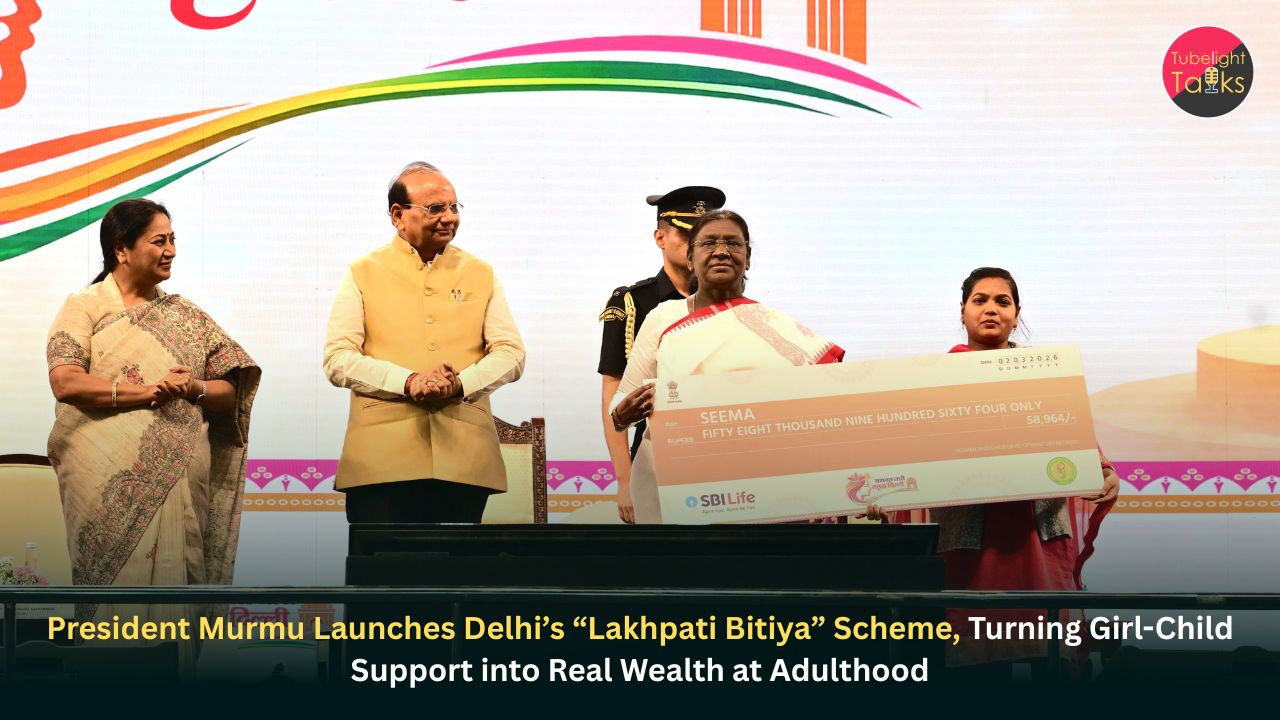
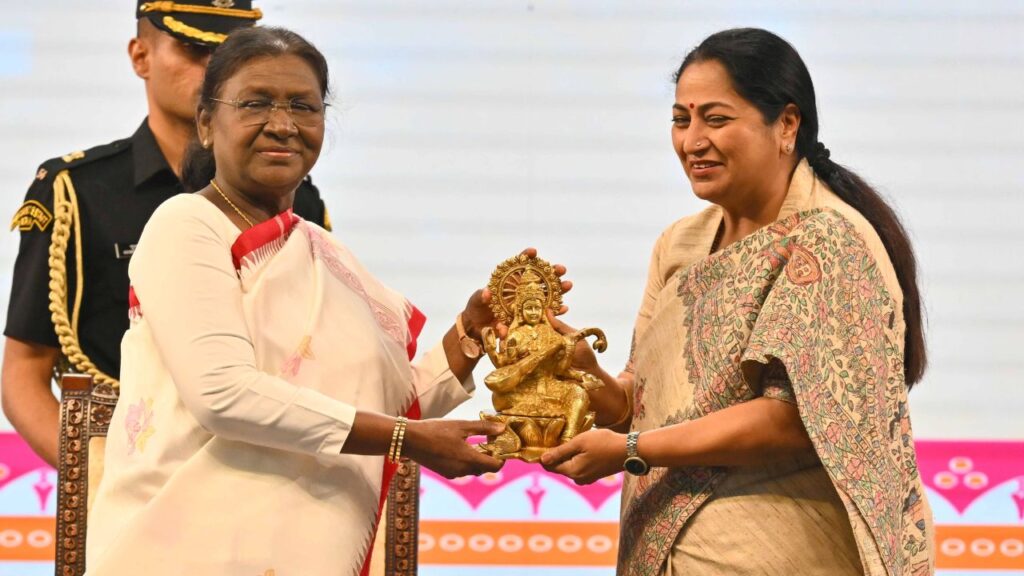
On Monday, March 2, 2026, President Droupadi Murmu launched the Delhi Lakhpati Bitiya Yojana at a major programme titled “Sashakt Nari, Samriddh Delhi” at the Indira Gandhi Indoor Stadium.
This is not a routine subsidy announcement. It is a policy shift: Delhi is restructuring the older Ladli scheme into a stronger, milestone-linked savings corpus – designed to mature into ₹1 lakh+ for eligible girls by the time they reach adulthood.
The core idea is direct and hard: a girl’s education and independence should not collapse under household financial stress – and the state is now trying to “pre-fund” her freedom.
Why This Scheme Is Being Called a Turning Point
It targets the moment families silently break a girl’s future
In many households, the turning point is not ideology – it’s money.
A father loses work. A medical bill arrives. Rent increases. A sibling needs coaching. And suddenly, the daughter’s education becomes the first negotiable item. The tragedy is quiet, and the consequence lasts decades: early dropout, reduced employment options, and dependence that becomes “normal.”
Delhi’s upgraded approach tries to block that collapse with a structure that keeps paying as long as the girl keeps moving through education milestones – so the household is repeatedly incentivized to choose school over surrender.
Also Read: President Murmu Launches Lakhpati Bitiya Scheme for Delhi’s Daughters
It reframes support from “small help” to “wealth creation”
President Murmu, in her address, emphasized that empowerment becomes real when a woman has the freedom to make decisions, and that empowered women can change the direction of society and the nation.
That statement lands because this scheme is literally about decision-making power: when adulthood begins with a protected corpus, a girl can say yes to college, skill training, or a new start – without begging for permission or taking predatory debt.
What the Delhi Lakhpati Bitiya Yojana Actually Does
A strengthened, restructured version of the Ladli scheme
News On AIR states clearly that the existing Ladli Scheme has been expanded and restructured into the Delhi Lakhpati Bitiya Yojana.
The philosophy remains milestone-linked support, but the “end goal” has been sharpened: to ensure long-term financial security and a meaningful maturity amount.
Deposits across life stages, not a one-time payout
Under the earlier Ladli structure described by News On AIR, deposits were made at birth (different amounts for institutional vs home birth) and at key schooling milestones like admission to Classes 1, 6, 9, passing Class 10, and admission to Class 12.
The new scheme is presented as significantly enhanced in both assistance and vision – moving toward the “lakhpati” maturity target.
The commonly reported financial design
Multiple reports explain the redesigned scheme as a total support structure that can reach ₹1 lakh (or more with interest), with deposits continuing from birth through graduation/diploma milestones, subject to conditions.
The policy intent is to ensure the corpus is not consumed early, but instead strengthens as the girl progresses.
Who Benefits: Eligibility and Targeting
Income ceiling and residency conditions
News On AIR and NDTV both report a key eligibility threshold: families with annual income not exceeding ₹1.2 lakh and Delhi residency of at least three years, with the girl child born in Delhi.
This targeting matters because the scheme is meant for households where financial stress is most likely to derail education.
Cap and coverage logic
NDTV reports that two girl children per family are eligible.
This is a policy balancing choice: widen support while staying within fiscal limits.
Registration windows and entry points
NDTV reports registration can be done within one year of birth, or later at key education entry points (Classes I, VI, IX, XI) or a recognized graduation/diploma course.
This flexibility is important because many vulnerable families miss early registration due to documentation barriers – so entry points at school admissions matter.
When the Money Can Be Claimed and Why That Matters
The maturity conditions are tied to education and age
NDTV reports that the deposited amount earns interest and can be claimed after passing Class XII and turning 18, or after completing graduation/diploma and turning 21.
This design does two things at once:
- It creates a discipline that keeps the benefit linked to educational progress.
- It delays cash access until the ages when major life decisions are made.
Why linking it to education is not “control,” it’s protection
In the real world, a girl’s maturity payout can be threatened by family pressure – especially where early marriage is normalized. That is why many such schemes embed safeguards. NDTV reports that if the girl is married before 18, the benefit will be cancelled.
Whether one agrees with every condition, the policy intent is clear: the state is trying to keep the corpus aligned to education and adulthood – not diverted earlier.
A Bigger Message Hidden Inside a Welfare Scheme
The state is acknowledging that women’s empowerment is not only “safety”
Empowerment is often talked about in terms of safety, mobility, and awareness. Those matter. But financial independence is the lever that sustains everything else.
President Murmu’s speech is explicit about this reality: women face violence, economic inequality, social stereotypes, and neglect, and empowerment becomes real when women can make decisions freely and live with self-respect.
This scheme is trending because it tries to operationalize that statement into money that grows over time.
It’s also a direct nudge toward women-led development
The President noted India’s move beyond empowerment toward women-led development, and called for collective responsibility – society, not only government, must support women.
A scheme like this becomes a test of that idea: if families actively keep girls in school to unlock benefits, it becomes a social movement, not only a government plan.
What “Success” Will Look Like for This Scheme
Success is not the announcement; it is the last-mile delivery
Schemes fail for predictable reasons: slow processing, complex paperwork, weak grievance systems, and families not knowing how to apply. The strongest policy design collapses if the process is confusing.
The Delhi government has framed the scheme as part of a broader women-centric package launched at the same event.
So implementation will be judged publicly: beneficiaries must actually receive the support without chasing it for years.
The measurable outcomes that will matter
If this scheme works as intended, the city should see:
- lower dropout rates for girls at Class 9–12 transition points
- higher transition into graduation/diploma routes
- increased age of marriage among beneficiaries
- greater participation of women in skill training and entry-level work
- stronger household spending on girls’ education without fear of collapse
Those outcomes would make it a genuine “wealth creation” policy, not just a slogan.
The Human Truth: A Girl’s Future Often Dies from Small Cuts
One of the cruelest things about inequality is that it does not always strike with one big blow. It bleeds slowly: one unpaid fee, one missed exam, one year lost, one “we’ll see next year.” A maturity corpus cannot solve everything, but it can prevent the most common type of collapse: financial helplessness at the moment the girl needs support the most.
In that sense, “Lakhpati Bitiya” is heavy because it is an admission: too many girls have been forced to become adults without resources, without mobility, and without bargaining power. This scheme tries to change that starting line.
Building Dignity Through Responsible Support
President Murmu’s address speaks repeatedly about self-respect, decision-making ability, and the collective duty to support women.
This aligns naturally with a deeper moral idea taught in the satsang tradition of Sant Rampal Ji Maharaj: that a society becomes truly civilized when it protects the vulnerable, removes discrimination, and builds systems that reduce suffering rather than normalize it.
When a state creates a protected financial path for girls – and when families uphold that path through education – this is not merely “financial policy.” It is social reform in action: turning dignity into structure, not just words.
FAQs: Lakhpati Bitiya” – President Murmu launches bold financial vision for girls.
1. What is Delhi’s Lakhpati Bitiya Yojana?
It is a revamped version of the Ladli scheme designed to build a milestone-linked corpus so eligible girls can reach adulthood with ₹1 lakh or more (with interest).
2. Who launched the scheme and when?
President Droupadi Murmu launched it on March 2, 2026 at the “Sashakt Nari, Samriddh Delhi” programme.
3. Who is eligible (as reported)?
Reports state the girl must be born in Delhi, the family must have lived in Delhi for at least three years, and annual family income should be up to ₹1.2 lakh (with a cap of two girls per family).
4. When can the money be claimed?
After passing Class XII and turning 18, or after completing graduation/diploma and turning 21, as reported.
5. Are there key conditions attached?
Reported safeguards include education from a recognized institution and cancellation if the girl is married before 18.
Related Stories







Discussion (0)