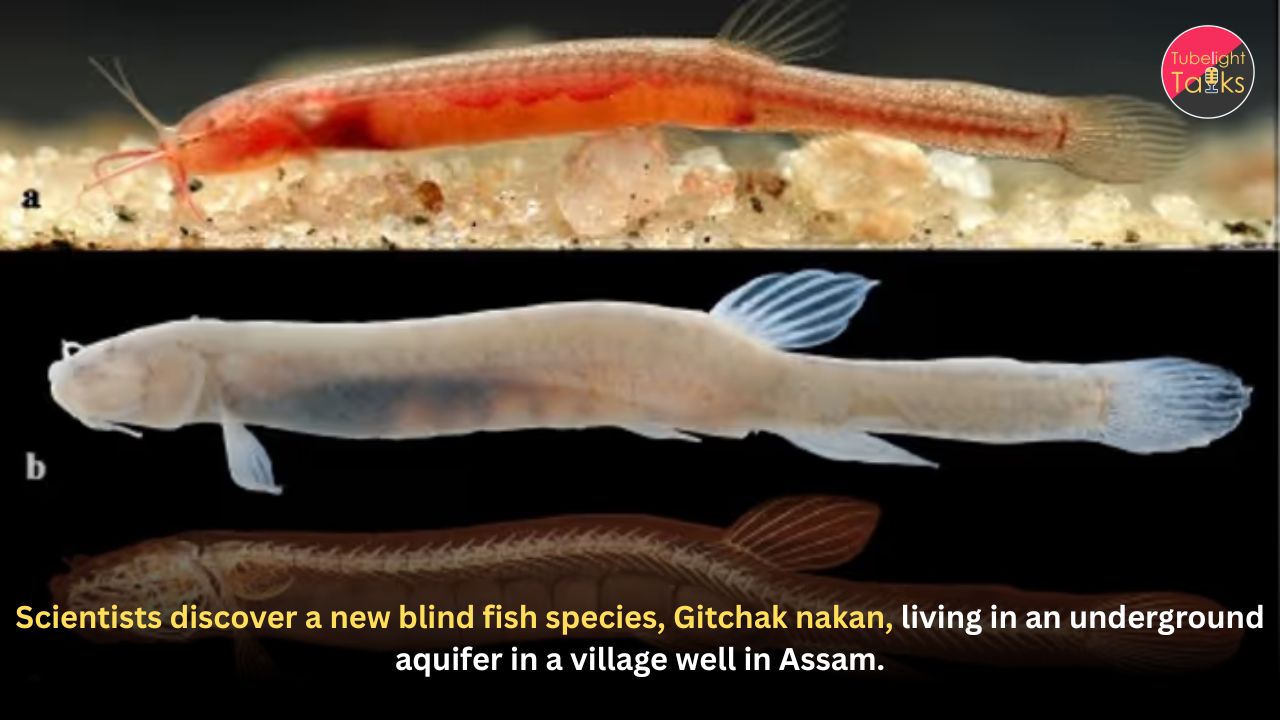
Gitchak nakan: The Blind Fish Discovery in a Village Well
In an extraordinary scientific discovery, researchers have identified a new species of blind fish living in an underground aquifer connected to a village well in Assam. The fish, named Gitchak nakan, survives in complete darkness and has evolved unique characteristics suited for life beneath the Earth’s surface.
Unlike surface-dwelling fish, it lacks functional eyes and relies on heightened sensory abilities to navigate its environment. The discovery highlights the remarkable adaptability of life and offers scientists valuable insight into subterranean ecosystems. It also reminds us that even familiar places can hide unknown forms of life waiting to be discovered.
A Rare Glimpse into Underground Ecosystems
Life in complete darkness
Subterranean aquatic ecosystems exist in caves, aquifers, and underground water channels. Species living in these environments often develop unusual adaptations, such as the loss of eyesight and enhanced sensory organs.
The newly discovered Gitchak nakan is believed to have evolved these traits over generations, allowing it to survive in an environment where sunlight never reaches.
Why scientists find these species fascinating
Blind cavefish and aquifer fish are important for understanding evolutionary biology. Their adaptations help scientists study how organisms evolve when environmental conditions change dramatically.
These species also help researchers understand how groundwater ecosystems function and how sensitive they may be to environmental disturbances.
Also Read: Two New Earthworm Species Discovery in Kerala’s Silent Valley
Discovery in an Unexpected Place
A simple village well
The fish was discovered in a hand-dug village well, highlighting how underground water systems can connect to human settlements.
What appeared to be an ordinary well turned out to be a window into an unseen ecosystem beneath the ground.
International research collaboration
The discovery involved researchers studying biodiversity in underground aquatic environments. Their work demonstrates how collaboration between scientists from different countries can reveal hidden biodiversity.
Why This Discovery Matters
Understanding groundwater biodiversity
Groundwater habitats are among the least explored ecosystems on Earth. Discoveries like this help scientists map biodiversity in underground water systems.
Protecting fragile ecosystems
Subterranean species are often extremely sensitive to environmental changes such as pollution or groundwater depletion. Discovering them helps scientists advocate for better conservation of underground water resources.
Expanding knowledge of evolution
The adaptation of species like Gitchak nakan shows how life can evolve in extreme conditions. Studying such species can provide insights into evolutionary processes and biological resilience.
Why This Story Is Trending
A “hidden world” beneath our feet
Stories about undiscovered species always capture public imagination. The idea that a new fish species was found in a common village well makes the discovery even more fascinating.
A reminder that biodiversity still holds surprises
Despite modern science and technology, countless species remain unknown to humanity. Each discovery adds another piece to the puzzle of Earth’s biodiversity.
Respecting the Hidden Life Around Us
The discovery of Gitchak nakan reminds us that life exists in places we rarely think about. Underground ecosystems, forests, rivers, and oceans all contain delicate forms of life that depend on environmental balance. Spiritual teachings shared by Sant Rampal Ji Maharaj emphasize compassion toward all living beings and responsible living that avoids harming nature.
When humans respect the natural world and protect ecosystems, they help preserve the extraordinary diversity of life that exists both above and beneath the Earth’s surface.
FAQs: Gitchak nakan” — The blind fish discovered in a village well in Assam.
1. What is Gitchak nakan?
It is a newly discovered species of blind fish found in an underground aquifer in Assam.
2. Where was the fish discovered?
In a hand-dug village well connected to underground groundwater systems.
3. Why does the fish not have functional eyes?
It evolved in complete darkness, where eyesight is not necessary for survival.
4. Why is this discovery important?
It helps scientists understand underground ecosystems and evolutionary adaptations.
5. What does the discovery reveal about biodiversity?
It shows that many species still remain undiscovered in hidden ecosystems.
Related Stories










Discussion (0)