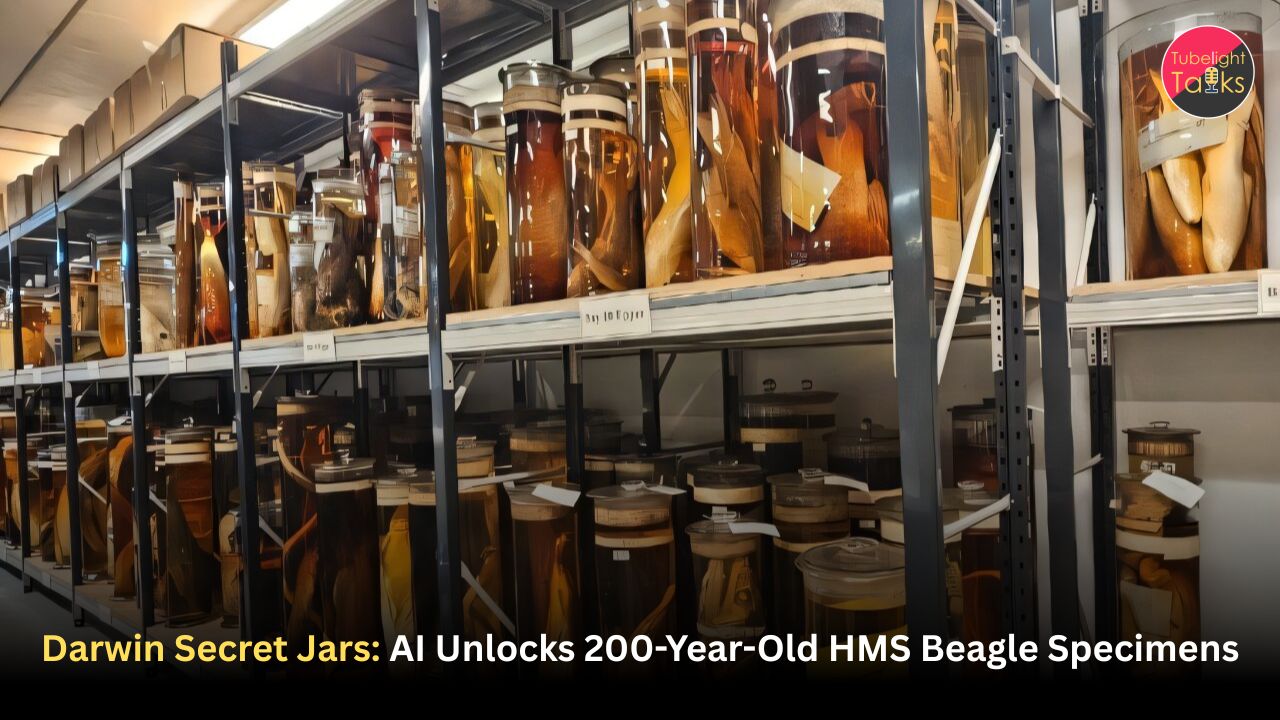
Darwin Secret Jars Revealed: AI Studies 200-Year-Old HMS Beagle Specimens
Scientists have achieved a remarkable breakthrough by using advanced imaging technology and artificial intelligence to analyze biological specimens collected during Charles Darwin’s historic HMS Beagle voyage—without opening the Darwin secret jars that have preserved them for nearly 200 years. Traditionally, studying these specimens required breaking the original seals, risking damage to priceless historical material.
The new technique uses high-precision laser imaging combined with AI analysis to examine the contents and chemical composition inside the jars. This innovation allows researchers to uncover new scientific insights while preserving the integrity of one of the most important collections in the history of evolutionary science.
Why Darwin’s Specimens Are So Important
The HMS Beagle expedition
Between 1831 and 1836, Charles Darwin traveled aboard the HMS Beagle, collecting plant, animal, and geological specimens from around the world.
These collections later played a critical role in shaping Darwin’s groundbreaking ideas about evolution and natural selection.
Historical scientific treasures
Many of these specimens remain stored in museum collections around the world. Because they were preserved using 19th-century techniques, opening their containers today could damage them or alter their chemical composition.
How the New Technology Works
Laser-based imaging
Researchers use highly precise laser scanning to examine the contents of sealed glass jars. This method allows scientists to observe internal structures without physically disturbing the specimens.
Artificial intelligence analysis
AI algorithms analyze the data collected from imaging scans, identifying biological structures and chemical patterns that might otherwise remain hidden.
The combination of these technologies allows scientists to extract valuable information from historical specimens safely.
Also Read: Spinosaurus mirabilis: The “Hell Heron” Discovery in the Sahara
Why This Is a Major Scientific Breakthrough
Preserving historical artifacts
One of the biggest advantages of the new technique is that it protects priceless scientific artifacts. The original jars and seals remain untouched, preserving their historical authenticity.
Discovering new information
Even though the specimens were collected nearly two centuries ago, modern technology can reveal new biological and chemical details that scientists in Darwin’s time could not observe.
Connecting past science with future innovation
The breakthrough demonstrates how modern technology can enhance historical research. By combining AI with advanced imaging, scientists can unlock knowledge stored in museum collections worldwide.
Try Random Object Generator Free Tool by usefulaitool.com
Why This Story Is Trending
A blend of history and modern technology
The idea that 2026 technology can analyze specimens collected in the 1800s has fascinated both historians and technology enthusiasts.
A “scientific time machine”
Many science communities describe the technique as a time machine—allowing researchers to revisit historical discoveries with modern tools.
Science, Knowledge, and Responsible Use
Scientific discoveries become truly valuable when they are used responsibly for the benefit of humanity. Spiritual teachings shared by Sant Rampal Ji Maharaj emphasize that knowledge and intelligence should guide people toward wisdom and positive change.
In the same way, technologies like artificial intelligence should serve humanity by advancing understanding, protecting knowledge, and preserving history rather than causing harm. The study of Darwin’s preserved specimens beautifully illustrates how science and responsibility can work together to expand knowledge while respecting the past.
FAQs: AI unlocks Charles Darwin Secret Jars
1. What are Darwin’s “secret jars”?
They are preserved biological specimens collected during Charles Darwin’s HMS Beagle expedition.
2. Why were the jars kept sealed for so long?
Opening them could damage the specimens and compromise their historical integrity.
3. What technology is used to study them now?
Scientists use laser imaging and artificial intelligence to analyze the contents without opening the jars.
4. Why is this breakthrough important?
It allows researchers to study historical specimens while preserving them.
5. How old are these specimens?
Many were collected during Darwin’s voyage between 1831 and 1836, nearly 200 years ago.
Related Stories










Discussion (0)