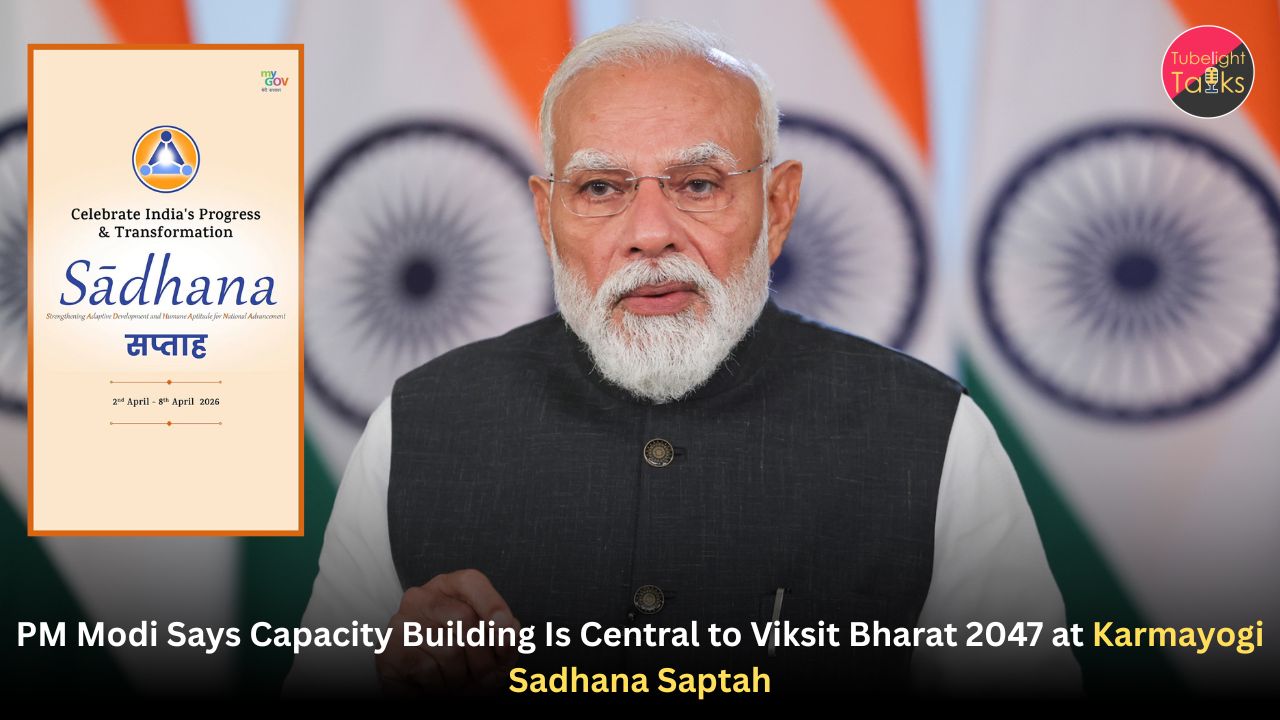
PM Modi Addresses Karmayogi Sadhana Saptah, Says Capacity Building Will Shape Viksit Bharat 2047
Prime Minister Narendra Modi on April 2 addressed Karmayogi Sadhana Saptah through a video message and used the occasion to connect civil-service reform directly with the national goal of building a Viksit Bharat by 2047.
Speaking on the foundation day of the Capacity Building Commission, he said India’s aspirations, infrastructure goals, technology adoption and economic growth targets cannot be achieved without capable, sensitive and future-ready public servants. He also argued that public service must remain relevant in a rapidly changing world by embracing continuous learning, data literacy and citizen-centric governance.
A governance reform message anchored in Viksit Bharat 2047
Modi linked public service quality to national development
In his official remarks, the Prime Minister said public institutions and public servants have a critical role to play in achieving fast economic growth, modern infrastructure, technology adoption and a large skilled workforce. He framed Karmayogi Sadhana Saptah not as a routine training event, but as part of India’s larger journey toward Viksit Bharat. He also said today’s India is deeply aspirational and that the responsibility of governance is to provide maximum support for citizens to fulfil their dreams and goals.
This framing matters because it places administrative reform at the center of national development rather than at the margins. The government’s official background note for Sadhana Saptah says civil servants across the country will participate in structured programmes designed to build the competencies required for achieving the vision of Viksit Bharat 2047. That means the week is being positioned as a practical governance tool, not just a ceremonial observance.
Also Read: India in 2026: Gauging the Road Ahead for Viksit Bharat 2047
What Karmayogi Sadhana Saptah is and why it matters
A week-long national initiative for civil servants
According to the Ministry of Personnel, Public Grievances and Pensions, Sadhana Saptah 2026 runs from April 2 to April 8 and marks one of the country’s largest collaborative capacity-building efforts across the civil-services ecosystem.
The initiative coincides with the foundation day of the Capacity Building Commission and five years of Mission Karmayogi. The same official release says more than 100 central ministries, departments and organisations, over 30 states and UTs, and more than 250 training institutions are participating.
The Capacity Building Commission’s own event page describes the programme as a coordinated national effort to reinforce continuous learning in government, deepen use of the digital learning ecosystem and encourage knowledge exchange across institutions. It also lays out a schedule from April 2 to April 8, including a launch-day conclave, webinars, Samuhik Charcha sessions, workshops and curated learning pathways on iGOT Karmayogi.
The meaning behind “Sadhana”
The official expansion of the initiative’s name is “Strengthening Adaptive Development and Humane Aptitude for National Advancement.” That phrasing is significant because it suggests the government wants civil-service reform to be not only technical, but also human-centered. The official note says the aim is to support responsive, citizen-centric governance across levels, from early-career officers to senior leadership.
Modi’s core message: duty, citizen focus and continuous learning
“Nagrik Devo Bhava” at the center of governance
One of the strongest themes in the Prime Minister’s remarks was the idea that the citizen must remain supreme in public service. He said the core principle of governance today is “Nagrik Devo Bhava,” and argued that public services are being made more capable and more sensitive to citizens. He also said governance should be judged by whether it improves the ease of living and quality of life of ordinary people.
That message is politically and administratively important. It suggests the government wants civil servants to think less in terms of office hierarchy and more in terms of duty and outcomes. Modi explicitly contrasted the old emphasis on being an “officer” with the current emphasis on Kartavya, or duty, and said that when decisions are made with a duty-first mindset, their public impact multiplies.
From individual transformation to institutional transformation
The Prime Minister also urged public servants to see their work on a larger canvas, asking them to reflect on how one decision can change the lives of many citizens and how individual transformation can lead to institutional transformation. He said such work requires energy drawn from selfless service.
That language fits closely with the larger Mission Karmayogi idea. The official Sadhana Saptah background note says Mission Karmayogi has sought to move civil-service training from a rule-based approach to a role-based one, where learning is aligned with actual responsibilities and required competencies such as collaboration, innovation, empathy and problem-solving.
Technology and AI were a major part of the speech
Modi said future administrators must understand data and technology
A major section of the Prime Minister’s address focused on technology. He said that government functioning has already seen deep integration of technology over the past eleven years and that these changes will accelerate further with artificial intelligence. He added that a better administrator and a better public servant will be one who has a strong understanding of technology and data, because that will increasingly form the basis of decision-making.
He also expressed hope that capacity building and continuous learning in AI would be an important focus area during the week. That lines up with the official Sadhana Saptah programme, which includes AI-focused courses on the iGOT Karmayogi platform such as “Artificial Intelligence for Public Governance,” “AI in Government: Transforming Public Service Delivery,” “IndiaAI for All,” and several introductory and applied AI modules from institutions including IITs, IISc Bengaluru, NIC and Wadhwani AI.
Also Read: Digital Bharat 2026: How Everyday Life in India Changed in Just Five Years
Why this matters for the bureaucracy
This is more than a fashionable tech mention. It signals that the government wants future administrative capacity to include digital fluency, regulatory readiness and AI-enabled thinking. The event framework itself is built around three official “Sutras” or thematic pillars: Technology, Tradition and Tangible Outcomes. On the CBC event page, the technology pillar includes AI and emerging technologies, sector-specific use cases and digital public infrastructure integration.
Breaking silos and building a “whole-of-government” culture
Modi called for coordination over departmental isolation
Another important theme in the speech was interdepartmental coordination. Modi said India must break silos and move forward with better coordination, shared understanding and a whole-of-government approach, because only then will every mission succeed. He also said India’s success is the collective success of all its states and suggested that older state hierarchies and labels need to give way to more uniform intensity of effort.
This aligns with the official rationale behind Sadhana Saptah. The government’s background note says that, for the first time, capacity-building activities across ministries, states and training institutions are being aligned within a common thematic framework, creating a shared learning movement at national scale. That is a structural attempt to address one of the long-standing weaknesses of Indian administration: fragmented learning and siloed functioning.
Capacity building as administrative reform, not just training
From “rule to role”
One of the strongest official phrases associated with Mission Karmayogi is the shift “from Rule to Role.” The Ministry’s release says the mission moves beyond periodic training and procedural learning toward a role-based approach, where learning is tied to actual functions and service-delivery needs. It also emphasizes competencies such as collaboration, empathy, innovation and problem-solving, not just administrative knowledge.
That matters because it shows why the Prime Minister’s speech kept returning to capability, sensitivity and institutional transformation. The intended reform is not merely to train officials more often, but to reshape how governance talent is prepared and measured. In that sense, Karmayogi Sadhana Saptah is being presented as part of a broader cultural shift in the Indian state.
Duty-driven service and moral discipline
A modern state needs skill, technology and coordination, but it also needs sincerity in service. This is where the message naturally connects with the teachings of Sant Rampal Ji Maharaj, which stress selfless conduct, duty, humility and truthful living.
A government employee may learn systems, data and AI tools, but the real public benefit comes when work is done with honesty, compassion and service-mindedness. That flow is natural here: administrative capability becomes most meaningful when it is guided by moral discipline and a genuine desire to serve citizens rather than status or ego.
Call to Action
Karmayogi Sadhana Saptah should be watched as more than an official event. It reflects a larger question: can India build a bureaucracy that is faster, more empathetic, more tech-ready and more accountable to citizens? The government has clearly said that Viksit Bharat 2047 will need that kind of public-service culture.
The success of this vision will depend not only on speeches and platforms, but on whether ministries, states and institutions actually turn learning into better decisions and better delivery.
FAQs: PM Modi Says Capacity Building Is Central to Viksit Bharat 2047 at Karmayogi Sadhana Saptah
1. What is Karmayogi Sadhana Saptah 2026?
It is a national capacity-building initiative running from April 2 to April 8, 2026, led by the Capacity Building Commission as part of Mission Karmayogi.
2. Why did PM Modi address the event?
He addressed it on the foundation day of the Capacity Building Commission and linked the initiative to India’s journey toward Viksit Bharat 2047.
3. What did Modi say about government employees?
He said public institutions and public servants have a critical role in achieving fast growth, modern infrastructure, technology adoption and better quality of life for citizens.
4. What did Modi say about technology and AI?
He said better administrators will need a strong understanding of technology and data, and he expressed hope that AI-focused learning will be a key area during Sadhana Saptah.
5. What are the three themes of Sadhana Saptah?
The official themes are Technology, Tradition and Tangible Outcomes.
6. How large is the initiative?
The government says it brings together more than 100 central ministries, departments and organisations, over 30 states and UTs, and more than 250 training institutions.
Related Stories






Discussion (0)