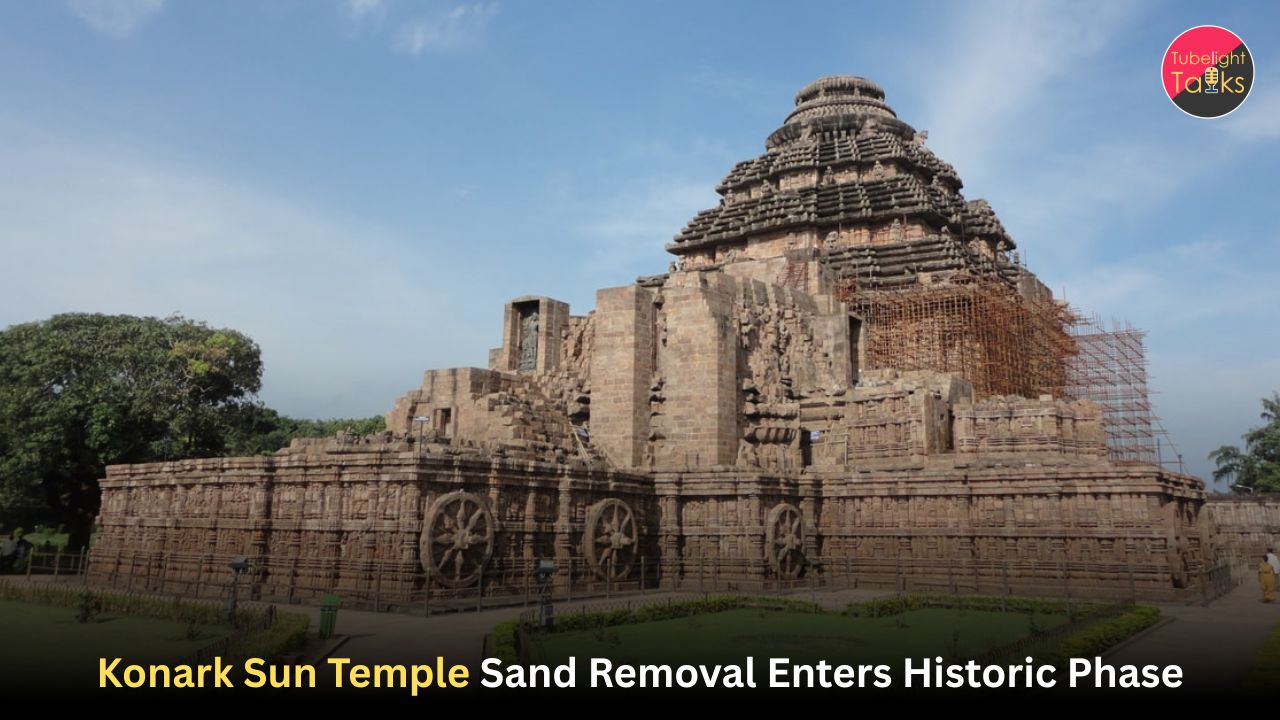
UNESCO Heritage Preservation: Konark Sun Temple Sand-Removal Work Marks Historic Conservation Milestone
The restoration of Odisha’s Konark Sun Temple has reached an important conservation phase as the Archaeological Survey of India prepares to open a passage inside the Jagamohan, or assembly hall, to facilitate removal of sand filled more than a century ago. Reports say the sand was placed during the British era to stabilize the structure.
While social media claims suggest hidden carvings have already been revealed, verified reports currently support a more careful conclusion: ASI has been drilling, assessing sand settlement, and preparing controlled removal, not confirming complete sand removal or discovery of hidden carvings yet.
Why Sand Was Filled Inside the Temple
The Jagamohan of the Konark Sun Temple was filled with sand in the early 20th century to prevent structural collapse. That decision protected the monument for decades but also sealed the interior space. Now conservation experts are exploring how to remove the sand safely without damaging the ancient structure.
ASI’s Careful Restoration Approach
Reports state that ASI has conducted core drilling and found sand settlement inside the Jagamohan. Fine, moist river sand was identified at depth, and samples were analyzed to understand the internal condition. The removal is expected to be carried out under strict supervision and expert guidance.
Also Read: ASI Begins Delicate Restoration Operation at Konark Sun Temple
Konark’s UNESCO Heritage Value
The Konark Sun Temple is one of India’s most celebrated monuments. Odisha Tourism describes it as the pinnacle of Odisha temple architecture and a UNESCO World Heritage Site. Built by King Narasimha Deva I and dedicated to the Sun God, the temple is designed like a chariot with twenty-four carved wheels and seven horses.
What Makes the Temple Extraordinary
The temple’s architecture blends massive scale, symmetry, sculptural detail, and scientific imagination. Odisha Tourism notes that the wheels of the temple are designed so that one can gauge the time of day through the shadow on the spokes. Such artistic and scientific precision makes Konark a symbol of India’s heritage genius.
Conservation Must Avoid Haste
Heritage restoration is not like ordinary construction. Every cut, drill, support, and removal step matters. If sand is removed too quickly, the structure could be destabilized. If it is not removed properly, moisture and internal pressure may continue to affect the monument. Therefore, ASI’s gradual and scientific approach is essential.
Preserving Heritage, Preserving Wisdom
Konark reminds us that civilizations are remembered not only for power but for knowledge, devotion, and discipline. Sant Rampal Ji Maharaj’s teachings similarly emphasize that true knowledge must be preserved and practiced in its pure form. Just as a monument can be damaged when its foundation is ignored, human life loses direction when spiritual truth is forgotten. Scripture-based worship protects the soul’s real heritage.
Call to Action
Protect India’s Sacred Heritage
Citizens should respect monuments, avoid vandalism, follow visitor rules, and support scientific conservation.
Trust Expert Restoration
Heritage work should be guided by ASI, structural experts, historians, and conservation scientists—not viral misinformation.
FAQs: Konark Sun Temple Sand Removal Enters Historic Phase
1. What is happening at Konark Sun Temple?
ASI is preparing a passage to remove century-old sand from the Jagamohan.
2. Why was sand filled inside the temple?
It was filled during the British era to support and protect the structure from collapse.
3. Has hidden carving discovery been officially confirmed?
Current verified reports discuss drilling, sand settlement assessment, and passage preparation, not confirmed complete discovery of hidden carvings.
4. Is Konark a UNESCO World Heritage Site?
Yes. Odisha Tourism describes Konark Sun Temple as a UNESCO World Heritage Site.
5. Why must sand removal be slow?
Because sudden removal may affect structural stability, so conservation must be expert-led and carefully monitored.
Related Stories









Discussion (0)