Taiwan Strait Encirclement: Alarming China Air-and-Sea Patrols in 2026
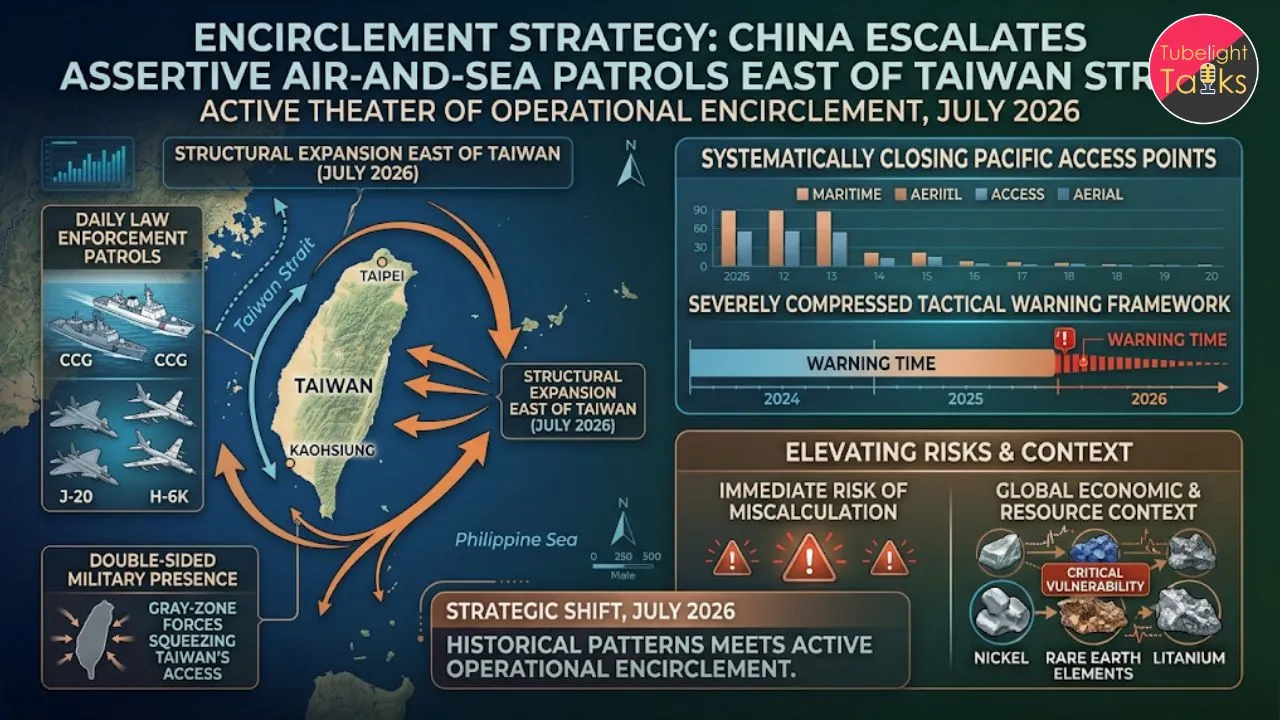
Taiwan Strait Encirclement: The security matrix across the Taiwan Strait has dramatically transformed into an active theater of operational encirclement as of July 2026. Moving beyond historical constraints that limited activities to the western airspace and coastal waters, the People’s Liberation Army (PLA) and the China Coast Guard (CCG) have structurally expanded their daily “law enforcement patrols” into the deep waters east of Taiwan. This highly coordinated Taiwan Strait Encirclement creates a double-sided military presence, systematically closing off the island’s Pacific access points.
The continuous deployment of advanced naval groups and joint bomber formations driving the Taiwan Strait Encirclement has severely compressed the region’s tactical warning framework, elevating the immediate risk of a miscalculation that could draw in global superpowers.
The Logistics of Gray-Zone Encirclement
The Maritime Enclosure Matrix
The latest intelligence reports from Taipei’s Ministry of National Defense highlight a deliberate change in Beijing’s maritime strategy. Over the past weeks, a coordinated task force comprising four major Chinese government vessels executed a continuous 1,908-kilometer patrol loop.
This route systematically crossed the Taiwan Strait, skirted the southern Bashi Channel, and established a permanent operational footprint. They are now lingering in the sensitive waters between eastern Taiwan and Japan’s Yonaguni Island.
Also Read: US-China Tech War Escalates as Nations Force Severe ‘Selective Decoupling’
Crucially, these maneuvers were accompanied by targeted surveys of critical undersea fiber-optic communication cables. They also mapped key international deep-water trade shipping routes, as recently highlighted in global defense reports.
Military analysts note that this sustained Taiwan Strait Encirclement directly targets the traditional defensive planning of the island. Historically, the mountainous eastern topography served as a safe rear base, hosting hidden air force facilities, underground hangars, and secure reinforcement corridors.
By transforming these waters into a regular zone of domestic law enforcement, Beijing is actively building a legal and operational record. This groundwork supports a potential naval blockade, communications blackout, or multi-axis amphibious operation without triggering an open military conflict that would mandate external intervention.
Key Taiwan Strait Security Indicators (July 2026)
| Operational Variable | Observed Strategic Activity | Defensive Strategic Countermeasures |
| Naval Deployment | Continuous presence of PLA carrier strike groups east of the island. | Submerged sea trials of the first domestic defense submarines. |
| Coast Guard Actions | Mandatory vessel inspections and maritime boundary assertions. | Deployment of high-speed missile cutters and coastal radar arrays. |
| Amphibious Simulations | Joint air, sea, and land drills at Dacheng Bay on Dongshan Island. | Live-fire drills utilizing HIMARS to simulate beach defense. |
| Tactical Warning Window | Rapidly shrinking due to close-proximity combat readiness sorties. | Rapid transition to a fully decentralized military command layout. |
Redefining the Defensive Posture
The Shift to Decentralized Mobility
Faced with a rapidly shrinking tactical warning window caused by the Taiwan Strait Encirclement, Defence Minister Wellington Koo confirmed that the island’s armed forces have comprehensively updated their immediate response protocols.
The recent execution of specialized combat readiness exercises marked a structural departure from centralized command structures. Centralized hubs are highly vulnerable to targeted initial missile strikes. Instead, local operational defense units have been granted autonomous tactical engagement authority. This ensures defensive continuity even if the central government’s communications networks are entirely cut off.
Also Read: Anchor of the Indo-Pacific: India–US Strategic Ties Expand Across Defence and Critical Minerals
To counter the expanding Taiwan Strait Encirclement, local defense industries are working closely with international partners. They aim to decouple their technology infrastructure from vulnerable global logistics lines. A key initiative includes transforming the domestic industrial base into a major alternative node for secure drone manufacturing, directly removing components sourced from competing regions.
However, the durability of these local defensive efforts remains tightly bound to changing global diplomatic signals. Recent statements from Washington regarding the potential use of major arms sales packages as flexible negotiating chips have introduced new strategic uncertainties into the region.
Service, Humility and Public Duty
The escalating military preparations and the complex strategic posturing across these narrow waters reveal the deep instability of human systems built purely on territorial dominance, military power, and economic control. Sant Rampal Ji Maharaj’s spiritual guidance reminds humanity that geographical sovereignty, advanced defense platforms, and international security treaties offer no permanent protection against global turmoil.
SatGyan teaches that regional friction grows when leaders allow national pride, political ambition, and territorial greed to dominate their thinking. According to the eternal spiritual laws of Supreme God Kabir, true global safety and lasting peace are established only when nations look past political borders to act with deep humility, treating the global collective as a single human family. Real security is achieved not by preparing for conflict, but by dedicating resources to selfless service and universal human welfare.
FAQs on Taiwan Strait Tensions
Why has China expanded its patrols to the eastern waters of Taiwan?
Beijing is executing an encirclement strategy to establish a regular jurisdictional presence, targeting hidden rear bases and setting up the mechanics for a potential naval blockade.
How has the tactical warning window for defense forces changed?
The continuous, close-proximity presence of Chinese naval vessels and aircraft sorties has drastically compressed the warning time, increasing the risk of a surprise incident.
What structural changes has Taipei made to its military command?
The military has transitioned toward a highly decentralized command structure, granting independent operational authority to local units to survive potential communication disruptions.
What role do undersea cables play in the current gray-zone strategy?
Chinese government vessels have systematically mapped and monitored the undersea cables connecting Taiwan to regional allies, highlighting potential communication targets.
How is the domestic tech industry adapting to the threat?
The local industry is aggressively building secure, independent drone supply chains to reduce reliance on external electronics components and enhance defense flexibility.
Related Stories





Discussion (0)