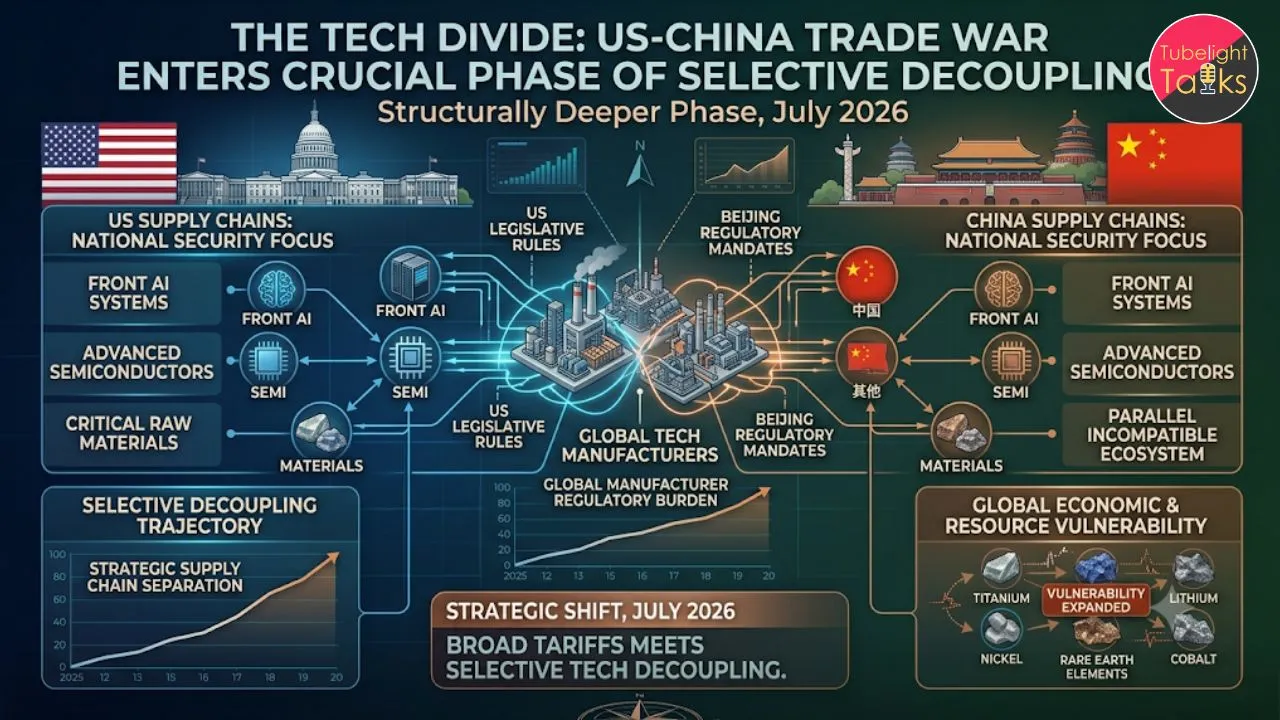
US-China Tech War Escalates as Nations Force Severe ‘Selective Decoupling’
The intense macroeconomic and technological rivalry driving the US-China Trade War has entered a complex, structurally deeper phase in July 2026. Shifting away from broad-based consumer tariffs, the conflict has solidified into a deliberate policy of “selective decoupling” designed to eliminate strategic vulnerabilities in national security supply chains.
The current friction focuses heavily on frontier artificial intelligence systems, advanced semiconductor production equipment, and critical raw materials. As both superpowers establish parallel, incompatible tech ecosystems, global technology manufacturers are finding themselves trapped in a complex regulatory landscape, forced to navigate conflicting legislative rules enforced by Washington and Beijing as the US-China Trade War escalates.
The Weaponization of the Tech Stack
Export Controls and Firmware Verification
The latest escalation in the US-China Trade War centers on a fundamental shift in how the United States manages technology access. The Bureau of Industry and Security (BIS) has transitioned from broad trade bans to a highly meticulous, case-by-case regulatory framework for high-performance computing hardware and frontier software logic.
A clear example of this is the heavily monitored trade involving modified AI processors, such as NVIDIA’s H200 accelerators. Under revised rules implemented earlier this year, these systems are permitted for select commercial transactions in China, but each individual delivery requires strict third-party hardware validation within the United States to ensure compliance with processing caps.
Concurrently, Washington has extended these national security limitations to cloud computing structures and proprietary frontier AI software architectures. Fearing that foreign entities could leverage advanced models to accelerate military modernization, US authorities have severely restricted access to top-tier large language models (LLMs) and advanced design automation software. This comprehensive digital boundary aims to protect Western architectural leads in advanced chip design while systematically restricting the physical deployment of highly dense data center infrastructure within competing economic zones.
Strategic Tech War Matrix (July 2026)
| Operational Battleground | US Strategy & Enforcement | Chinese Countermeasures & Response |
| Advanced Computing | Mandated performance caps and independent hardware verification. | Development of resource-efficient AI models and architectures. |
| Upstream Supply Chain | Subsidizing domestic foundries and friend-shoring equipment. | Tightening export permits for gallium, graphite, and antimony. |
| Frontier Software | Restricting cloud access to advanced, proprietary AI models. | Enhancing open-source contributions and localized ecosystems. |
| Corporate Regulations | Expanding military entity blacklists and procurement blocks. | Activating the Unreliable Entity List and targeted corporate bans. |
This systematic division is rapidly fragmenting the global hardware market, compelling multinational corporations to completely separate their operational facilities into distinct “China” and “Non-China” supply systems.
Beijing’s Retaliatory Arsenal in the US-China Trade War
Beijing has responded to these updated Western technology blockades by moving past mere diplomatic complaints. They have fully activated a sophisticated legal framework for targeted economic retaliation.
The Ministry of Commerce has aggressively utilized its export control laws to restrict the flow of dual-use raw materials and critical electronic minerals. Supply lines for vital manufacturing elements—including gallium, germanium, graphite, and antimony—now require specialized state licenses.
Also Read: Anchor of the Indo-Pacific: India–US Strategic Ties Expand Across Defence and Critical Minerals
These restrictions are creating noticeable supply constraints for overseas industries producing specialized optics, advanced magnets, and defense systems. Furthermore, China has directly applied its Unreliable Entity List against major Western defense and technology contractors.
Recent state procurement mandates have barred key global aerospace and defense firms from bidding on domestic infrastructure projects. This effectively locks them out of the world’s second-largest economy.
At the same time, domestic manufacturing giants like SMIC have significantly increased their deep ultraviolet (DUV) lithography workloads. This expansion has successfully decreased China’s historical reliance on imported legacy logic chips.
The Struggle for Infrastructure Dominance in the US-China Trade War
As the US-China Trade War moves beyond the foundry floor, both nations are focusing heavily on the physical infrastructure required to sustain the next generation of industrial computing. The enormous power consumption of modern data centers has turned electricity grids and renewable energy infrastructure into major strategic assets.
With its massive expansion of domestic solar, wind, and nuclear power generation, China has carved out a distinct structural advantage in powering large-scale computational centers. This allows domestic software firms to train highly capable, efficient AI platforms using alternative architectures despite Western hardware blockades.
Service, Humility and Public Duty
The accelerating technological division between the world’s leading economies reveals the deep insecurity that comes with a global order built entirely on material power, economic dominance, and digital supremacy. Sant Rampal Ji Maharaj’s spiritual guidance teaches us that no amount of computational intelligence, algorithmic control, or monopoly over the earth’s minerals can bring true safety or lasting prosperity to a society.
SatGyan reveals that geopolitical friction escalates when leaders allow national pride, fear, and economic greed to guide their policy decisions. According to the eternal laws of Supreme God Kabir, true global security is established only when nations look past technological barriers to embrace profound humility, mutual respect, and transparent public duty. Real human progress is achieved not by building parallel digital walls, but by using knowledge selflessly to foster universal human welfare.
FAQs on the US-China Trade War
What is selective decoupling in the context of the 2026 trade war?
Selective decoupling refers to the targeted economic separation between the US and China, specifically focusing on removing national security vulnerabilities in advanced technology, AI, and raw mineral supply chains.
How is the US regulating AI chip shipments under the latest guidelines?
The US permits specific high-performance computing shipments under strict conditions, requiring independent, third-party testing within the US to verify performance caps before delivery.
What specific raw materials has China placed under export controls?
China has heavily restricted the export of critical industrial elements, including gallium, germanium, graphite, and antimony, all of which are vital for advanced electronics and defense manufacturing.
How are global tech firms responding to these dual regulatory regimes?
Many multinational tech companies are being forced to structurally bifurcate their businesses, maintaining completely separate supply chains and entities for their Chinese and Western markets.
Why has energy infrastructure become a flashpoint in the tech war?
Modern AI data centers require immense amounts of electricity, transforming domestic energy capacity and grid resilience into critical strategic factors for training next-generation software models.
Related Stories










Discussion (0)