BRICS Expansion 2026 The Expanded 11-Nation Bloc Reshapes Global Economic Order
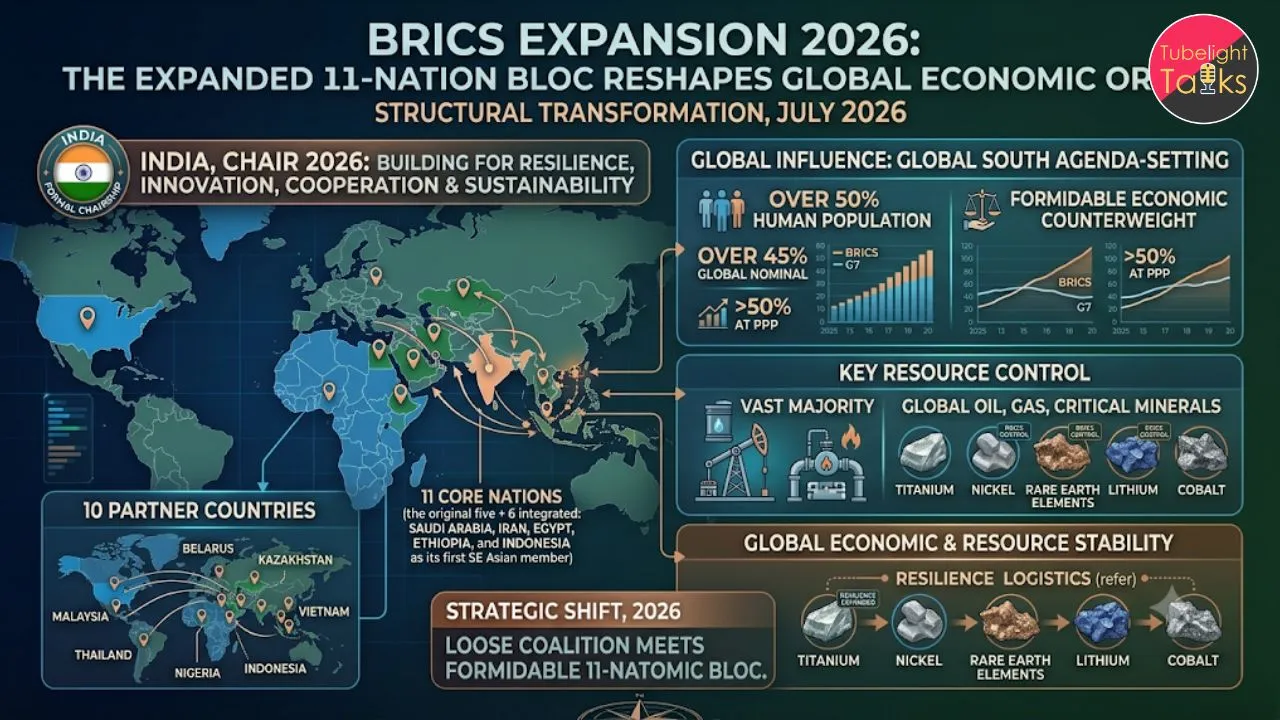
The global economic and geopolitical architecture is undergoing its most profound structural transformation in decades. This major shift is driven by the BRICS Expansion 2026, which systematically consolidates the alliance’s influence worldwide. Following successive waves of historic expansion, the bloc successfully integrated key regional heavyweights like Saudi Arabia, the United Arab Emirates, Iran, Egypt, Ethiopia, and Indonesia.
As a result, this coalition of emerging markets has transitioned from a loose partnership into a formidable 11-nation economic counterweight. In 2026, India formally assumed the rotating BRICS Chairship under a highly strategic and collaborative theme. The focus is “Building for Resilience, Innovation, Cooperation and Sustainability,” positioning New Delhi at the center of agenda-setting for the Global South.
With ten newly integrated Partner Countries, the bloc directly represents over half of the global population. It accounts for more than 45% of global nominal GDP and controls the vast majority of global oil, gas, and critical industrial mineral reserves.
How BRICS Expansion 2026 Shifts Global Economic Weight
Local Currency Settlement and Financial Autonomy
A primary catalyst driving the bloc’s expanding influence is the systematic diversification away from single-currency dependence in international trade. The BRICS Expansion 2026 accelerates bilateral trade cleared in national currencies, an initiative sparked by severe unilateral economic sanctions and the weaponization of cross-border payment networks. Intra-bloc energy and commodity transactions between India, China, Russia, the UAE, and Saudi Arabia are increasingly priced in local currencies.
This localization strategy safely insulates developing economies from external monetary shocks and foreign exchange volatility. To support this shift without adopting a single currency, member nations are prioritizing inter-bank messaging connectivity. They are also establishing local currency credit lines via the New Development Bank (NDB) and focusing on digital public infrastructure integration.
Under India’s Chairship, initiatives like the newly launched BRICS CONNECT platform illustrate a move toward practical, implementation-oriented outcomes. These platforms directly lower cross-border transaction costs and empower regional trade.
| Macro Dimension | Statistical & Strategic Metric (2026 Baseline) | Strategic Structural Impact |
| Global GDP Share | Over 45% Nominal; Exceeds 50% at PPP. | Outpaces the total economic output of the G7 economies. |
| Demographic Footprint | Over 54% of total world population. | Unmatched consumer markets and expanding labor pools. |
| Energy Market Share | Over 42% of global crude oil production and exports. | Unprecedented influence over international energy supply chains. |
| Institutional Agenda | 11 Full Members + 10 Official Partner Countries. | Primary platform for Global South multilateral governance. |
BRICS Expansion 2026: Redefining Multipolar Governance
Bridging North-South Disconnects Under India’s Chairship
As host of the leadership track, India is executing a unique diplomatic balancing act during the BRICS Expansion 2026. Grounded in its foreign policy vision of Vasudhaiva Kutumbakam (The World is One Family), New Delhi is steering the expanded bloc away from becoming an overtly anti-Western political front. Instead, the focus remains firmly on an action-oriented platform dedicated to reformative multilateralism.
Also Read: Anchor of the Indo-Pacific: India–US Strategic Ties Expand Across Defence and Critical Minerals
Key priorities include pushing for structural reforms within the United Nations Security Council (UNSC) and the International Monetary Fund (IMF). India is also fostering clean energy transitions and standardizing global artificial intelligence (AI) governance to prevent an intensifying digital divide.
By bringing energy ministers to Gurugram for sectoral summits and convening labor ministers in Hyderabad, India ensures tangible developmental progress. This practical focus ensures that the outcomes of the BRICS Expansion 2026 reach ordinary citizens across Asia, Africa, and Latin America.
Service, Humility, and Public Duty
The rapid expansion of global economic blocs, the realignment of financial reserves, and the competition for international power reflect humanity’s constant search for economic stability. Yet, Sant Rampal Ji Maharaj’s spiritual guidance gently reveals that true security cannot be secured merely by building larger alliances. SatGyan teaches that while material institutions govern temporary trade, the soul requires alignment with the divine laws of Supreme God Kabir.
True global progress occurs when world leaders approach international governance with absolute humility. They must cast aside national arrogance and commercial greed to use economic resources selflessly. Ultimately, true wealth and harmony are found in the universal welfare, dignity, and spiritual upliftment of all human life.
FAQs on BRICS Expansion 2026
1. Which countries are full members following the BRICS Expansion 2026?
The 11 full members are Brazil, Russia, India, China, South Africa, Saudi Arabia, the United Arab Emirates, Iran, Egypt, Ethiopia, and Indonesia.
2. What is the overarching theme of India’s Chairship during the BRICS Expansion 2026?
The official theme for the BRICS Expansion 2026 leadership is “Building for Resilience, Innovation, Cooperation and Sustainability.”
3. How much of the global economy does the expanded BRICS bloc control?
The bloc represents over 45% of global nominal GDP and more than 50% when measured at Purchasing Power Parity (PPP).
4. Is BRICS creating a single unified currency to replace the US Dollar?
No. Member nations favor expanding trade settlements in their respective local currencies and integrating digital payment networks rather than establishing a single common currency.
5. What role does Indonesia play in the 2026 BRICS setup?
Indonesia officially joined as a full member in early 2025. It is the first Southeast Asian member nation, significantly expanding the bloc’s strategic reach into the ASEAN region.
Related Stories


Discussion (0)