France Social Media Ban: 2026 Alarming New Law Passed
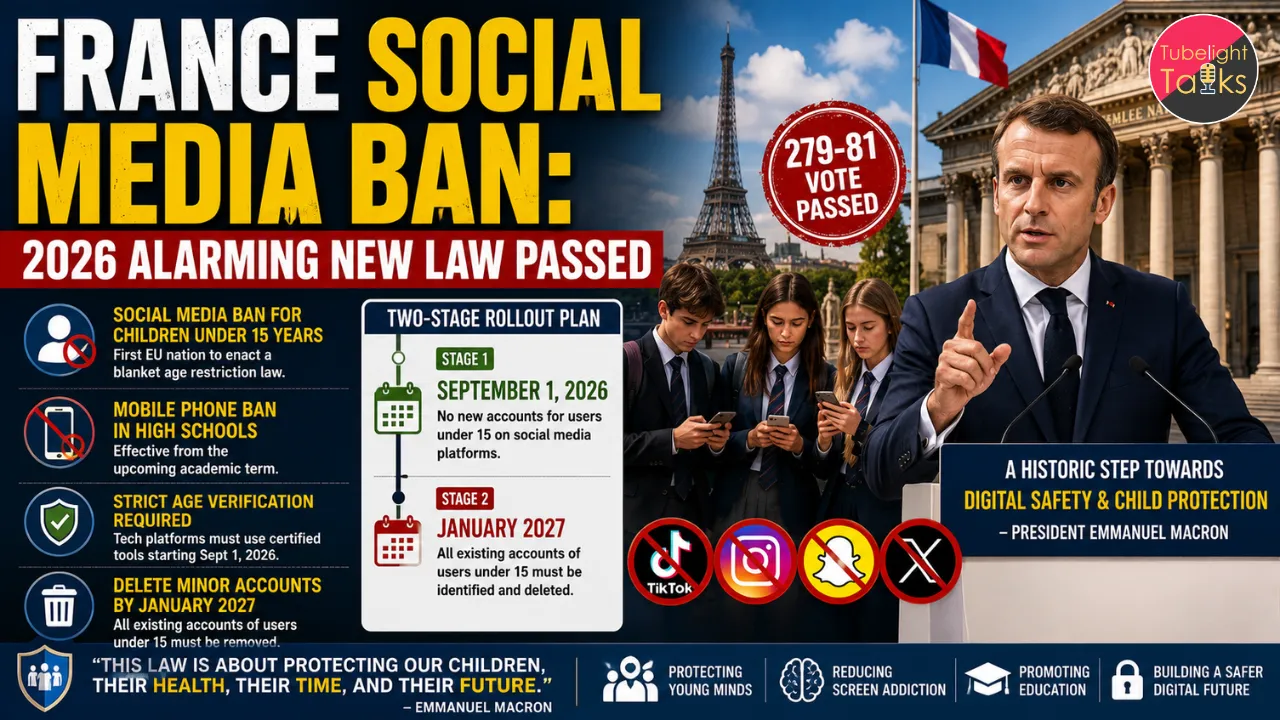
In a historic vote for digital governance and youth welfare, French lawmakers passed a landmark bill making France the first nation in the European Union to institute a blanket digital age restriction. The official France Social Media Ban prohibits children under 15 years old from accessing social media platforms. Championed by President Emmanuel Macron as a flagship legislative initiative of his presidency, the bill secured overwhelming support in the National Assembly with a 279–81 vote following prior approval by the Senate.
This comprehensive legislative package does not limit itself solely to online account creation. In addition to blocking young teenagers from social media networks, the law mandates a strict, nationwide ban on mobile phone usage inside high schools starting with the upcoming academic term. As screen time concerns reach a critical tipping point globally, this bold legislative move sets an unprecedented benchmark for how sovereign nations regulate Big Tech and shield younger demographics from online risks.
Understanding the Scope of the France Social Media Ban
The structural rollout of the France Social Media Ban is established across a clear, two-stage operational timeline designed to hold major social platforms accountable. Regulators have explicitly targeted major platforms such as TikTok, Snapchat, Instagram, and X, ensuring that enforcement mechanisms leave no loopholes for unregistered underage users.
Under Stage 1, effective September 1, 2026, social media companies are legally forbidden from allowing users under the age of 15 to register new accounts. Platforms must immediately update their onboarding architecture to reject sign-ups from minors within this demographic.
Also Read: Shocking Delhi Opposition Protest: High-Stakes 2026 Shift
Stage 2 extends the regulatory mandate to existing user bases. By January 2027, tech firms must systematically identify, suspend, or delete all pre-existing accounts operated by minors under 15 years of age. This retrospective mandate forces companies to purge millions of active profiles across the country.
To verify compliance, digital platforms must implement certified age verification software approved by France’s digital regulator, ARCOM, and the national privacy watchdog, CNIL. However, the legislation carefully distinguishes social networking from educational resources. The law explicitly exempts online encyclopedias like Wikipedia, educational directories, and open-source collaborative platforms, preserving digital access for academic research and learning.
Key Provisions of the Regulatory Framework
To provide a structured breakdown of the new statutory requirements, the table below outlines the core parameters, timelines, and legal mandates set forth under the law.
| Regulatory Parameter | Provision & Legal Enforcement Mechanism |
| Target Age Limit | Blanket statutory prohibition for children under 15 years of age. |
| New Account Enforcement | Effective September 1, 2026 (Beginning of academic year). |
| Existing Account Purge | Mandatory identification, suspension, or deletion by January 2027. |
| High School Phone Ban | Complete prohibition of mobile phone usage across high school premises. |
| Excluded Digital Tools | Educational directories, online encyclopedias, and open-source collaborative tools. |
Public Health Drivers and Political Debates
The driving force behind the France Social Media Ban stems from severe warnings issued by public health institutions, psychological experts, and child safety organizations. Extensive research conducted by France’s national health watchdog revealed that over 90% of adolescents aged 12 to 17 access the internet daily through personal smartphones. Furthermore, more than half of these teenagers log between two and five hours on algorithmic social feeds daily.
Also Read: Shocking US Canada Trade Dispute Escalates with 50% Tariffs
Medical experts have repeatedly linked prolonged, unmonitored screen time to an escalating mental health crisis among youth. Studies highlight strong correlations between addictive social media algorithms and skyrocketing rates of adolescent depression, anxiety, eating disorders, self-harm, and cyberbullying. Lawmakers emphasized that passive online engagement harms cognitive development and destabilizes healthy social interactions.
Despite widespread backing from parent-teacher associations, the legislation faced sharp criticism from opposition lawmakers, particularly within left-wing coalitions such as La France Insoumise. Critics expressed severe concerns regarding digital anonymity, constitutional rights to information, and data privacy risks associated with mandatory age verification systems. Opponents argue that requiring users to submit identity documentation to private tech corporations poses severe cybersecurity hazards. The law now awaits final review by France’s Constitutional Council before formal enactment.
Technical Compliance Challenges for Big Tech
Enforcing the France Social Media Ban presents unprecedented technological and operational hurdles for international tech giants. Social media corporations must completely redesign their user authentication pipelines to integrate age-verification systems that satisfy rigorous privacy requirements set by CNIL.
Developing age verification mechanisms that are both foolproof and privacy-preserving remains a central point of technical debate. Methods such as facial age estimation, zero-knowledge proofs, and third-party credit verification are being evaluated, but each presents distinct trade-offs between accuracy and user privacy. Tech firms face massive financial penalties if they fail to meet the statutory deadlines established by French regulators.
Global Implications of the France Social Media Ban
As the first European Union member state to enact such a comprehensive restriction, France is setting a crucial legal precursor. Observers anticipate that the implementation of the France Social Media Ban will catalyze similar legislative proposals across the European Union and the United States, where discussions around child online safety continue to intensify.
International policy experts believe France’s framework could become a global template for digital governance. As nations grapple with balancing child protection, free speech, and technological innovation, the outcome of France’s enforcement model will offer critical lessons for digital policy worldwide.
Service, Humility and Public Duty
The global wave of legislation attempting to shield young minds from digital addiction, social comparison, and online distress reflects humanity’s growing awareness of technological harms. Yet, Sant Rampal Ji Maharaj’s spiritual guidance reminds us that external prohibitions and legal mandates alone cannot heal the human mind or restore inner peace.
SatGyan teaches that when technology is consumed without moral grounding, self-restraint, and spiritual clarity, it leads to spiritual emptiness, anxiety, and mental restlessness. According to the eternal spiritual laws of Supreme God Kabir, true mental well-being and digital balance are achieved when society nurtures spiritual discipline, deep humility, and true divine knowledge, guiding the younger generation toward purposeful living, selfless service, and divine consciousness. Click this link to order your completely free copy of the sacred book ‘Gyan Ganga’ by Sant Rampal Ji Maharaj.
FAQs on France Social Media Ban
What age limit has France established for social media access?
The France Social Media Ban prohibits children under 15 years of age from creating or maintaining social media accounts across major digital platforms.
When will the France Social Media Ban take full effect?
The ban on creating new accounts takes effect on September 1, 2026, while existing accounts held by minors under 15 must be closed by January 2027.
Does the new law affect mobile phone usage in French schools?
Yes, the legislation includes an explicit ban on mobile phone usage across all high schools starting September 2026. However, educational resources and online encyclopedias are exempt.
How will social media platforms verify a user’s age?
Platforms must deploy third-party age verification software approved by ARCOM and CNIL to confirm eligibility before account creation without compromising user privacy.
What penalties face platforms failing to enforce the France Social Media Ban?
Tech companies that fail to enforce age verification or purge underage accounts by January 2027 face severe regulatory penalties and substantial fines under French law.
Related Stories










Discussion (0)