Dr APJ Abdul Kalam Legacy: A Historic Space Milestone in 2026
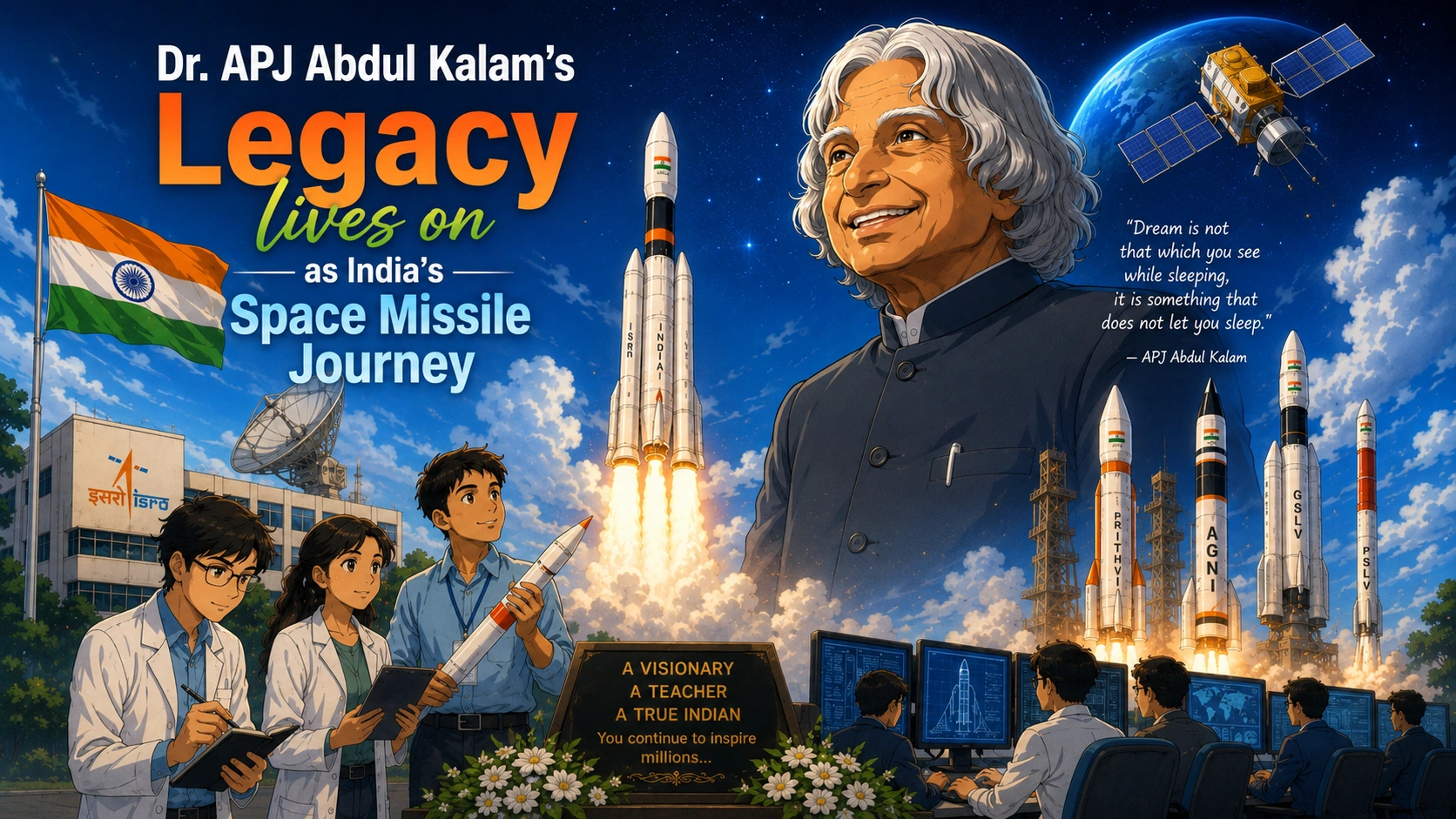
The Dr APJ Abdul Kalam legacy is once again in the national spotlight. India marks his death anniversary on 27 July 2026. This renewed attention follows a historic milestone in the nation’s space sector. Skyroot Aerospace successfully launched Vikram-I, India’s first private orbital launch vehicle, on 18 July 2026. This achievement beautifully echoes Kalam’s leadership of India’s first Satellite Launch Vehicle (SLV) mission on the exact same date in 1980.
Why the Dr APJ Abdul Kalam Legacy Matters Today
As India observes the death anniversary of former President Dr Avul Pakir Jainulabdeen Abdul Kalam, his contributions remain central to nation-building. The Dr APJ Abdul Kalam legacy gained fresh momentum in July 2026.
The Vikram-I mission carried a miniature gold sculpture of Dr Kalam into space. This gesture recognized his lasting contribution to India’s scientific progress. It completed a full-circle moment for the country’s space sector.
Key Milestones in the Dr APJ Abdul Kalam Legacy
During his 83 years of life, Dr Kalam served in pivotal positions across India’s scientific and public institutions. His career trajectory highlights a deep, unwavering commitment to national development.
| Position | Organisation |
|---|---|
| Aeronautical Engineer | ISRO |
| Director General | Defence Research and Development Organisation (DRDO) |
| Principal Scientific Adviser | Government of India |
| President of India | 2002–2007 |
| Professor | Anna University |
| Faculty Positions | Indian Institute of Science, Bengaluru, and IIM Shillong |
Also Read : A.P.J. Abdul Kalam: मिसाइल मैन, जनता के राष्ट्रपति, भारतरत्न एपीजे अब्दुल कलाम, अनूठी महान शख्सियत
Building India’s Indigenous Space Programme
Dr Kalam joined ISRO in 1969 and became Project Director of the SLV-III programme. His work laid the foundation for modern Indian space exploration. These achievements form the core of the Dr APJ Abdul Kalam legacy in aerospace.
Major milestones include the development of the Satellite Launch Vehicle (SLV). He also oversaw the successful placement of the Rohini satellite into near-Earth orbit in July 1980. Furthermore, he influenced the selection of Sriharikota as India’s preferred rocket launch site.
Leading India’s Missile Programme
In 1982, Dr Kalam returned to DRDO to head the Integrated Guided Missile Development Programme (IGMDP). This programme aimed to build indigenous missile technology.
Under his leadership, the programme successfully delivered Agni, Akash, Nag, and Prithvi missiles. Between 1992 and 1999, he oversaw the weaponisation of strategic missile systems. This critical work strengthened India’s position as a nuclear weapon state.
The Teacher He Wanted to Be
Although widely known as the “Missile Man of India”, Dr Kalam repeatedly stated he wanted to be remembered as a teacher. This aspect of the Dr APJ Abdul Kalam legacy remains deeply inspiring to educators nationwide.
After his presidency, he continued teaching at Anna University, IISc Bengaluru, and IIM Shillong. He believed that science survives only through questions. He often stated that children are the first scientists because of their unending curiosity.
Lasting Legacy, Lasting Spiritual Purpose
The Dr APJ Abdul Kalam legacy reflects dedication to knowledge, discipline, humility, and service to the nation. His journey continues to inspire millions to contribute positively to society through education and selfless work.
From a spiritual perspective, good deeds and noble conduct are the result of virtuous actions. However, spiritual teachings emphasize that human life carries a higher purpose beyond worldly achievements. According to Tatvadarshi Saint Rampal Ji Maharaj, true worship of the Supreme God, along with righteous conduct, is essential for attaining complete spiritual welfare. While serving humanity and the nation is invaluable, His Spiritual Knowledge teaches that true devotion to the Supreme God leads the soul toward the ultimate goal of eternal liberation.
FAQs on the Dr APJ Abdul Kalam Legacy
Q1: Why is the Dr APJ Abdul Kalam legacy in the news in 2026?
India is observing his death anniversary while reflecting on his contributions alongside Skyroot Aerospace’s successful Vikram-I launch.
Q2: What was Dr Kalam’s role in India’s space programme?
He led the SLV-III programme that successfully placed the Rohini satellite into near-Earth orbit in July 1980, cementing the Dr APJ Abdul Kalam legacy in space history.
Q3: Why is Dr Kalam called the Missile Man of India?
He led the Integrated Guided Missile Development Programme, which developed the Agni, Akash, Nag, and Prithvi missiles.
Q4: Why did Dr Kalam consider himself a teacher?
He believed teachers transform lives and continued teaching at various institutions even after serving as President of India.
Q5: What message did Dr Kalam give about science?
He said science survives through questions and believed children are the first scientists because of their natural curiosity.
Related Stories









Discussion (0)