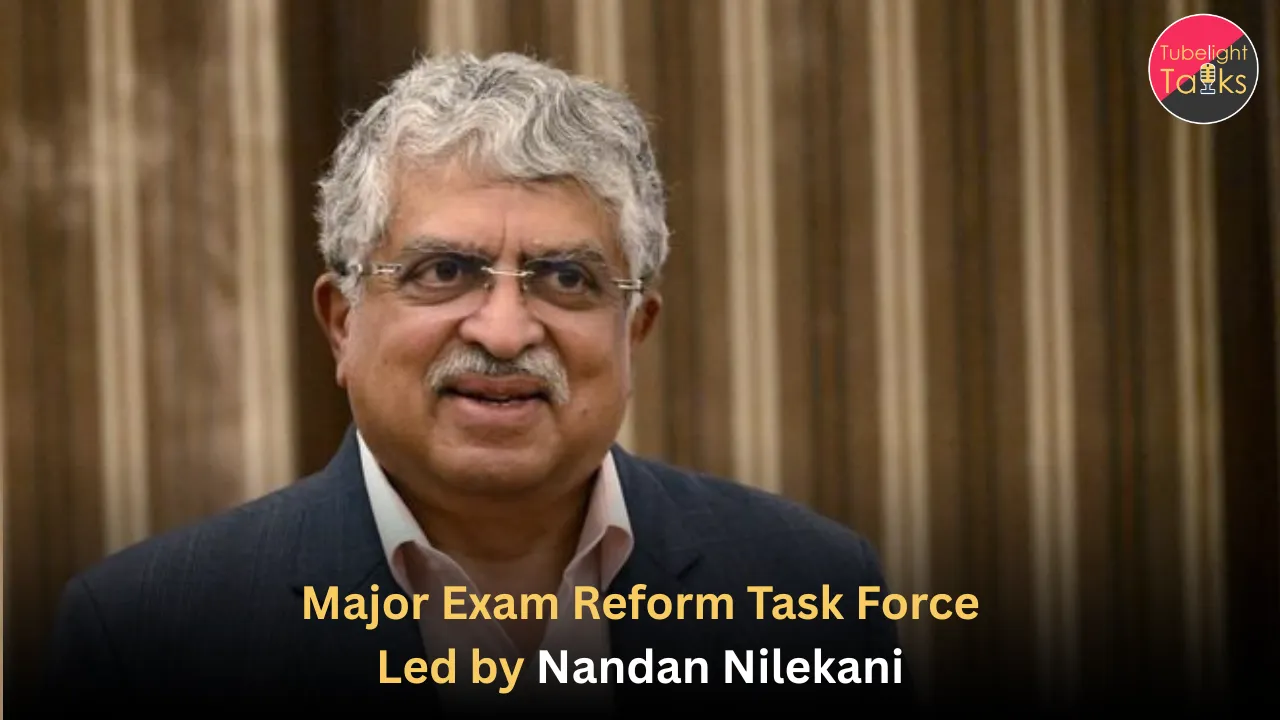
Major Exam Reform Task Force Led by Nandan Nilekani
Prime Minister Narendra Modi has officially appointed technology pioneer Nandan Nilekani to lead a high-powered Exam Reform Task Force aimed at completely overhauling India’s public examination system. The co-founder of Infosys and chief architect of the Aadhaar digital identity framework brings decades of experience in population-scale technology solutions to this critical government mandate. Formed in response to intense student protests and systemic irregularities surrounding major national tests like NEET-UG and UGC-NET, this committee is tasked with engineering an unbreachable, highly transparent testing framework for millions of aspirants across the country.
Nandan Nilekani: The Digital Architect Leading National Transformation
To understand why Nandan Nilekani was selected to direct the Exam Reform Task Force, one must look at his historical track record in creating transformative digital public infrastructure. Born in Bengaluru in 1955, Nilekani earned his degree from the prestigious Indian Institute of Technology (IIT) Bombay. In 1981, he co-founded Infosys alongside N. R. Narayana Murthy, eventually serving as its Chief Executive Officer and helping elevate the firm into a global IT services powerhouse.
His most defining contribution to Indian governance occurred in 2009 when he served as the founding Chairman of the Unique Identification Authority of India (UIDAI). Under his vision, India successfully deployed Aadhaar, establishing the largest biometric identification program in human history. Nilekani was also instrumental in shaping the Unified Payments Interface (UPI) framework, which revolutionized digital transactions nationwide. His expertise in building robust, population-scale digital architectures makes him uniquely qualified to lead the Exam Reform Task Force in fortifying national evaluation systems.
The Need for a Dedicated Exam Reform Task Force
The public examination ecosystem in India has faced severe public scrutiny following recurring allegations of widespread question paper leaks, logistical mismanagement, and organized cheating syndicates. These vulnerabilities severely eroded public trust, triggering a intense 36-day nationwide student agitation after irregularities surfaced during critical testing cycles.
To permanently eradicate these vulnerabilities, the government established the Exam Reform Task Force to evaluate end-to-end digital interventions. The panel is assessing advanced question paper encryption, candidate biometric authentication, and AI-enabled surveillance during test administration. Crucially, the committee operates as a multi-agency body, bringing together premier domain experts from space research, national intelligence, cyber security, and public administration.
Composition of the High-Powered Exam Reform Task Force
Because vulnerabilities in national competitive testing encompass logistics, cyber security, and physical distribution networks, the government assembled a diverse six-member panel. Below is the detailed breakdown of the distinguished members working alongside Chairman Nandan Nilekani on the Exam Reform Task Force:
| Panel Member | Professional Background | Strategic Role on Task Force |
| Nandan Nilekani | Co-founder, Infosys & Former Chairman, UIDAI | Technology architecture, digital identity, and systemic scaling |
| S. Somanath | Former Chairman, ISRO | Large-scale technology systems and operational logistics |
| Tapan Deka | Former Director, Intelligence Bureau (IB) | Security frameworks, threat assessment, and counter-intelligence |
| V. Kamakoti | Director, IIT Madras | Cybersecurity, artificial intelligence, and academic standards |
| Anita Karwal | Former Secretary, School Education | Education policy formulation and administrative oversight |
| Amrit Lal Meena | Governance and Logistics Expert | Logistical planning and secure operational deployment |
Technological Innovations for Examination Integrity
The Exam Reform Task Force is mandated to evaluate multiple technological layers to safeguard national competitive assessments. A primary directive involves deploying automated digital encryption protocols for question paper transmission, thereby eliminating unauthorized human access prior to test commencement.
Also Read: Major Infosys Q1 FY27 Results Redefine 2026 Markets
Additionally, the committee is exploring decentralized, computer-based testing environments to replace vulnerable physical paper formats. By integrating real-time facial recognition software and automated biometric checks at test centers, the panel aims to stop impersonation rackets entirely. These technological interventions will help transition the National Testing Agency (NTA) into a modernized, tamper-proof institution.
Eradicating the Root of Corruption Through Righteous Action
While the government is implementing advanced technological safeguards through the Exam Reform Task Force to prevent paper leaks, the root cause of these crimes—greed, corruption, and a lack of moral integrity—can only be cured through spiritual awakening. When individuals tamper with student futures for monetary gain, they incur severe karmic debt. True peace and ethical living are naturally cultivated when society understands the real purpose of human life. The profound spiritual discourses of Sant Rampal Ji Maharaj provide a definitive solution to societal degradation by instilling the fear of God and promoting a life of honesty.
The Dhamana Village School Van Initiative
The recent intervention at the Government Middle School in Dhamana, Hansi, serves as a practical example of this philosophy in action. The government school serves over 70 children, the majority of whom come from poor and labor-class families. Children were previously forced to commute in open autos on broken roads heavily trafficked by mining trucks, posing severe safety risks. Following a formal request and a direct survey, Sant Rampal Ji Maharaj provided a new school van to the institution.
These actions are driven by Sant Rampal Ji Maharaj to provide basic human necessities—food, clothing, education, medicine, and housing—to every needy individual. Humanity can eradicate corruption from its very core through true spiritual knowledge and moral living.
Click this link to order your completely free copy of the sacred book ‘Gyan Ganga’ by Sant Rampal Ji Maharaj.
Frequently Asked Questions (FAQs)
1. What is the main objective of the Exam Reform Task Force?
The primary goal of the Exam Reform Task Force is to recommend comprehensive technology-driven reforms, robust security measures, and operational overhauls to ensure national competitive examinations conducted in India remain completely secure, transparent, and leak-proof.
2. Who has been appointed to lead the Exam Reform Task Force?
Prime Minister Narendra Modi appointed Nandan Nilekani, the co-founder of Infosys and former founding Chairman of UIDAI, as the head of the Exam Reform Task Force.
3. Which key experts serve on the panel alongside Nandan Nilekani?
The multidisciplinary committee includes former ISRO Chairman S. Somanath, former Intelligence Bureau Director Tapan Deka, IIT Madras Director V. Kamakoti, former School Education Secretary Anita Karwal, and governance logistics expert Amrit Lal Meena.
4. What specific security measures will the committee evaluate?
The panel is evaluating digital question paper encryption, automated distribution systems, AI-driven surveillance, biometric verification to prevent impersonation, and transitioning away from vulnerable paper-based formats toward secure computer-based testing.
5. Why was the creation of this committee considered urgent?
The government constituted the high-powered body following widespread paper leak controversies and operational irregularities in major national entrance tests like NEET-UG and UGC-NET, which led to nationwide student protests and demands for structural reform.
Related Stories







Discussion (0)