Income Tax Return Filing 2026: Why Filing Before the Deadline is Crucial for Every Eligible Taxpayer
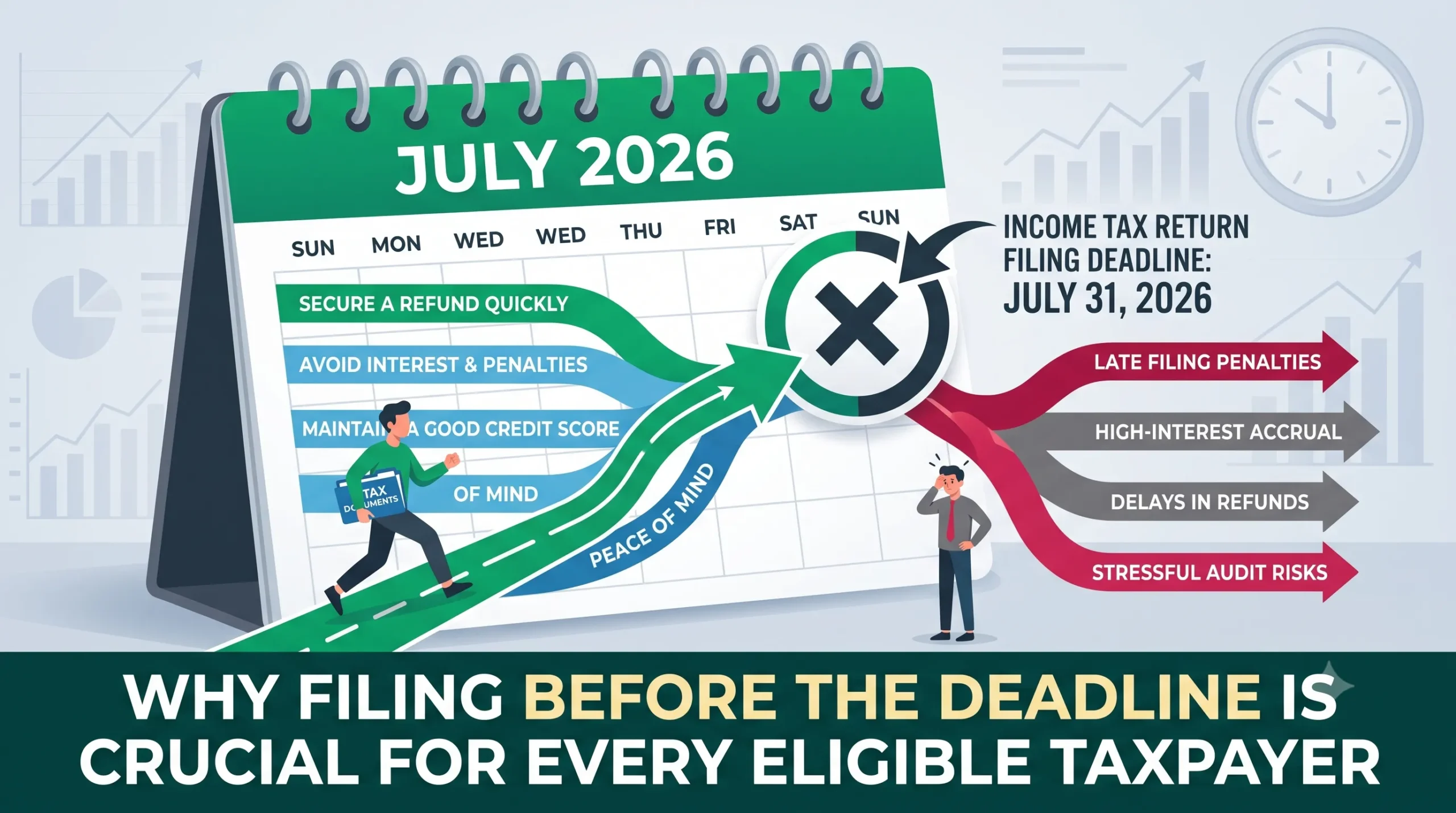
As the Income Tax Return Filing 2026 deadline approaches across India, tax compliance has emerged as the most widely discussed financial topic nationwide. Salaried professionals, enterprise owners, pensioners, and gig economy workers are actively submitting their annual declarations to meet statutory requirements established by the Income Tax Department. Tax experts strongly advise every taxpayer to complete their submission well in advance rather than waiting for the final hours. Web server congestion, authentication failures, and documentation mismatches frequently occur during peak traffic periods, leading to processing delays or unwanted regulatory scrutiny.
Understanding the nuances of Income Tax Return Filing 2026 ensures that individual taxpayers fulfill their civic obligation while optimizing their overall financial planning. An Income Tax Return serves as a comprehensive financial health statement that validates your legal income sources, tax payments, and eligible tax deductions for the assessment year.
Understanding the Essentials of Income Tax Return Filing 2026
An Income Tax Return is an official statement submitted to the Income Tax Department containing detailed breakdowns of annual gross earnings, deductions, exemptions, and net tax liabilities. Completing your Income Tax Return Filing 2026 provides verifiable proof of financial standing. Financial institutions inspect tax returns when processing mortgage applications, personal loans, and business credit lines. Consistently submitting returns builds a clean financial background that simplifies visa documentation and international travel compliance.
Taxpayers must aggregate data from multiple financial statements before initiating their online submission. Essential documents include Form 16 provided by employers, Form 26AS detailing tax credit histories, the Annual Information Statement (AIS), and interest certificates from banking institutions. Cross-referencing these statements ensures that all income streams—including capital gains, bank interest, rental revenue, and dividend income—are accurately reported. Discrepancies between self-declared numbers and automated AIS reporting can trigger computer-generated notices from tax authorities.
Strategic Overview of Tax Compliance Deadlines and Categories
| Taxpayer Category | Applicable Return Form | Key Income Sources Included | Statutory Due Date |
| Salaried Individuals | ITR-1 (Sahaj) / ITR-2 | Salary, pension, single house property, bank interest | July 31, 2026 |
| Non-Audit Professionals | ITR-3 / ITR-4 (Sugam) | Business or professional income, presumptive tax | August 31, 2026 |
| Tax Audit Accounts | ITR-3 / ITR-5 | Turnover exceeding audit statutory thresholds | October 31, 2026 |
| Corporate Entities | ITR-6 | Registered corporate entities and businesses | October 31, 2026 |
| Belated Tax Filers | Any Applicable Form | Submissions made after missing primary due date | December 31, 2026 |
Strategic Advantages of Completing Your Tax Filing Early
Filing your tax return early offers multiple distinct operational and financial advantages for taxpayers across income brackets. The primary benefit is the accelerated processing and distribution of excess tax refunds. When Tax Deducted at Source (TDS) or advance tax payments exceed your final calculated liability, the department refunds the balance directly to your validated bank account. Early submissions are processed much faster because automated assessment systems experience lighter data loads early in the tax cycle.
Another major benefit of early compliance is the flexibility to select your preferred tax regime. Taxpayers can choose between the Old Tax Regime, which permits various deductions under Section 80C, 80D, and HRA, and the New Tax Regime, which features lower tax slabs. Delaying your submission past the statutory due date restricts non-business taxpayers from opting into the Old Tax Regime, as late filings automatically default to the New Tax Regime.
Consequences of Missing the Official Income Tax Filing Cutoff
Failing to complete your Income Tax Return Filing 2026 by the designated cutoff date triggers several mandatory legal penalties, interest charges, and financial restrictions. Taxpayers who miss the primary due date are required to pay late filing fees under Section 234F. A standard late fee of up to ₹5,000 applies to delayed submissions, though this fee is capped at ₹1,000 for taxpayers whose total income remains under ₹5 Lakhs.
Late filing also creates additional financial burdens through penal interest accumulation. Section 234A mandates a penal interest rate of 1% per month on any outstanding tax liability, calculated from the original due date until the return is verified. Furthermore, late submissions restrict your ability to carry forward specific capital losses. While house property losses can still be carried forward, stock market, mutual fund, or business losses cannot be offset against future gains if the original return is submitted late.
After filing your tax return online, you must complete the e-verification process within the prescribed timeframe. You can complete e-verification using Aadhaar-linked Mobile OTP, Net Banking, or Bank Account Validation. An unverified return is treated as invalid by the Income Tax Department, which can nullify your entire filing attempt and expose you to non-filing consequences.
Why Honesty in Tax Compliance Matters: A SatGyan Perspective
True spiritual wisdom extends far beyond rituals—it reflects directly in our everyday conduct, integrity, and choices. Sant Rampal Ji Maharaj guides millions toward moral purity and righteous living. A core pillar of His teachings is the absolute rejection of bribery, corruption, and dishonest gain in any form.
Under His guidance, followers are inspired to stand firmly against bribery, uphold complete transparency in their financial dealings, and fulfill their duties with a clean conscience. When individuals choose strict honesty over corrupt practices, it builds a foundation of trust, justice, and accountability across society. Fulfilling your civic obligations truthfully is a natural extension of these spiritual principles. Unveil the profound wisdom of the holy scriptures in the world-renowned sacred book ‘Gyan Ganga’ by Sant Rampal Ji Maharaj.
[Click Here to Order Your Completely FREE Copy of ‘Gyan Ganga’ Today] (Delivered to your doorstep with zero delivery charges)
Frequently Asked Questions (FAQs)
Q1. What is the fundamental purpose of Income Tax Return Filing 2026?
Income Tax Return Filing 2026 is the official process by which eligible taxpayers report their gross earnings, claimed tax deductions, tax paid, and net tax liabilities to the Income Tax Department for the financial year. It validates legal income sources, allows taxpayers to claim tax refunds, and provides official proof of financial eligibility required for bank credit approvals and visa applications.
Q2. Who is required to submit an ITR under Indian tax regulations?
An Income Tax Return must be filed by any individual whose gross annual income exceeds the basic tax exemption limit before claiming tax deductions. Filing is also mandatory for individuals holding foreign assets, those who spent over ₹2 Lakhs on foreign travel, or those whose annual electricity bills exceeded ₹1 Lakh, regardless of whether their total taxable income falls below the exemption slab.
Q3. What major benefits do taxpayers gain from completing Income Tax Return Filing 2026 early?
Completing Income Tax Return Filing 2026 on time helps avoid late fees under Section 234F, prevents monthly penal interest charges, speeds up tax refund processing, and allows you to carry forward stock market or business losses to future years. Additionally, on-time filers retain the option to choose between the Old and New Tax Regimes.
Q4. What specific penalties apply if I miss the statutory tax deadline?
Missing the filing deadline attracts a late filing fee of up to ₹5,000 (capped at ₹1,000 for total income under ₹5 Lakhs). Unpaid taxes accrue penal interest at 1% per month. Late filers also lose the ability to carry forward capital losses to offset future income gains and are automatically processed under the default New Tax Regime.
Q5. Why is e-verification mandatory after submitting an Income Tax Return online?
Submitting your tax return forms online is only the initial step of the process. The Income Tax Department will not process your return until it is validated through e-verification. Unverified returns are deemed invalid after the statutory deadline passes, leaving the taxpayer exposed to non-filing penalties and delays in receiving tax refunds.
Related Stories










Discussion (0)