
Public Examinations Amendment Bill 2026: Key Changes Every Student Should Know
The Indian Parliament has taken a historic step to strengthen the overall integrity of national tests by introducing and passing the Public Examinations Amendment Bill 2026 in the Lok Sabha. This pivotal legislative update aims to reinforce existing anti-paper leak frameworks by introducing uncompromising legal provisions against organized cheating networks, enabling swift investigative actions, and ensuring rapid judicial proceedings.
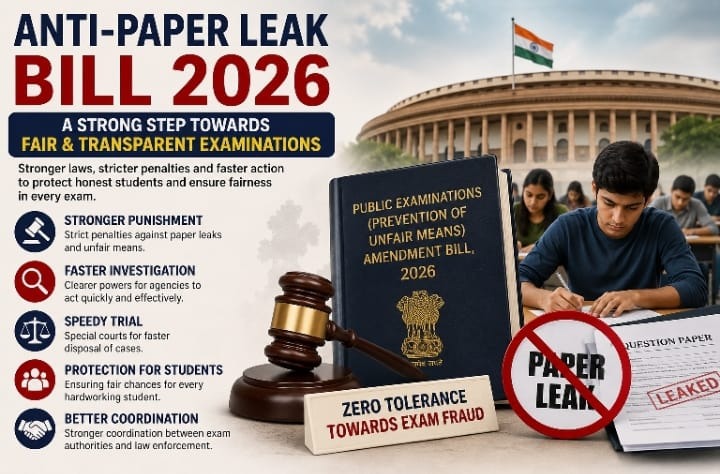
The primary goal of the updated legislation is to preserve the aspirations of honest candidates while maintaining unwavering public confidence in high-stakes recruitment and entrance assessments. As widespread paper leak incidents have repeatedly disrupted critical competitive evaluations in recent years, this legislative overhaul is viewed as an essential reform within India’s educational and administrative ecosystems.
| Key Legislative Aspect | Details & Legal Implications |
| Primary Legislation | Public Examinations (Prevention of Unfair Means) Amendment Bill, 2026 |
| Key Focus Area | Prevention of organized paper leaks, digital fraud, and systemic impersonation |
| Investigative Mandate | Clear, expanded powers for national agencies with strict inquiry timelines |
| Judicial Pathway | Establishment of designated special courts for expedited trial proceedings |
| Primary Beneficiaries | Millions of honest students, recruitment agencies, and educational boards |
Understanding the Public Examinations Amendment Bill 2026
The Public Examinations Amendment Bill 2026 significantly upgrades India’s primary legal defense against paper leaks, systemic impersonation, and sophisticated examination fraud. By building upon previous anti-unfair-means legislation, this modern framework refines investigative protocols, enhances statutory punishments for corporate or organized perpetrators, and establishes specialized courts to clear backlog cases rapidly.
Central authorities have repeatedly emphasized that these updated provisions seek to guarantee total operational transparency, administrative accountability, and fairness across all entrance assessments managed by central testing bodies, public service commissions, and national recruitment agencies. Ultimately, the legislation forms an unyielding protective barrier around millions of candidates who invest years of disciplined effort preparing for competitive assessments.
Escalating Challenges: Why Legislative Intervention Became Necessary
In recent years, recurring instances of question paper leaks and organized digital tampering have created immense stress for candidate communities, while repeatedly derailing national employment schedules. Such compromised events do not merely penalize deserving candidates; they also severely undermine broader public trust in state-level and national recruitment mechanisms.
The Public Examinations Amendment Bill 2026 directly addresses these operational vulnerabilities by equipping law enforcement agencies with specific tools to dismantle criminal syndicates, eliminate high-tech cheating methods, and prevent unauthorized personnel from interfering with testing materials. Through stricter statutory deterrence, the government aims to guarantee that future assessment sessions maintain absolute credibility across every testing center nationwide.
Core Provisions and Features of the Updated Law
1. Severe Statutory Penalties
The amended legislation imposes exceptionally strict financial penalties and non-bailable imprisonment terms on individuals, coaching networks, and organized syndicates found guilty of facilitating paper leaks or unauthorized access.
2. Streamlined Investigative Timelines
Investigating officers are granted clear statutory authority to gather forensic, digital, and financial evidence swiftly, ensuring that complex multi-state cheating investigations do not stall in administrative delays.
3. Dedicated Courts for Fast Trials
Special judicial provisions have been incorporated to route examination fraud offenses through designated courts, ensuring cases are resolved quickly rather than dragging on for years.
Also Read: Major Exam Reform Task Force Led by Nandan Nilekani
4. Advanced Safeguards for Candidate Protection
The updated framework emphasizes proactive administrative security, ensuring that honest candidates are not unfairly penalized or subjected to unexpected test cancellations caused by isolated criminal activities.
5. Enhanced Inter-Agency Coordination
The statutory framework establishes formal collaboration guidelines between central testing organizations, state police departments, cybersecurity experts, and national intelligence units to neutralize potential threats before exam days.
Direct Benefits for Competitive Exam Aspirants
When implemented with precision across all administrative tiers, the revised legislation offers several transformative advantages for candidates:
- Restored Academic Trust: Rebuilds personal confidence among aspirants preparing for national-level recruitment drives and entrance evaluations.
- Transparent Selection Procedures: Ensures that merit, subject knowledge, and personal effort remain the sole criteria for academic or professional selection.
- Deterrence Against Syndicates: Reduces the influence of criminal networks that seek to profit from compromised examination materials.
- Rapid Resolution of Fraud Allegations: Facilitates fast-track investigations, minimizing prolonged uncertainty or extended delays in publishing test results.
- Equal Opportunity Standards: Guarantees a level playing field for candidates coming from diverse socio-economic backgrounds across the country.
For lakhs of young individuals devoting countless hours to intense study, a completely secure testing environment is a foundational requirement for social mobility and professional success.
Practical Implementation Challenges and Security Requirements
While the legal updates marked by the Public Examinations Amendment Bill 2026 represent a decisive policy shift, policy experts stress that consistent operational execution will determine its ultimate success. Passing robust laws must be matched by continuous technical upgrades across physical and digital examination infrastructure.
Key measures such as end-to-end question paper encryption, secure biometric verification at test centers, real-time network monitoring, frequent third-party security audits, and strict institutional accountability remain necessary to prevent operational breaches. Comprehensive public awareness and strict compliance by all regional testing partners will further eliminate vulnerabilities across the examination supply chain.
Broader Socio-Economic Significance
India coordinates thousands of public recruitment and educational entrance tests annually to evaluate millions of candidates. Even a single paper leak incident inflicts severe financial, psychological, and institutional damage, leading to canceled schedules, wasted financial resources, and widespread public frustration.
By instituting stringent legal deterrents against organized paper leaks, the updated statutory framework aims to stabilize public recruitment pipelines and protect merit-based progression. Effective execution of this law will serve as a vital landmark in preserving institutional credibility throughout India’s public selection systems.
Strategic Roadmap for Sustainable Reform
The passage of the updated legislation reflects an ongoing national effort to modernize test administration and eliminate systemic vulnerabilities. By combining statutory deterrence with digital protection measures, educational bodies are working toward a highly resilient assessment environment.
Achieving complete exam security requires total cooperation among testing authorities, law enforcement units, technology partners, and candidate communities. When rigorous legal accountability works alongside ethical awareness, India’s public recruitment ecosystem can function with absolute transparency and fairness.
Honesty Is the Foundation of Success
The issue of paper leaks reminds us that success achieved through dishonesty never brings lasting respect or peace. Sant Rampal Ji Maharaj teaches that truthfulness, honesty, and righteous conduct are essential qualities for every human being. According to His teachings, earning success through unfair means creates negative karmic consequences, whereas sincere effort and truthful actions lead to real progress and inner satisfaction.
Students should prepare with dedication, patience, and honesty instead of looking for shortcuts. A transparent examination system, combined with ethical values, helps build a society where talent and hard work receive the recognition they deserve. Click this link to order your completely free copy of the sacred book ‘Gyan Ganga’ by Sant Rampal Ji Maharaj.
FAQ: Public Examinations Amendment Bill 2026
1. What is the main purpose of the Public Examinations Amendment Bill 2026?
The primary objective of the Public Examinations Amendment Bill 2026 is to eliminate paper leaks, organized cheating networks, digital manipulation, and systemic impersonation during state and national testing sessions through severe penalties, faster investigations, and special trials.
2. Why was updating the anti-paper leak framework necessary this year?
Frequent breaches in competitive testing schedules created uncertainty, delayed recruitment cycles, and damaged candidate trust. Updating the legal framework provides law enforcement agencies with the statutory powers required to dismantle organized criminal networks effectively.
3. How does the Public Examinations Amendment Bill 2026 protect honest aspirants?
The law reduces the risk of overall test cancellations by establishing rapid investigative protocols and severe penalties that discourage criminal interference, ensuring that candidate selection remains based strictly on individual merit and hard work.
4. What special judicial mechanisms are introduced under this legislation?
The framework includes provisions for establishing designated special courts, allowing examination fraud cases to be processed through fast-track legal proceedings rather than suffering long delays within standard judicial channels.
5. How can testing agencies ensure the effective execution of this updated law?
Testing authorities must pair strict legal provisions with advanced digital safeguards, including encrypted question paper distribution, multi-factor biometric authentication, real-time cybersecurity monitoring, and comprehensive audits across all testing locations.
Related Stories










Discussion (0)