NEET Paper Leak Controversy: BJP Denies Portfolio Offer Report to CJP After Dharmendra Pradhan Resigns
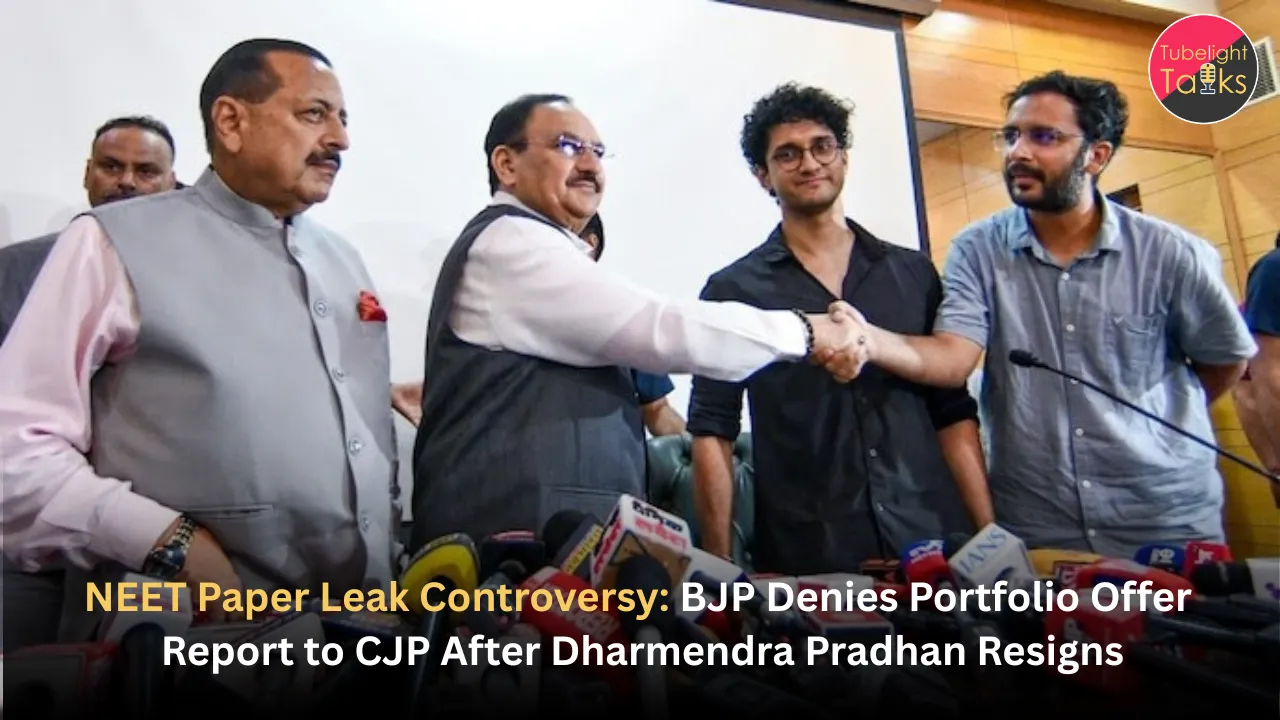
The Bharatiya Janata Party (BJP) has rejected reports claiming that the Centre initially offered to change Dharmendra Pradhan’s ministerial portfolio instead of removing him from the Union Cabinet during negotiations with the Cockroach Janta Party (CJP). While reports citing sources claimed the proposal was discussed during talks, BJP spokesperson Sambit Patra described the claim as “baseless, imaginary and unfounded.” The political developments unfolded amid nationwide protests over the NEET paper leak, culminating in Pradhan’s resignation.
Key Takeaways: BJP Rejects Portfolio Offer Claims Amid NEET Paper Leak Controversy Protests
- BJP denied reports that the Centre proposed changing Dharmendra Pradhan’s portfolio instead of removing him from the Cabinet.
- BJP MP and spokesperson Sambit Patra called the reports “baseless, imaginary and unfounded.”
- NDTV, citing sources, reported that the Centre had initially proposed shifting Pradhan to another ministry.
- The CJP reportedly insisted that only Pradhan’s resignation would be acceptable.
- Dharmendra Pradhan resigned after the third round of talks between the Centre and the CJP.
- The CJP subsequently called off its nationwide protests.
- Parliament later witnessed political confrontation over the NEET paper leak issue and the proposed amendment to the anti-paper leak law.
BJP Denies Reports of Portfolio Change Proposal
The Bharatiya Janata Party rejected reports claiming that the Centre had offered to change Dharmendra Pradhan’s portfolio as part of negotiations with the Cockroach Janta Party (CJP). BJP MP and official spokesperson Sambit Patra stated that reports published in a reputed newspaper suggesting such a proposal were incorrect.
“I want to make it clear that this report, which was published in a reputed newspaper, is completely baseless, imaginary and unfounded. As an official spokesperson, I have stated this clearly. There should be no attempt to spread any kind of confusion”, Patra said.
Patra later also described media reports as “misleading and fictitious,” adding that Dharmendra Pradhan had already resigned.
Reports Citing Sources Claimed Centre Made Initial Proposal
Earlier reports, including one by NDTV citing sources, stated that the Centre’s first proposal during negotiations was to shift Dharmendra Pradhan from the Education Ministry to another portfolio.
According to the report, Union Ministers JP Nadda and Jitendra Singh conveyed the proposal to the CJP delegation during their first meeting on July 20.
The report said the Centre viewed changing or removing a minister as the Prime Minister’s prerogative. However, according to the same sources, CJP representatives Ashutosh Ranka and Saurav Das rejected the proposal and maintained that only Pradhan’s resignation would satisfy the protesters.
The sources further claimed that CJP negotiators believed accepting anything less than a resignation could trigger a backlash among protesters.
Three Rounds of Talks Between Centre and CJP
The negotiations between the Centre and the CJP took place over three rounds.
| Round | Key Development |
| First Round (July 20) | Held during the CJP’s “Sansad Chalo” march. JP Nadda and Jitendra Singh met the delegation. |
| Second Round | Another meeting was held later the same day. |
| Third Round | Conducted at Constitution Club, where the government agreed to accept all of the CJP’s demands, according to the CJP. Dharmendra Pradhan resigned hours later. |
The first meeting took place at JP Nadda’s residence during the CJP’s Parliament march from Jantar Mantar.
CJP spokesperson Saurav Das claimed that delegation members’ phones were taken away and they were placed under house arrest before waiting nearly two hours for a ten-minute meeting. As protests intensified across several cities following the Parliament march, the CJP refused to attend another meeting at Nadda’s residence and demanded a neutral venue.
CJP spokesperson Ashutosh Ranka stated that the delegation no longer wanted symbolic gestures and expected concrete action.
Also Read: Dharmendra Pradhan Resignation 2026: Historic Exit Under Pressure
“And this time, we don’t want empty gestures or mere optics. If you are meeting us, you can’t waste our time. You will have to accept some of our demands or clearly tell us how many days it will take to fulfil them.”
Ranka reiterated that Dharmendra Pradhan’s resignation remained non-negotiable. Eventually, the government agreed to hold the third round of talks at Constitution Club.
According to the CJP, the government accepted all of its demands, including withdrawing cases against peaceful protesters in Delhi and NDA-ruled states. Dharmendra Pradhan resigned from his position hours after the third round concluded, after which the CJP called off its protests.
CJP’s Main Demands During Negotiations
In its memorandum submitted to JP Nadda, the CJP listed three principal demands:
- Unconditional release of activist Sonam Wangchuk.
- Removal of Education Minister Dharmendra Pradhan.
- ₹1 crore compensation for families of NEET aspirants who died by suicide following the NEET paper leak.
The memorandum formed the basis of discussions during negotiations between the Centre and the CJP.
Sonam Wangchuk’s Transfer After Court Order
The CJP stated that activist Sonam Wangchuk was on a hunger strike when police picked him up from Jantar Mantar and shifted him to Safdarjung Hospital.
A day later, following a Delhi High Court order, Wangchuk was transferred from Safdarjung Hospital to Medanta Hospital in Gurugram, the facility of his choice.
Parliament Witnesses Political Confrontation
On Monday, Dharmendra Pradhan received a warm welcome from NDA leaders upon arriving in Parliament.
BJP MPs assembled near the Makar Dwar entrance, greeted the former Education Minister, escorted him inside Parliament, and presented him with a ceremonial cap as a gesture of solidarity. Meanwhile, Opposition leaders led by Congress MP Priyanka Gandhi Vadra protested over the alleged use of excessive force against students during demonstrations.
Raising the slogan “Shiksha Chori” (theft of education), Opposition leaders demanded that Union Home Minister Amit Shah apologise for what they described as police brutality against peaceful protesters.
Congress MP Jairam Ramesh, who had earlier demanded Pradhan’s resignation, also met the former minister inside Parliament.
“It happens,” Ramesh told him.
Pradhan replied, “Nothing happened,” before adding, “I am a street fighter, not an AC-room activist.”
Anti-Paper Leak Amendment Bill Introduced
The political developments unfolded as Parliament prepared to discuss the Public Examinations (Prevention of Unfair Means) Amendment Bill, 2026.
Also Read: Shocking Delhi Opposition Protest: High-Stakes 2026 Shift
The proposed legislation aims to strengthen India’s anti-paper leak framework following the NEET controversy.
The Bill proposes:
| Proposed Provision | Details |
| Maximum imprisonment | Increased from 5 years to 10 years |
| Maximum fine | Up to ₹50 lakh |
| Objective | Strengthen action against examination fraud and paper leaks |
The Bill was tabled amid continued Opposition protests over the alleged use of force against demonstrators in Delhi and other parts of the country.
After six days of disruption during the Monsoon Session, Parliament was expected to begin discussion on the proposed amendments.
Political Developments Continue After Pradhan’s Resignation
The disagreement over whether the Centre initially proposed changing Dharmendra Pradhan’s portfolio remained contested.
Reports citing sources maintained that such an offer was discussed during negotiations, while the BJP officially denied the claim and described it as unfounded.
Pradhan’s resignation brought an end to the CJP-led protests, but the political debate over the NEET paper leak, student demonstrations, police action and the proposed anti-paper leak legislation continued inside and outside Parliament.
Seeking Truth Through Spiritual Wisdom
The nationwide protests reflected how people united to seek accountability, transparency and justice through constitutional and peaceful means when they believed the system had failed them. In the spiritual sphere, too, scriptures emphasise that truth should be accepted on the basis of authentic knowledge rather than blind faith. Tatvdarshi Sant Rampal Ji Maharaj explains that holy scriptures such as the Bhagavad Gita, Vedas, Quran Sharif, Bible, and Guru Granth Sahib provide guidance on the correct path of worship.
Referring to Bhagavad Gita Chapter 4 Verse 34, He explains the importance of seeking the guidance of a Tatvadarshi Saint to understand true spiritual knowledge according to the scriptures. His discourses encourage people to verify spiritual teachings through scriptural evidence and adopt a path based on truth, wisdom and peaceful coexistence.
For more information visit our:
Website: www.jagatgururampalji.org
YouTube: Sant Rampal Ji Maharaj
Facebook: Spiritual Leader Saint Rampal Ji
X (Twitter): @SaintRampalJiM
FAQs on CJP Demands Dharmendra Pradhan Exit
1. Why did the CJP demand Dharmendra Pradhan’s resignation?
The CJP made his resignation a principal demand during protests over the NEET paper leak controversy.
2. Did the Centre offer to change Dharmendra Pradhan’s portfolio?
Reports citing sources claimed it did, but the BJP officially denied the claim as baseless.
3. When did Dharmendra Pradhan resign?
He resigned hours after the third round of talks between the Centre and the CJP concluded.
4. What were the CJP’s key demands?
The CJP sought Sonam Wangchuk’s release, Pradhan’s removal and ₹1 crore compensation for affected NEET aspirants’ families.
5. What does the Public Examinations Amendment Bill, 2026 propose?
It proposes increasing the maximum jail term to 10 years and fines up to ₹50 lakh for examination fraud and paper leaks.
Related Stories





Discussion (0)