What Is Driving the DR Congo Ebola Outbreak?
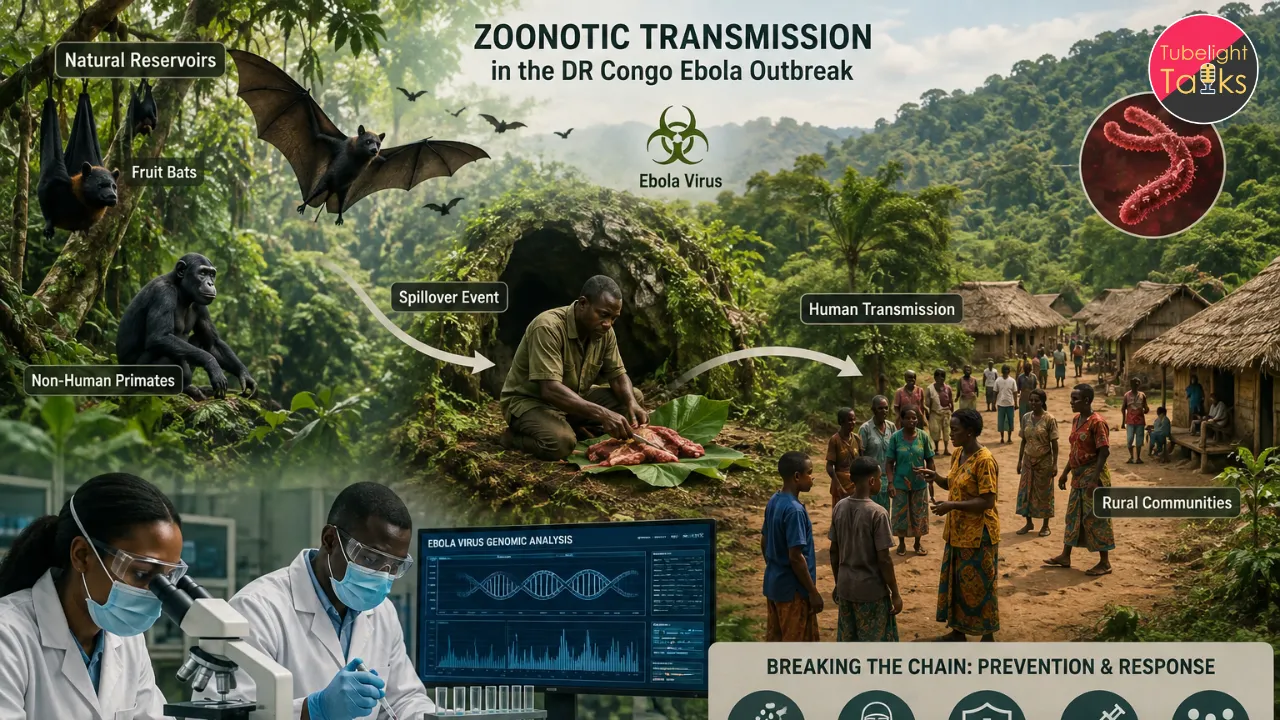
The latest DR Congo Ebola outbreak has raised global alarm after genomic surveillance confirmed the emergence was initiated by a fresh zoonotic transmission rather than the reactivation of previous chains.
Public health agencies, led by the Ministry of Health and international response teams, identified early cases originating in the forested provinces of the nation.
Epidemiologists note that when a pathogen crosses from wildlife reservoirs into human hosts, initial detection is frequently obscured by other endemic tropical fevers. This delay allows primary cases to spark secondary clusters across remote villages before emergency isolation units are established.
How Genetic Sequencing Confirmed a Fresh Animal Spillover
Pathogen genomic sequencing performed by reference laboratories in Kinshasa proved pivotal. By mapping viral isolates extracted from initial patients, researchers established that the circulating strain is phylogenetically distinct from historical local outbreaks.
Also Read: Understanding the Shocking Surge in H1N1 Cases in Delhi
Instead of deriving from latent infection flare-ups among earlier survivors, the data demonstrated an independent crossover event. This confirms that forest wildlife reservoirs continue to maintain silent circulation loops that periodically intersect with human activity.
Key Findings
- Phylogenetic Divergence: Isolate genomes branch outside historical survivor-linked clusters.
- Index Exposure: Direct contact with bushmeat preparation or cave ecosystems preceded initial symptom onset.
- Containment Urgency: Ring-vaccination and active contact-tracing protocols were immediately mobilized around confirmed cluster zones.
Key Data and Evolution: Comparing Recent Outbreaks
Evaluating epidemiological shifts helps health authorities allocate rapid-response resources to vulnerable health zones.
Comparison of Recent Ebola Outbreaks
| Metric / Parameter | 15th & 16th Outbreaks (Equateur / Kasai) | Current DR Congo Ebola Outbreak |
| Primary Emergence Mode | Zoonotic Spillover / Isolated Transmission | Confirmed Independent Animal-to-Human Spillover |
| Identified Viral Strain | Zaire Ebolavirus (EBOV) | Bundibugyo / Zaire Lineage Variance |
| Case Fatality Ratio (CFR) | 60%–70% in localized zones | High severity across rural remote corridors |
| Response Tactics | Ring Vaccination (Ervebo) & Safe Burials | Intensive Genomic Tracing, Mobile Labs, Border Screening |
| Key Vectors | Direct contact with forest fauna, bodily fluid spread | Wildlife exposure, delayed community presentation |
Recognizing Symptoms and Transmission Vectors
Ebola virus disease (EVD) remains one of the world’s most severe viral hemorrhagic fevers.
Transmission requires direct physical contact with blood, secretions, organs, or other bodily fluids of infected individuals, dead bodies, or infected animals such as fruit bats and non-human primates.
Early-Stage Clinical Symptoms: Days 1–3
Common early symptoms include:
- Sudden onset of high fever
- Profound fatigue
- Intense muscle aches
- Severe sore throat
- Persistent headache
- Joint inflammation
Advanced-Stage Clinical Symptoms: Days 4–10
More severe symptoms can include:
- Gastrointestinal distress, including intractable vomiting and watery diarrhea
- Impaired kidney and liver function, leading to electrolyte imbalance
- Internal and external bleeding manifestations, such as mucosal bleeding, hematomas, and oozing at venipuncture sites in severe cases
According to the World Health Organization Guidelines on Filovirus Management, early supportive rehydration and electrolyte correction significantly boost survival probability.
On-the-Ground Containment Challenges in Eastern Congo
Managing the DR Congo Ebola outbreak entails major logistical hurdles.
Dense rainforest geography makes transport between rural clinics and central diagnostic laboratories arduous.
Furthermore, community mistrust and local misinformation can hinder immediate isolation measures. Mobile medical units must collaborate with village leaders to explain quarantine protocols, safe burial techniques, and the benefits of early symptom reporting.
One Health: Why Wildlife Surveillance Is Critical
The latest findings underscore the necessity of the One Health framework. Human well-being cannot be divorced from animal population dynamics and ecological stability.
When deforestation, agricultural encroachment, or unregulated bushmeat harvesting expand, the barrier between wildlife pathogens and human settlements diminishes.
Sustained surveillance of wild bat roosts, along with community education on safe animal handling, serves as the first line of global biosecurity.
Beyond Epidemics: Finding Lasting Peace and Shelter in Supreme Spiritual Truth
The recurring devastation of the DR Congo Ebola outbreak mirrors the broader state of our material world, where humanity continually faces unpredictable viral plagues, physical mortality, climate catastrophes, and deep emotional turmoil.
Modern medical science works tirelessly to treat the physical vessel, yet worldly remedies cannot eliminate universal suffering, decay, and the inevitability of death.
True, permanent liberation from this cycle of distress is attained only through the authentic spiritual path revealed in sacred scriptures.
Sant Rampal Ji Maharaj imparts the precise, evidence-based method of true worship (Satbhakti) derived directly from the Holy Vedas, Shrimad Bhagavad Gita, Holy Quran, Guru Granth Sahib, and the Holy Bible.
His spiritual discourses clarify that the Supreme Almighty God—Kabir Saheb—is the ultimate healer who completely removes physical agonies and liberates the soul from the transient realm of Kaal (Brahm).
By adopting Satbhakti under the guidance of a true Tatvdarshi Saint, a seeker attains both inner tranquility during worldly crises and everlasting salvation (Moksha) in the eternal abode of Satlok, where sorrow, disease, and death do not exist.
To learn the profound spiritual secrets of eternal life and true devotion, explore the official discourses on the Official YouTube Channel of Sant Rampal Ji Maharaj.
Frequently Asked Questions (FAQs)
Q1. How did the new DR Congo Ebola outbreak originate?
Genomic sequencing confirms that the current outbreak began from an independent zoonotic spillover event, where the virus jumped directly from a wild animal reservoir into human hosts.
Q2. What are the main transmission routes of the Ebola virus?
The Ebola virus spreads to humans through handling infected wildlife and propagates between people via direct contact with infected blood, bodily fluids, or contaminated materials.
Q3. Which wild animals serve as natural reservoirs for Ebola?
Fruit bats, specifically species of the Pteropodidae family, are widely recognized as natural hosts, with non-human primates and forest antelopes serving as intermediate spillover hosts.
Q4. What are the primary initial symptoms of an Ebola infection?
Infected individuals typically experience a sudden onset of fever, extreme weakness, muscle pain, persistent headache, and a sore throat before gastrointestinal complications emerge.
Q5. How do health agencies control active Ebola transmission chains?
Containment relies on rapid case isolation, comprehensive contact tracing, supportive medical rehydration, community engagement, and ring vaccination around confirmed cases.
Related Stories









Discussion (0)