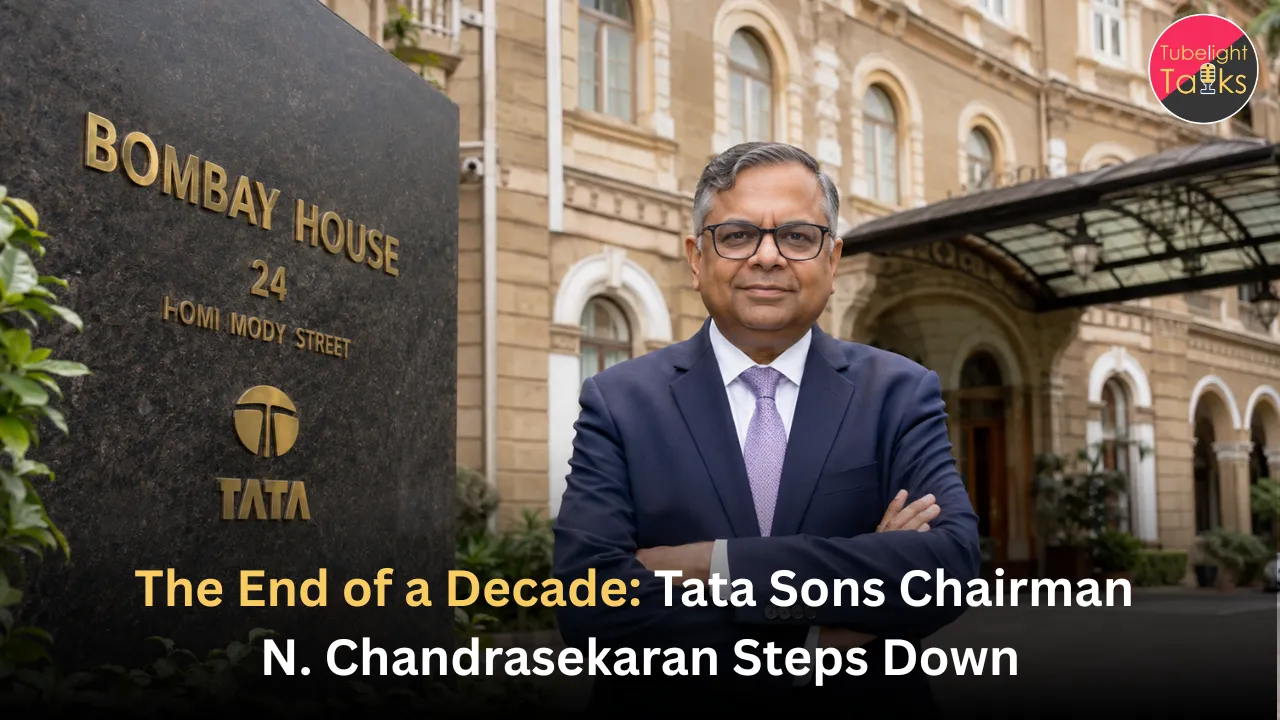
The End of a Decade: Tata Sons Chairman N. Chandrasekaran Steps Down
As Tata Sons Chairman N Chandrasekaran announced his decision to step down at the conclusion of his second term in February 2027, corporate India marks the end of one of the most transformative leadership eras in modern business history.
Taking charge in February 2017 following a high-profile boardroom restructuring, Chandrasekaran became the first non-Parsi executive to head the multi-billion-dollar Tata Group.
Over his decade-long tenure, he turned around struggling legacy businesses, spearheaded mega-acquisitions like Air India, and pushed the conglomerate into frontier tech sectors including semiconductors and electric vehicles.
The announcement came ahead of the Tata Sons Annual General Meeting. Chandrasekaran communicated to the board that despite receiving unanimous backing from the principal philanthropic owners—the Sir Dorabji Tata Trust and Sir Ratan Tata Trust—he elected not to seek reappointment due to lack of unanimous board consensus.
His announcement gives the holding company ample lead time to execute a seamless leadership transition.
Key Takeaways from N Chandrasekaran’s Era
To quickly understand the impact of his decade-long leadership, here are the vital highlights of his tenure:
- Pioneering Leadership: First professional, non-Parsi leader to head Tata Sons.
- Reclaiming Air India: Led the historical repurchasing and consolidation of Air India back into the Tata fold.
- Tech and Semiconductor Shift: Committed billions of dollars into semiconductor fabrication plants, EV batteries, and Tata Neu digital ecosystems.
- Massive Wealth Creation: Group market capitalization scaled unprecedented highs, driving significant dividend streams for philanthropic trusts.
- Disciplined Capital Allocation: Exited unprofitable legacy telecommunication businesses and consolidated overlapping operations across group entities.
Also Read: Ratan Tata, Titan of Indian Industry, Passes Down at 86
From TCS Trainee to Corporate Titan: The Rise of “Chandra”
Born in 1963 in Mohanur, Tamil Nadu, Natarajan Chandrasekaran’s journey is a quintessential story of grit and meritocracy.
He completed his Master of Computer Applications (MCA) at Regional Engineering College, Trichy, before joining Tata Consultancy Services (TCS) as a software trainee in 1987.
Over nearly three decades at TCS, “Chandra” demonstrated an extraordinary capacity for operational execution and client management.
By 2009, he was elevated to Chief Executive Officer and Managing Director of TCS. Under his leadership, TCS cemented its status as India’s most valuable IT services bellwether and the cash cow of the entire Tata Group.
His stellar execution at TCS made him the natural candidate chosen by late Ratan Tata to take charge of Tata Sons in early 2017.
Major Milestones Under Tata Sons Chairman N Chandrasekaran
During his tenure as Tata Sons Chairman N Chandrasekaran, he executed a multi-pronged strategy focused on simplification, synergy, and scale.
He systematically cleaned up debt-ridden balances, restructured Tata Steel’s European operations, and consolidated fragmented airline assets under Air India.
1. The Homecoming of Air India
In 2021, Tata Sons successfully placed the winning bid for state-owned Air India, bringing the national carrier back to its founding group after 68 years.
Chandrasekaran initiated a multi-billion-dollar fleet modernization program to restore the airline’s global standing.
2. High-Tech Manufacturing and Electronics
Recognizing the shifting global geopolitical dynamics, Chandrasekaran positioned Tata as a crucial player in electronics manufacturing.
The group set up state-of-the-art semiconductor assembly and testing plants in Assam and Gujarat, along with massive iPhone assembly facilities in Tamil Nadu.
3. Energy Transition and EV Leadership
Under his oversight, Tata Motors transformed into India’s dominant electric passenger vehicle manufacturer, capturing over 70% of the domestic EV market share.
Simultaneously, Tata Power accelerated its green portfolio toward renewable generation.
The Marathoner’s Philosophy: Discipline and Long-Term Strategy
Beyond the boardroom, Chandrasekaran is an avid long-distance runner who has completed all six World Marathon Majors.
He frequently credits marathon running with shaping his corporate management philosophy—emphasizing endurance, pacing, and emotional discipline over short-term sprints.
This long-term focus was evident in his book Bridgital Nation, where he outlined how digital technology and physical infrastructure can collaborate to solve India’s employment and healthcare challenges.
“Running a marathon teaches you that pain is temporary, but discipline yields enduring results. Managing a diversified conglomerate requires the exact same mindset—patience through turbulence and steady execution toward the long horizon.”
— N. Chandrasekaran
Financial Transformation of Tata Group (2017–2026)
To understand the financial scale of transformation under his leadership, the data below highlights the growth metrics recorded across the conglomerate.
| Metric / Parameter | Status at Start (2017) | Status at Peak (2025–2026) | Primary Growth Drivers |
| Combined Market Capitalization | ~$116 Billion | Over $400 Billion | TCS, Tata Motors, Trent, Tata Power |
| Group Operating Revenues | ~$103 Billion | ~$165+ Billion | Global IT services, auto sales, retail |
| Air Services Portfolio | Fragmented (Vistara, AirAsia) | Unified under Air India | Strategic consolidation & expansion |
| Tech Focus | Legacy Software Services | AI, Semiconductors, Batteries | Strategic venture capital & capex |
| Chairman Remuneration | ~$30 Crore | ~₹158.66 Crore (FY26) | Profit-linked compensation model |
For official corporate disclosures and detailed institutional records, readers can review public filings via the Bombay Stock Exchange (BSE India) and official press releases from the Tata Group Official Portal.
Why Chandrasekaran Decided Not to Seek Reappointment
According to official communications sent to the board, the decision stems from corporate governance clarity.
The Sir Dorabji Tata Trust and Sir Ratan Tata Trust—which jointly hold roughly 66% of Tata Sons—had unanimously recommended extending Chandrasekaran’s tenure for another five-year term starting February 2027.
However, during a board meeting on February 24, 2026, the resolution failed to achieve unanimous backing due to opposition from a single board member.
Rather than operating under leadership ambiguity during critical capital projects, Chandrasekaran requested the board to initiate a formal succession selection committee to choose the next chairman.
The Fleeting Nature of Material Success: Unlocking True Eternal Peace
The corporate world places immense value on titles, market capitalization, and organizational dominance.
Leaders like N. Chandrasekaran work tirelessly for decades, managing billions of dollars and navigating intense high-stakes pressures. Yet, no matter how high one climbs in the material sphere, every earthly position, power, and worldly honor remains temporary. Human life is continually shadowed by unexpected stress, health challenges, uncertainties, and the inevitable passage of time.
In our pursuit of professional excellence, we often forget the true purpose of human existence. True peace, security, and eternal joy cannot be found in fleeting corporate thrones or material wealth. As explained in the profound spiritual discourses of Sant Rampal Ji Maharaj, the ultimate goal of human life is to achieve spiritual liberation and connect with the Supreme God (Kabir Saheb).
While material wealth stays behind in this mortal world, true spiritual devotion (Bhakti) safeguards the soul through eternity. To break free from the endless cycle of stress, suffering, and rebirth, one must seek authentic spiritual knowledge (Tattvagyan) under the guidance of a Complete Saint.
By understanding our true spiritual nature, we can live a balanced life with mental peace while attaining ultimate salvation. To learn more about the path to true eternal peace, explore the spiritual discourses on the Official YouTube Channel of Sant Rampal Ji Maharaj.
Frequently Asked Questions (FAQs)
Q1. Who is the current Chairman of Tata Sons?
Natarajan Chandrasekaran is the current Executive Chairman of Tata Sons. He took charge in February 2017 and was reappointed for a second five-year term in 2022.
Q2. When will N Chandrasekaran step down as Tata Sons Chairman?
N. Chandrasekaran will complete his current tenure and officially step down as Chairman of Tata Sons on February 20, 2027.
Q3. Why is N Chandrasekaran not seeking a third term as Tata Sons Chairman?
Although the primary Tata Trusts unanimously recommended a five-year extension, the resolution lacked unanimous board approval in February 2026.
Chandrasekaran chose to defer the decision and eventually requested a succession process to ensure leadership clarity.
Q4. What were N Chandrasekaran’s major achievements at Tata Group?
Key achievements include:
- Acquiring Air India
- Expanding group market capitalization beyond $400 billion
- Building semiconductor and battery manufacturing ecosystems
- Simplifying group operational structures
Q5. How will the next Tata Sons Chairman be selected?
As per Tata Sons’ Articles of Association, a formal five-member selection committee will be formed.
This panel consists of:
- Three nominees from Tata Trusts
- One member from the Tata Sons board
- One independent external expert
Related Stories



Discussion (0)