Water Security in India: 5 Key Economic Challenges & Solutions (2026)
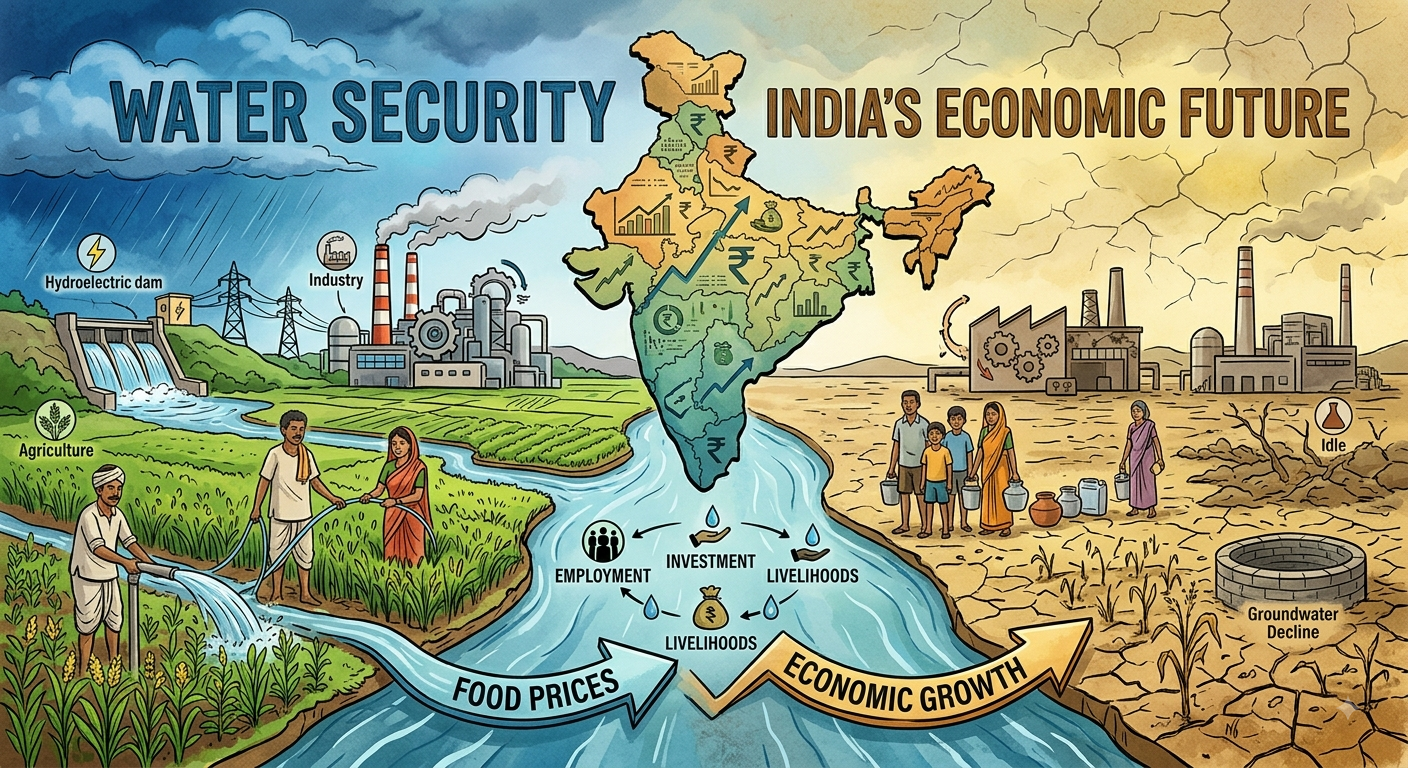
Water is frequently discussed through the lens of public health or environmental conservation, but water security in India has rapidly evolved into an economic baseline. Key sectors including agriculture, manufacturing, energy generation, and municipal services rely continuously on stable water supplies. While hosting roughly 18% of the global population, the nation holds only about 4% of global renewable water resources, paired with highly seasonal rainfall.
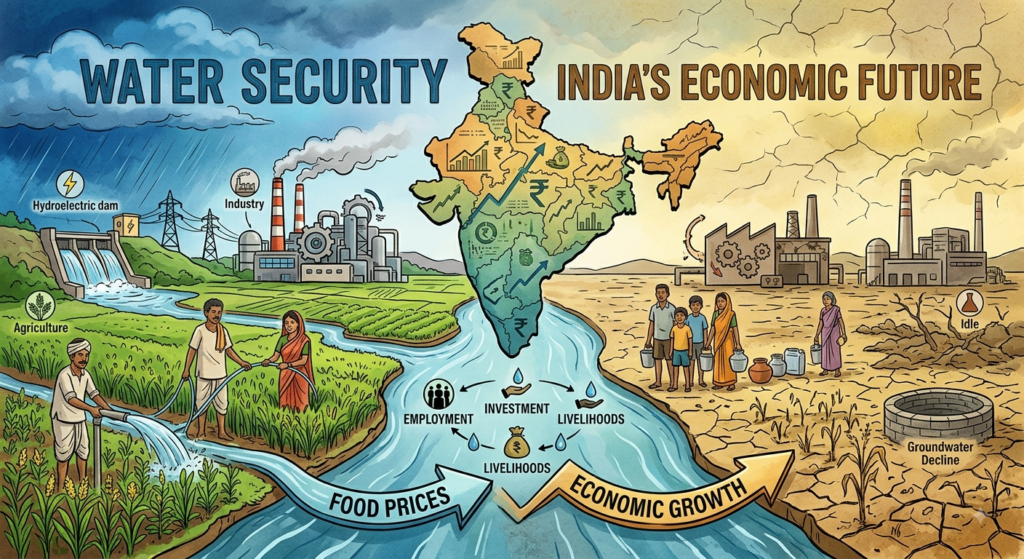
According to reports by the World Bank, water-dependent sectors generate nearly half of India’s economic value added and employ approximately 70% of its total workforce. As groundwater tables decline and weather patterns become increasingly erratic, water availability will directly impact food prices, industrial output, employment levels, and national growth rates.
Also read : NITI Aayog Water Budgeting: New Report to Strengthen Local Water Security in Aspirational Blocks
Why Water Security in India Matters to the Broader Economy
When analyzing economic indicators, attention typically centers on financial markets, technological innovation, industrial output, and job creation. Yet, water forms the silent foundation beneath every commercial ecosystem.
Agriculture relies heavily on irrigation to maintain yields. Industrial facilities require water for cooling, processing, and refining, while energy production demands continuous supply for operational stability. Simultaneously, urban centers require dependable supplies for households, sanitation, and commercial services.
+-------------------------------------------------------------------------+
|                  Socio-Economic Impact Flow Chart                       |
|                                                                         |
|  [Water Scarcity] ---> [Higher Production Costs] ---> [Supply Shocks]   |
|                                                                         |
|  [Crop Failure]   ---> [Food Price Inflation]    ---> [Reduced Growth]  |
+-------------------------------------------------------------------------+
When supply becomes unpredictable or costly, businesses incur higher operating expenses, farm productivity drops, and household budgets tighten. Unmitigated resource stress shifts over time from a localized supply problem into a macro-level growth constraint.
Key Sectors Affected by Water Stress
| Sector | Primary Water Use | Economic Risk Factor | Mitigation Focus |
| Agriculture | Irrigation, crop cultivation | Yield drops, volatile food prices, reduced rural income | Micro-irrigation, crop-water matching |
| Manufacturing | Processing, cooling, cleaning | Higher input costs, production shutdowns | Zero liquid discharge (ZLD), water recycling |
| Energy Sector | Thermal plant cooling, hydro power | Grid instability, generation outages | Closed-loop cooling, renewable energy shift |
| Urban Centers | Domestic supply, commercial operations | Increased supply costs, health burdens | Rainwater harvesting, wastewater treatment |
Groundwater Depletion: The Hidden Economic Risk
Groundwater represents one of the most vital natural assets supporting water security in India. It provides the vast majority of rural drinking supplies and supports millions of agricultural wells nationwide.
Agriculture and the Water-Energy Nexus
Agricultural operations account for roughly 80% to 90% of total fresh water extraction. To sustain yields, farmers have relied extensively on tube wells and groundwater pumping. However, extraction has outpaced natural recharge across several major agrarian states, causing water tables to drop steadily.
Falling Groundwater ---> Deeper Drilling & High Energy Use ---> Increased Production Costs
This dynamic creates a clear economic challenge. As groundwater levels drop, accessing water requires deeper drilling, more equipment, and higher electricity or fuel consumption. Over time, these rising production expenses lower farm net incomes and strain rural purchasing power.
Aligning Cropping Patterns with Water Resources
Improving water security in India requires aligning agricultural practices with regional water availability. Cultivating water-intensive crops in naturally arid or water-stressed regions puts severe pressure on deep aquifers.
NITI Aayog has consistently emphasized adjusting crop patterns to match regional agro-climatic conditions while scaling efficient water application. Expanding micro-irrigation systems—such as drip and sprinkler setups—enables higher agricultural output per unit of water consumed.
Impacts Across Food Prices, Cities, and Industrial Growth
Shortages in water supply propagate quickly across integrated economic networks. Reduced water availability lowers crop yields, disrupting food supply chains and putting upward pressure on consumer prices.
+--------------------------------------------------------------------------+
|                  Multi-Sector Vulnerability Matrix                       |
|                                                                          |
|  [Industrial Operations] --> Requires consistent water volume & quality   |
|  [Urban Economies]       --> Requires expanded municipal supply & reuse   |
|  [Labor Markets]         --> Requires stable agricultural/industrial jobs |
+--------------------------------------------------------------------------+
- Industrial Supply Chains: Factories depend on stable water quality and volume. Rationing or shortages increase operational overhead, interrupt production schedules, and make long-term capital investments riskier.
- Urban Expansion: Rapidly growing cities require expanded municipal supply, distribution, and treatment infrastructure. Recycling urban wastewater for non-potable uses lightens the burden on surrounding freshwater ecosystems.
- Climate Resilience: Increasing weather extremes present both drought and flood risks. Enhanced storage infrastructure, watershed management, and artificial groundwater recharge strengthen overall resilience against climate variations.
Strategic Actions to Build Water Security in India
Achieving long-term stability requires targeted investments, policy alignment, and community participation across six primary areas:
- Expand Modern Irrigation: Accelerate the adoption of drip and sprinkler irrigation to minimize evaporation and distribution losses.
- Systematize Aquifer Recharge: Scale rainwater harvesting, wetland restoration, and community watershed structures to replenish groundwater aquifers.
- Scale Wastewater Recycling: Modernize municipal treatment plants to provide treated recycled water for industrial cooling and landscaping.
- Update Agricultural Policies: Encourage crop diversification toward lower-water crops in regions facing severe aquifer depletion.
- Modernize City Utilities: Reduce non-revenue water loss by repairing pipeline leaks, installing smart meters, and upgrading urban infrastructure.
- Deploy Digital Analytics: Utilize satellite monitoring, hydrogeological mapping, and IoT sensors to track extraction rates and optimize allocation.
A Thought on Responsible Use of Nature
In the spiritual framework (Satgyaan) taught by Sant Rampal Ji Maharaj, human life is considered a rare opportunity given by Almighty Kabir (“Jeev hamari jaati hai, Maanav dharam hamara”) to perform righteous karma, serve others, and break free from the cycle of suffering through true spiritual devotion (Satnam). Environmental protection—such as tree plantation, cleanliness, and water conservation—is seen as an essential, practical extension of compassion toward all living beings (Jeev Daya) and a duty to honor nature’s resources without greed or unnecessary waste. Ultimately, this philosophy asserts that living a disciplined, selfless life and conserving essential resources for society is not merely social welfare, but an indispensable foundation for true spiritual growth.
Also read: Way of Living | Book by Sant Rampal Ji
Frequently Asked Questions
1. Why is water security in India considered an economic challenge?
Water security in India directly affects major value-producing sectors including agriculture, manufacturing, energy, and urban services. Supply disruptions increase operational costs, reduce output, and lower overall growth potential.
2. How does groundwater depletion affect agricultural costs?
As groundwater levels drop, farmers must drill deeper wells and use more energy to pump water. This increases capital expenses and energy costs, lowering net farm income.
3. What steps strengthen urban water security in India?
Cities can enhance water availability by reducing supply pipeline leaks, expanding rainwater harvesting, implementing water metering, and recycling treated wastewater for non-potable uses.
4. How does water stress impact food inflation?
Inadequate water access limits crop yields and shrinks agricultural output. Reduced crop availability creates supply imbalances in markets, leading to food price increases.
5. What role does technology play in water management?
Digital technologies like satellite telemetry, remote sensing, and smart metering provide real-time data on groundwater levels and usage patterns, helping policymakers and communities optimize resource management.
Related Stories





Discussion (0)