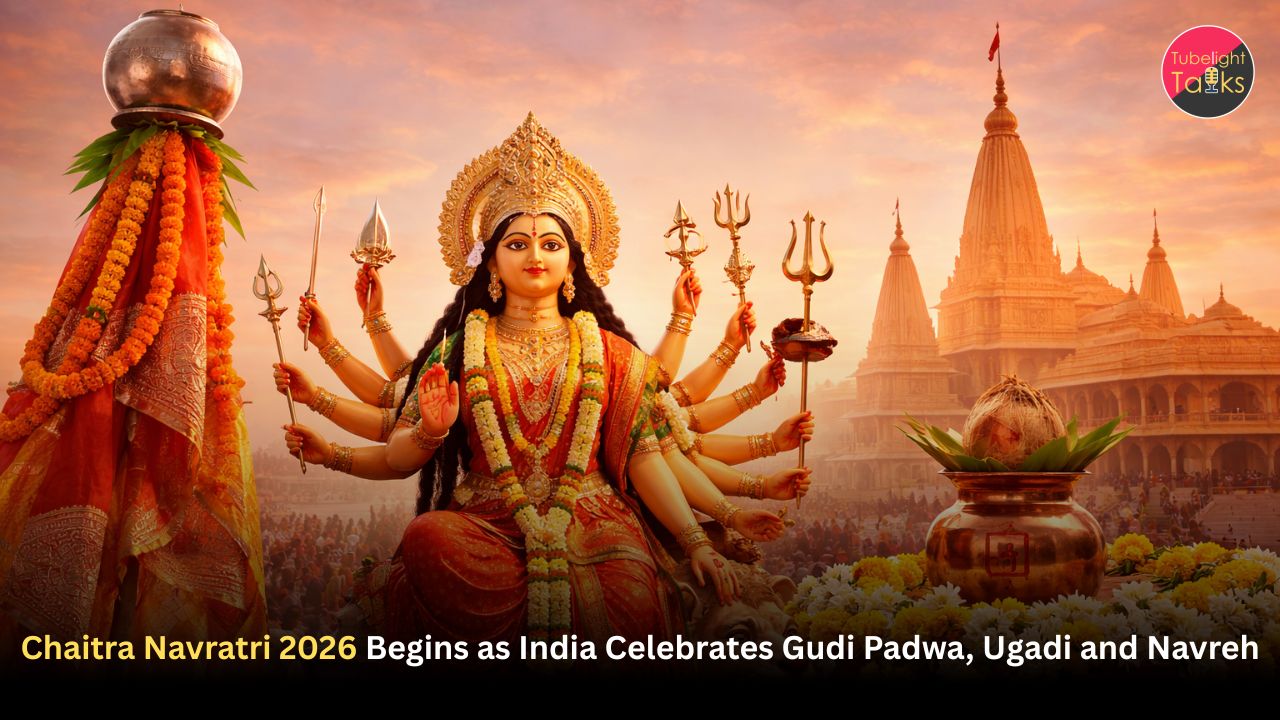
Chaitra Navratri 2026 Begins as India Celebrates Gudi Padwa, Ugadi and Navreh
India is observing one of its most symbolically rich days of the year, with Chaitra Navratri 2026 beginning alongside Nav Samvatsar and regional new-year celebrations such as Gudi Padwa, Ugadi and Navreh. The national focus is especially sharp on Ayodhya, where President Droupadi Murmu’s official programme includes darshan, aarti and participation in the Shri Ram Yantra Sthapana event at Shri Ram Janmabhoomi Mandir.
Messages from Rashtrapati Bhavan and the Prime Minister’s Office have framed the day not only as a religious occasion, but also as a reminder of India’s cultural diversity, shared traditions and spirit of renewal.
A Day of New Beginnings Across India
March 19 is being marked across India as the start of Chaitra Navratri and Nav Samvatsar, while the same date is also being celebrated in different regions through Gudi Padwa, Ugadi, Navreh, Cheti Chand and Sajibu Cheiraoba. In her official greeting, President Murmu said these festivals symbolize India’s rich cultural diversity and its deep connection with nature, while also inspiring people to move forward with new hopes, new resolutions and positivity.
That broad national character is also visible in the Prime Minister’s messaging. Narendra Modi issued separate greetings for Navratri, Nav Samvatsar, Gudi Padwa, Ugadi, Cheti Chand, Navreh and Sajibu Cheiraoba, showing how one date carries many cultural meanings across the country.
On the PM’s official website, the greetings appeared in multiple languages, including English, Marathi, Konkani, Kannada and Telugu, reinforcing the regional spread of the celebrations.
Why Chaitra Navratri Matters Today
The Beginning of a Nine-Day Spiritual Period
Chaitra Navratri begins today and marks the start of a nine-day period dedicated to the worship of Goddess Durga. The Prime Minister’s official Navratri message specifically referred to the first day’s association with Maa Shailaputri, while contemporary festival reporting also described March 19 as the opening day of the nine-day observance.
This gives the day a dual rhythm. On one level, it is a festival of devotion, fasting and prayer. On another, it is a threshold moment in the traditional calendar, when households, temples and communities see the day as a fresh beginning. That is why Chaitra Navratri often carries both spiritual seriousness and festive optimism at the same time. This is an inference drawn from the official greetings and the festival framing in current coverage.
Gudi Padwa, Ugadi and Navreh on the Same Day
The same date is also being observed as Gudi Padwa, Ugadi and Navreh in different cultural settings. Prime Minister Modi’s official greetings named each of these festivals individually, while Times of India’s roundup said Ugadi is celebrated in Andhra Pradesh, Telangana and Karnataka, and Navreh is observed by Kashmiri Pandits. Reuters is not needed here because the most relevant current references are official government statements and same-day festival coverage.
Taken together, these observances show how India’s festival calendar often works through regional expressions of a shared civilizational idea: renewal. Whether the symbol is the Gudi in Maharashtra, Ugadi’s new-year spirit in the south, Navreh in the Kashmiri tradition, or Navratri’s devotional beginning, the underlying message is remarkably similar—start again with faith, discipline and hope. This is an inference based on the wording of the President’s and Prime Minister’s greetings.
Also Read: Deepavali UNESCO Heritage Status: India’s Triumphant Light Secures Global GLORY
President Murmu’s Ayodhya Visit Gives the Day National Focus
What the Official Programme Says
According to Rashtrapati Bhavan and the PIB release, President Droupadi Murmu is on a March 19-21 visit to Uttar Pradesh, and on March 19 she is visiting Shri Ram Janmbhoomi Mandir in Ayodhya. The official itinerary says she will perform darshan and aarti at various places within the temple complex and participate in the Shri Ram Yantra Sthapana event.
That official schedule makes Ayodhya the single most visible ceremonial location in the country today. The visit links a national constitutional office with one of the country’s most-watched religious and cultural spaces on a day already loaded with devotional and new-year significance. This is a reasonable inference from the official programme and the day’s wider festival context.
Ayodhya’s Ceremonial Preparations
Local and national media reports ahead of the visit said Ayodhya had been preparing a major ceremonial welcome around the Ram Yantra event. Reports described cultural stages, special security arrangements and a temple programme tied to the beginning of Chaitra Navratri and the new-year observances.
Even without overstating those preparations, the symbolism is clear. Ayodhya is not simply another stop on the President’s calendar today; it is the place where a national public event, temple ritual and festival atmosphere are converging at once. That is why the story is being read as both religious news and national news. This is an inference supported by the official visit schedule and the reported festival preparations in Ayodhya.
What the President and Prime Minister Chose to Emphasize
President Murmu’s official message highlighted harmony, happiness, prosperity and well-being, and described these festivals as expressions of India’s cultural heritage and traditions of sharing joy with others. Her framing was notable because it presented the day as socially unifying, not just ritually important.
Prime Minister Modi’s messages carried a similar but slightly more action-oriented tone. In his Nav Samvatsar message, he wished that the new year would strengthen courage, self-confidence and service, and add fresh momentum to nation-building. In his Navratri message, he prayed for prosperity, health and energy toward the resolve of a developed India.
When the President and Prime Minister both stress renewal, positivity and shared culture on the same day, it signals how festival observances also function as public moments of national reflection. That does not erase their religious meaning; it expands it into a civic one. This is an inference from the language used in the official greetings.
More Than a Religious Calendar Event
A National Mood of Renewal
There are many festival days in India, but some dates stand out because they gather multiple traditions into a single national mood. March 19 is one of those days. Chaitra Navratri, Gudi Padwa, Ugadi and Navreh may come from different regional and devotional settings, yet today they are moving together in public life through greetings, temple visits, family rituals and community observances.
This matters because it shows how India’s diversity often expresses itself not through separation, but through parallel celebration. One community raises a Gudi, another marks Ugadi, another greets Navreh, and millions begin Navratri worship—yet all are participating in the same emotional grammar of renewal. That is why today’s festival news feels larger than any one event in one city. This is an inference supported by the official greetings and current same-day coverage.
Why the Ayodhya Moment Stands Out
Ayodhya’s prominence today also comes from timing. President Murmu’s visit places the Ram Janmabhoomi Mandir at the center of a day already associated with the Hindu new year in several traditions and the opening of Chaitra Navratri. That overlap gives the visit ceremonial depth far beyond a routine stop on a state tour.
It is also a reminder that national attention often settles where calendar, faith and public office intersect. On some days that place is Parliament, on others a launch site, a courtroom or a disaster zone. Today, for many Indians, it is Ayodhya. This is an interpretive conclusion drawn from the official schedule and the scale of coverage surrounding the visit.
Why Rituals Alone Are Not Enough: A Sat Gyaan Perspective
According to the scripture-based Sat Gyaan of Sant Rampal Ji Maharaj, such ritual-centric puja is not considered shastra-anukul bhakti unless it is directly supported by the holy scriptures.
His official teachings stress that worship should be performed strictly according to the Vedas and other sacred texts under the guidance of an authorised complete saint; arbitrary, man-made rituals and outward ceremonial practices may carry emotional value, but they do not grant complete spiritual benefit or liberation.
From this perspective, true devotion is not proved by grandeur of ritual, but by scripture-substantiated worship and correct naam-based bhakti.
FAQs: Chaitra Navratri 2026, Gudi Padwa, Ugadi, Navtej, Cheti Chand Time in India
1. What is being celebrated in India today?
India is observing the start of Chaitra Navratri and Nav Samvatsar, while many regions are also marking Gudi Padwa, Ugadi, Navreh, Cheti Chand and Sajibu Cheiraoba.
2. What is President Murmu doing in Ayodhya?
According to the official schedule, President Murmu is visiting Shri Ram Janmbhoomi Mandir, performing darshan and aarti, and participating in the Shri Ram Yantra Sthapana event.
3. Why is Ayodhya so important in today’s news?
Ayodhya is in focus because the President’s official temple visit coincides with the start of Chaitra Navratri and broader new-year celebrations across India.
4. What did the President say about these festivals?
President Murmu said these festivals reflect India’s cultural diversity, connection with nature and spirit of positivity, and she wished happiness, prosperity and well-being for all.
5. Why are Gudi Padwa, Ugadi and Navreh being mentioned together?
Because all three are regional new-year festivals being observed on the same day in different parts of India. Their joint mention highlights the country’s cultural diversity and the shared spirit of renewal, joy and fresh beginnings.
6. What makes this day nationally significant beyond religious celebration?
This day stands out because multiple major festivals are being observed together, and President Murmu’s Ayodhya visit has added national visibility. It has become a moment that combines faith, culture, tradition and public symbolism in one shared national atmosphere.
Related Stories








Discussion (0)