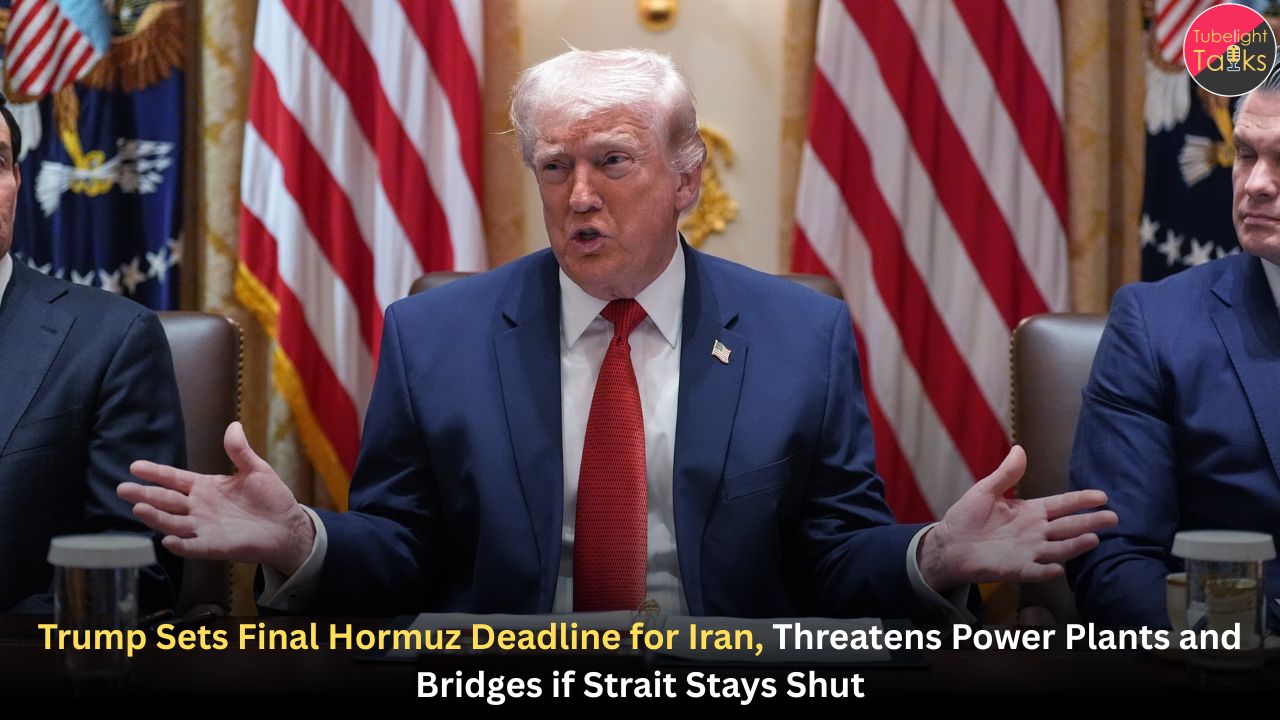
U.S. Sets Final Hormuz Deadline as Trump Threatens Iranian Infrastructure
Trump Sets Final Hormuz Deadline to Iran over the Strait of Hormuz, telling Tehran it must act by Tuesday evening U.S. time or face direct attacks on key infrastructure. Reuters reported that Trump told the Wall Street Journal Iran would have no power plants or bridges standing if it failed to comply, and later reinforced that demand by posting “Tuesday, 8:00 P.M. Eastern Time!” on social media. For India, that translates to Wednesday, April 8, 2026 at 5:30 a.m. IST.
The threat is now tied to a precise deadline
Until now, Trump’s threats had been severe but somewhat fluid. Reuters’ April 5 and April 6 coverage shows that the rhetoric has now hardened into a fixed ultimatum. He explicitly linked the reopening of Hormuz to possible attacks on Iranian power plants and bridges, moving from broad coercive pressure to a timed escalation point.
That matters because deadlines compress diplomacy. Once a public red line is tied to a specific hour, the space for ambiguity narrows sharply. In this case, the issue is not symbolic. Hormuz is one of the world’s most sensitive energy chokepoints, so the deadline has direct implications for shipping, oil markets and regional war planning.
The infrastructure threat is unusually stark
Reuters reported that Trump’s stated targets include Iranian power plants and bridges, and he used repeated public language to suggest they could be destroyed if the strait is not reopened. That is significant because these are not vague military references. They are named infrastructure targets that touch civilian and economic life directly.
This is one reason the latest phase of the crisis is being watched with greater alarm. Threatening civilian-linked infrastructure raises the stakes not only militarily but also legally and morally. It also increases the chance of retaliation against U.S.-linked or allied infrastructure across the wider region. This is an inference, but it follows directly from the nature of the threatened targets and Iran’s previously reported warnings.
Also Read: Diplomatic Progress: Trump Acknowledges “Significant” Iranian Proposal as Talks Intensify
India-time clarity matters here
Because the user is in India, the timing should be stated clearly. Reuters says the deadline is Tuesday, 8:00 p.m. Eastern Time. India is 9 hours 30 minutes ahead of Eastern Daylight Time, which places the effective deadline at 5:30 a.m. IST on Wednesday, April 8. That means the phrase “by tonight” is not accurate from an India-time perspective.
When force replaces wisdom
A crisis governed by threats, deadlines and destruction usually pushes ordinary people into the greatest danger first. Real strength is not shown by how close nations can drag each other to catastrophe, but by whether they can still choose restraint before irreversible damage begins.
Call to Action
The most important developments to watch now are whether Iran changes conditions on the water, whether mediators produce a last-minute opening, and whether the deadline passes without action. In a crisis like this, the clock itself becomes part of the battlefield.
FAQs: Trump Sets Final Hormuz Deadline for Iran, Threatens Power Plants and Bridges if Strait Stays Shut
1. What exact deadline did Trump give Iran?
Reuters reported that Trump set the deadline at Tuesday, 8:00 p.m. Eastern Time.
2. What time is that in India?
It is 5:30 a.m. IST on Wednesday, April 8, 2026.
3. What did Trump threaten to attack?
Reuters reported that he threatened Iranian power plants and bridges.
4. Why is the Strait of Hormuz so important?
Because it is a critical route for global energy shipments, so any disruption affects oil markets and international trade.
5. Is this just rhetoric or a firm ultimatum?
Reuters’ reporting indicates it is a firm public ultimatum because Trump attached a specific deadline and named target categories.
6. Is “by tonight” correct for India?
No. From India’s timezone, the deadline falls early Wednesday morning, not Tuesday night.
Related Stories








Discussion (0)